When Timing Changes the Tax Result
When Timing Changes the Tax Result
Follow FPA in Google
Get more timely tax insights from Freese, Peralez & Associates in Google Search.
Add FPA as a Preferred Source →FPA Executive Tax Brief™
Strategic Tax Intelligence for Growth-Focused Businesses
Issue No. 011 | Week of September 28–October 4, 2026
Estimated Reading Time: 9 Minutes
Executive Snapshot
Who Should Read This
✔ CEOs
✔ CFOs
✔ Controllers
✔ Construction Executives
✔ Manufacturing Leaders
✔ Real Estate Investors & Developers
✔ International Business Leaders
✔ Multi-Entity Business Owners
This Week at a Glance
| Development | Primary Industry | Priority |
|---|---|---|
| Kwong COVID-Era Deadline Appeal | All Verticals / Tax Controversy | 🟡 Monitor / Review Exposure |
| IEEPA Tariff Refund Tax Treatment | Manufacturing / International | 🔴 Immediate Review |
| New October 1 Per Diem Rates | Construction / Multi-State Employers | 🟡 Consider Action |
| Section 1062 Farmland Installment Election | Real Estate / Agricultural Landowners | 🟡 Consider Action |
| Proposed CFC Daily Ownership Rules | International / U.S. Multinationals | 🔴 Immediate Review |
Weekly Executive Theme
In Tax, Timing Is Sometimes the Rule
A tax deadline sounds simple.
A date passes, and an opportunity closes.
But this week’s developments demonstrate something more complicated.
Sometimes the dispute is over how the deadline itself should be measured.
Sometimes cash arrives years after the expense that created it.
Sometimes reimbursement rates change in the middle of a calendar year.
Sometimes Congress allows a tax liability to be spread across four years.
And sometimes owning a foreign subsidiary for part of a year can change how much income belongs to a U.S. shareholder.
Different provisions.
Different industries.
One common variable:
Time.
For executives, that means tax planning cannot focus exclusively on what happened.
Leadership also needs to understand when it happened, how long it lasted, and which tax year ultimately owns the result.
1. The Kwong Appeal Could Redefine How COVID-Era Tax Deadlines Are Measured
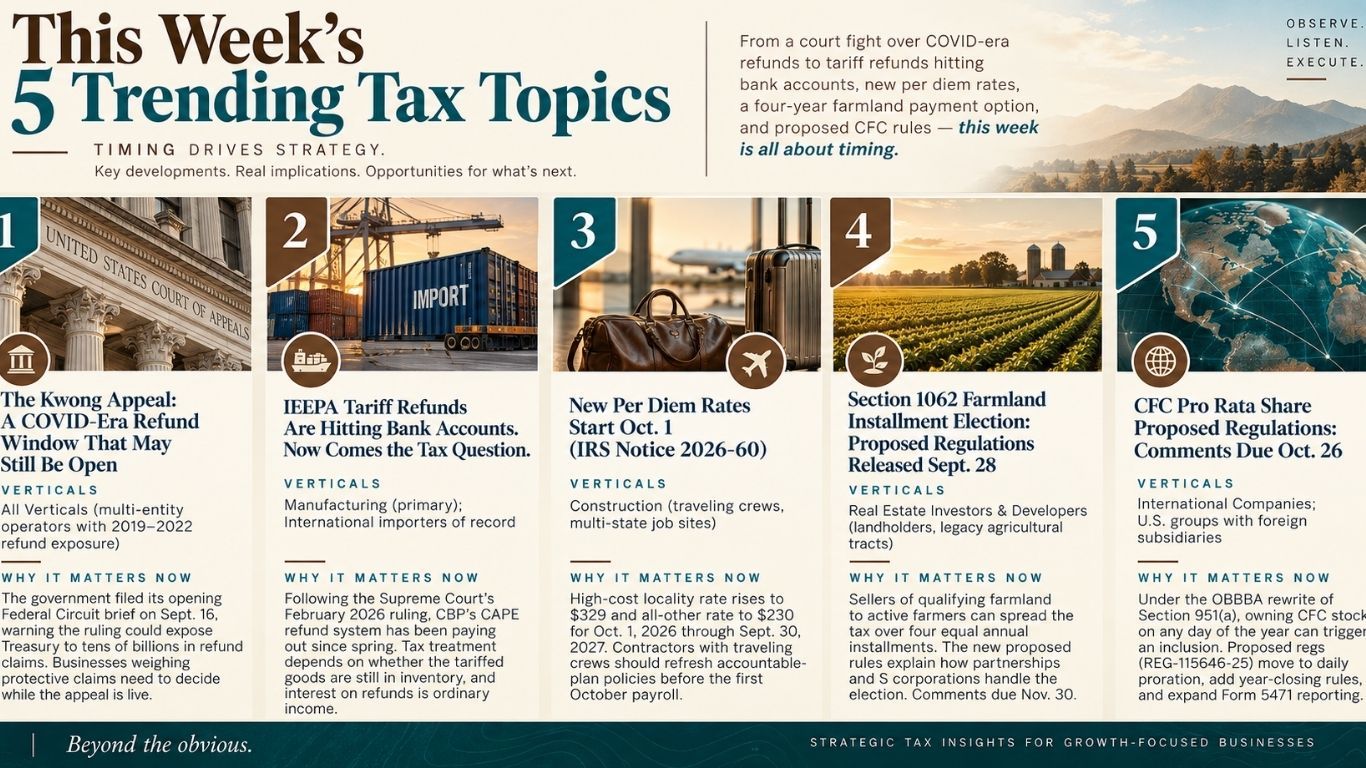
A tax case involving a refund lawsuit has become a much broader fight over what Congress actually meant when it suspended certain tax deadlines during the COVID-19 disaster.
In Kwong v. United States, the Court of Federal Claims concluded that the statutory COVID disaster-relief provision under Section 7508A(d) postponed certain deadlines for the duration of the federally declared disaster period.
That period stretched from January 20, 2020 through July 10, 2023.
The federal government disagrees.
In its September 16 appellate brief, the government asked the U.S. Court of Appeals for the Federal Circuit to reverse the decision, arguing that the lower court effectively converted what the government interprets as a 60-day statutory postponement into relief lasting more than three years.
The disagreement may sound technical.
Its potential implications are not.
Why Kwong Became Bigger Than One Refund Case
The original case concerns the deadline under Section 6532 for filing a refund lawsuit.
But taxpayers and practitioners have questioned whether the reasoning could affect other tax deadlines that ran during the COVID disaster period.
That has included potential claims involving:
- Refunds
- Penalties
- Interest
- Refund litigation deadlines
- Other time-sensitive tax rights
The IRS has continued to reject the broader interpretation while the appeal proceeds.
That means taxpayers should not assume that Kwong represents settled law.
What About Protective Refund Claims?
Earlier in 2026, the National Taxpayer Advocate and tax practitioners identified July 10, 2026 as an important potential deadline for many refund claims based on the broader interpretation of the COVID postponement rules.
That date has now passed.
But that does not make the litigation irrelevant.
Some taxpayers may already have filed protective claims.
Others may have different limitations periods based on when tax, penalties or interest were actually paid.
And businesses with pending disputes may need to understand whether the eventual Federal Circuit decision affects their position.
Questions Leadership Should Ask
- Did any of our entities file COVID-related protective refund or abatement claims?
- Are any of those claims still pending?
- Did we pay significant penalties or underpayment interest connected with COVID-era periods?
- Could a separate payment date create a different limitations period?
- Are any refund suits or administrative appeals potentially affected by the Kwong interpretation?
- Who is monitoring the Federal Circuit appeal for our organization?
The Kwong opportunity is no longer simply about filing before a date, it is about understanding whether an unresolved legal interpretation affects rights the business may already have preserved.
2. IEEPA Tariff Refunds Are Arriving. The Tax Accounting Now Matters.
For manufacturers and importers, the IEEPA tariff story has moved from litigation into cash flow.
Following the Supreme Court’s February 2026 decision invalidating certain tariffs imposed under the International Emergency Economic Powers Act, U.S. Customs and Border Protection developed the Consolidated Administration and Processing of Entries, or CAPE, system to process refunds.
CBP launched the first CAPE phase in April.
Refunds are now being processed for eligible importers.
And those payments can include interest.
For some companies, that means cash paid as tariffs during 2025 or early 2026 may be returning during a later accounting or tax period.
That creates the next question:
How should the recovery be treated?
The Answer May Depend on Where the Original Tariff Cost Went
The IRS has not issued specific federal income-tax guidance governing IEEPA tariff refunds.
That means taxpayers and their advisers must evaluate the refunds under existing tax-accounting principles.
The analysis can depend on factors including:
- Whether the tariff was deducted
- Whether it was capitalized into inventory
- Whether the inventory has already been sold
- The company’s accounting method
- The year in which the recovery becomes fixed
- Whether tariff costs were passed through to customers
- Whether contracts require any refund to be shared with customers
Consider two simplified situations.
If tariff costs remain embedded in unsold inventory, a refund may affect the basis or carrying cost associated with that inventory.
If the inventory was already sold and the tariff cost previously flowed through cost of goods sold, the recovery may affect current income differently.
The accompanying interest also needs to be separately identified rather than blended into the tariff recovery.
CBP says its refund deposits can include both the duty refund and applicable interest in the same payment.
The Timing Issue
This can create a year-crossing problem.
The tariff may have been paid in 2025.
The goods may have been sold in 2025 or 2026.
The refund claim may have become sufficiently fixed in 2026.
And cash may arrive at yet another point.
For a large importer, those differences can materially affect:
- Inventory
- Cost of goods sold
- Taxable income
- Estimated taxes
- Financial reporting
- Cash forecasting
Questions Leadership Should Ask
- How much in IEEPA duties did we pay?
- Which refunds have been approved?
- Which refunds have actually been received?
- Are the related goods still in inventory or already sold?
- How were the original tariff costs treated for tax purposes?
- How much of each CBP deposit represents interest?
- Did we pass tariff costs to customers under contracts containing refund or true-up provisions?
- Does the refund change our 2026 estimated taxable income?
Recovering the tariff is only the first step; leadership also needs to determine which period, inventory pool and income calculation should reflect the recovery.
3. New Business-Travel Rates Take Effect October 1
For construction companies with traveling crews, project managers and employees working across multiple states, October 1 brings another annual tax change.
IRS Notice 2026-60 establishes updated special per diem rates for business travel beginning October 1, 2026.
Under the high-low substantiation method, the rate for travel to designated high-cost localities increases to:
$329 per day
The rate for other qualifying continental U.S. locations increases to:
$230 per day
The portions treated as meals remain $86 for high-cost localities and $74 for other CONUS localities.
Special meal-and-incidental-expense rates for the transportation industry remain $80 within CONUS and $86 outside CONUS.
Why This Matters Beyond the Dollar Increase
Per diem rates can simplify substantiation of qualifying business travel expenses.
But employers still need a properly administered reimbursement structure.
For contractors with crews moving between job sites, that means finance and payroll teams should understand:
- Which employees are traveling away from their tax home
- Which locations qualify as high-cost
- Which reimbursement method the company uses
- How long-term assignments are treated
- Whether reimbursements satisfy accountable-plan requirements
- Whether payroll systems reflect the correct rates
There are also transition rules for the final three months of 2026.
Employers using the high-low method should not casually switch approaches employee by employee simply because the rates change October 1.
Consistency requirements still matter.
Questions Leadership Should Ask
- Do we reimburse traveling employees using federal per diem rates?
- Have payroll and expense systems been updated for October 1?
- Which active projects are located in high-cost localities?
- Are employees working on temporary assignments or potentially indefinite assignments?
- Does our accountable plan clearly define required documentation?
- Have we reviewed the October-through-December transition rules before changing rates?
For contractors with mobile workforces, a small reimbursement-policy error repeated across hundreds of travel days can become a much larger payroll and tax problem.
4. Section 1062 Creates a Four-Year Tax-Payment Option for Certain Farmland Sales
A new provision could change the liquidity conversation for owners selling qualifying agricultural property.
Section 1062 allows an eligible taxpayer selling or exchanging qualified farmland property to a qualified farmer to elect to pay the portion of federal income tax attributable to the qualifying gain in four equal annual installments.
Treasury and the IRS released proposed regulations on September 28 explaining how the new election would operate.
The provision applies to qualifying sales or exchanges occurring in tax years beginning after July 4, 2025.
This Is a Tax-Payment Election—Not a Four-Year Sale
That distinction matters.
Section 1062 does not necessarily require the seller to receive the purchase price over four years.
Instead, it allows the qualifying tax liability attributable to the gain to be paid in installments.
The first installment is generally due with the tax return for the year of the qualifying sale, determined without regard to extensions.
The remaining installments are generally due with the returns for each of the following three tax years.
What Counts as Qualified Farmland?
The statutory requirements are narrower than simply owning undeveloped acreage.
Qualified farmland generally must be U.S. real property that was used by the taxpayer as a farm for farming purposes—or leased to a qualified farmer, for substantially all of the 10-year period ending on the date of sale.
The property must also be subject to a legally enforceable restriction generally prohibiting nonfarm use for the 10 years following the transaction.
The buyer must be a qualified farmer meeting the applicable active-farming requirements.
The proposed regulations also address how these rules apply when farmland is held through partnerships and S corporations.
Why This Is a Liquidity Strategy
Imagine a family or investment group holding appreciated agricultural land.
Selling that property can create a substantial federal tax liability in the year of sale.
If Section 1062 applies, spreading the qualifying tax liability across four annual installments may preserve liquidity that would otherwise leave the business immediately.
That could affect:
- Sale negotiations
- Succession planning
- Debt reduction
- Reinvestment
- Estate planning
- Development timing
- Cash reserves
But the land-use restrictions and buyer requirements mean this is not simply an election that every farmland seller can make.
Questions Leadership Should Ask
- Has the property satisfied the required historical agricultural use?
- Does the proposed buyer qualify as an active farmer?
- Will the required post-sale farming restriction be enforceable?
- Is the property held directly, through a partnership or through an S corporation?
- What portion of the tax liability would qualify for installment payment?
- Does preserving cash for three additional years materially improve the transaction economics?
Section 1062 does not change the gain it changes when qualifying tax must leave the seller’s hands, which can materially change transaction liquidity.
5. Proposed CFC Rules Could Make Every Day of Ownership Matter
For U.S. businesses buying, selling or restructuring foreign subsidiaries, the old year-end assumption is changing.
Historically, Section 951 generally required a U.S. shareholder to own stock on the last relevant day of the foreign corporation’s CFC year to receive an allocation of certain Subpart F income.
The OBBBA rewrote the pro rata share rules.
Under revised Section 951, a U.S. shareholder that owns CFC stock at any time during the CFC year can potentially have an inclusion attributable to its period of ownership.
Treasury and the IRS have now proposed regulations under REG-115646-25 explaining how that rule would work.
The central mechanism is daily proration.
The Calendar Becomes Part of the Calculation
Under the proposed rules, Subpart F income—and similarly tested income or tested loss for purposes of the revised Section 951A regime—would generally be allocated based on:
- The shareholder’s percentage ownership, and
- The percentage of the CFC year during which the shareholder owned the stock while it was a U.S. shareholder and the foreign corporation was a CFC.
In other words:
Days matter.
That becomes particularly important when foreign-company ownership changes during the year.
Some Transactions Could Close the CFC’s Tax Year
The proposal also includes rules requiring the foreign corporation’s tax year to close when it becomes or ceases to be a CFC.
For certain large ownership shifts involving unrelated parties, taxpayers may also be able to elect to close the CFC’s tax year rather than rely entirely on daily proration.
That can affect the timing and allocation of:
- Subpart F income
- Net CFC tested income
- Tested losses
- Section 956 amounts
- Earnings and profits
- Related international tax attributes
More Than a Tax Calculation
The proposal would also modify information-reporting rules under Section 6038.
That makes ownership tracking important not only for computing income but also for international reporting, including information associated with Form 5471.
Treasury and the IRS expect the regulations, once finalized, generally to apply to foreign-corporation tax years beginning after December 31, 2025.
Comments on the proposed regulations are due October 26, 2026.
Questions Leadership Should Ask
- Did we acquire or dispose of CFC stock during 2026?
- Did ownership percentages change during the year?
- Did any foreign entity become or cease being a CFC?
- Are transaction models still assuming a year-end ownership test?
- Can our international tax systems track ownership by day?
- Could a required or elective year closing materially change the allocation of income?
- Have Form 5471 reporting processes been updated for the new ownership framework?
For multinational groups, the tax result may no longer depend primarily on who owns the foreign company on December 31, it can depend on who owned it on each day leading there.
Executive Perspective
This week’s developments have almost nothing in common at first glance.
A federal appeals case.
A customs refund.
Employee travel.
Farmland.
Foreign subsidiaries.
But underneath each is the same variable:
Timing determines the outcome.
Kwong asks how much time Congress actually suspended during a national disaster.
IEEPA refunds require companies to reconcile costs and recoveries occurring across different periods.
October 1 changes the reimbursement environment for traveling employees.
Section 1062 deliberately spreads qualifying tax payments across four years.
And proposed CFC rules divide foreign income according to ownership periods measured by the day.
That is why sophisticated tax planning requires more than identifying the correct provision.
Leadership needs to understand the timeline around it.
Because in tax, the same transaction on a different date can produce a very different result.
Frequently Asked Questions
What is the Kwong tax case?
Kwong v. United States concerns how COVID-era disaster relief under Section 7508A(d) affected certain federal tax deadlines. The Court of Federal Claims adopted a broader interpretation tied to the COVID disaster period, while the federal government is appealing that interpretation to the Federal Circuit.
Can businesses still file COVID refund claims based on Kwong?
The widely discussed July 10, 2026 potential deadline for many claims has passed. However, limitations periods can depend on the specific tax, payment date and procedural posture. Existing protective claims and pending disputes may also be affected by the appeal.
Are IEEPA tariff refunds taxable?
There is no single IRS rule specifically addressing all IEEPA tariff refunds. Treatment can depend on how the original tariff was accounted for, whether related inventory remains on hand, the taxpayer’s accounting method, the timing of the recovery and other facts. Interest included with a CBP refund should be analyzed separately.
What are the new high-low per diem rates beginning October 1, 2026?
Under IRS Notice 2026-60, the high-low substantiation rates are $329 per day for high-cost localities and $230 per day for other qualifying CONUS localities for the applicable 2026–2027 period.
What is the new Section 1062 farmland election?
Section 1062 allows eligible taxpayers selling qualifying farmland to qualified farmers to elect to pay the federal tax attributable to qualifying gain in four equal annual installments, subject to specific ownership, agricultural-use and land-restriction requirements.
How are CFC ownership changes treated under the proposed Section 951 rules?
The proposed regulations generally use a daily-proration approach to allocate Subpart F income, tested income or tested loss based on the shareholder’s ownership percentage and period of ownership during the CFC year. Additional rules address certain ownership changes and tax-year closings.
About Freese, Peralez & Associates
Freese, Peralez & Associates is a tax-focused CPA firm located in The Woodlands, Texas, serving growth-focused businesses throughout Texas and across the United States.
We specialize exclusively in:
- Strategic Tax Planning
- Tax Consulting
- Business Tax Preparation
Our clients generally generate between $1 million and $100 million in annual revenue and frequently operate through multiple entities, across multiple states, or within increasingly complex domestic and international tax environments.
We work extensively with organizations in the construction, manufacturing, real estate development and international business sectors.
Continue the Conversation
The tax code contains thousands of rules.
The calendar determines when many of them matter.
For established businesses, that means tax strategy should account not only for what a company owns, spends, sells or earns, but when those events occur.
If your organization is receiving tariff refunds, managing a traveling workforce, considering a significant land transaction, operating foreign subsidiaries or evaluating older refund positions, now is an appropriate time to determine whether timing changes the analysis.
If you are not currently an FPA client, visit our Contact Us page and complete the form to schedule a confidential discovery call.
We would welcome the opportunity to learn more about your organization and determine whether proactive tax planning can help protect cash flow, preserve margins and support your next stage of growth.
Coming Next Week
Our team continues monitoring:
- The Kwong Federal Circuit appeal
- IEEPA tariff refund administration
- OBBBA implementation
- International CFC regulations
- Q4 tax-planning deadlines
- Manufacturing and import-related tax developments
- Construction workforce and travel rules
- Real estate transaction planning
- Year-end opportunities for growth-focused businesses
The provision matters.
So does the clock.