10 Issues. 5 Tax Decisions Moving Now.
10 Issues. 5 Tax Decisions Moving Now.
Follow FPA in Google
Get more timely tax insights from Freese, Peralez & Associates in Google Search.
Add FPA as a Preferred Source →FPA Executive Tax Brief™
Strategic Tax Intelligence for Growth-Focused Businesses
Issue No. 010 | Week of September 21–27, 2026
Estimated Reading Time: 9 Minutes
Ten issues in, our objective remains the same: identify the tax and regulatory developments that matter to growth-focused businesses and explain what leadership should be asking before those developments become filing-season problems.
Executive Snapshot
Who Should Read This
✔ CEOs
✔ CFOs
✔ Controllers
✔ Construction Executives
✔ Manufacturing Leaders
✔ Real Estate Investors & Developers
✔ International Business Leaders
✔ Multi-State & Multi-Entity Business Owners
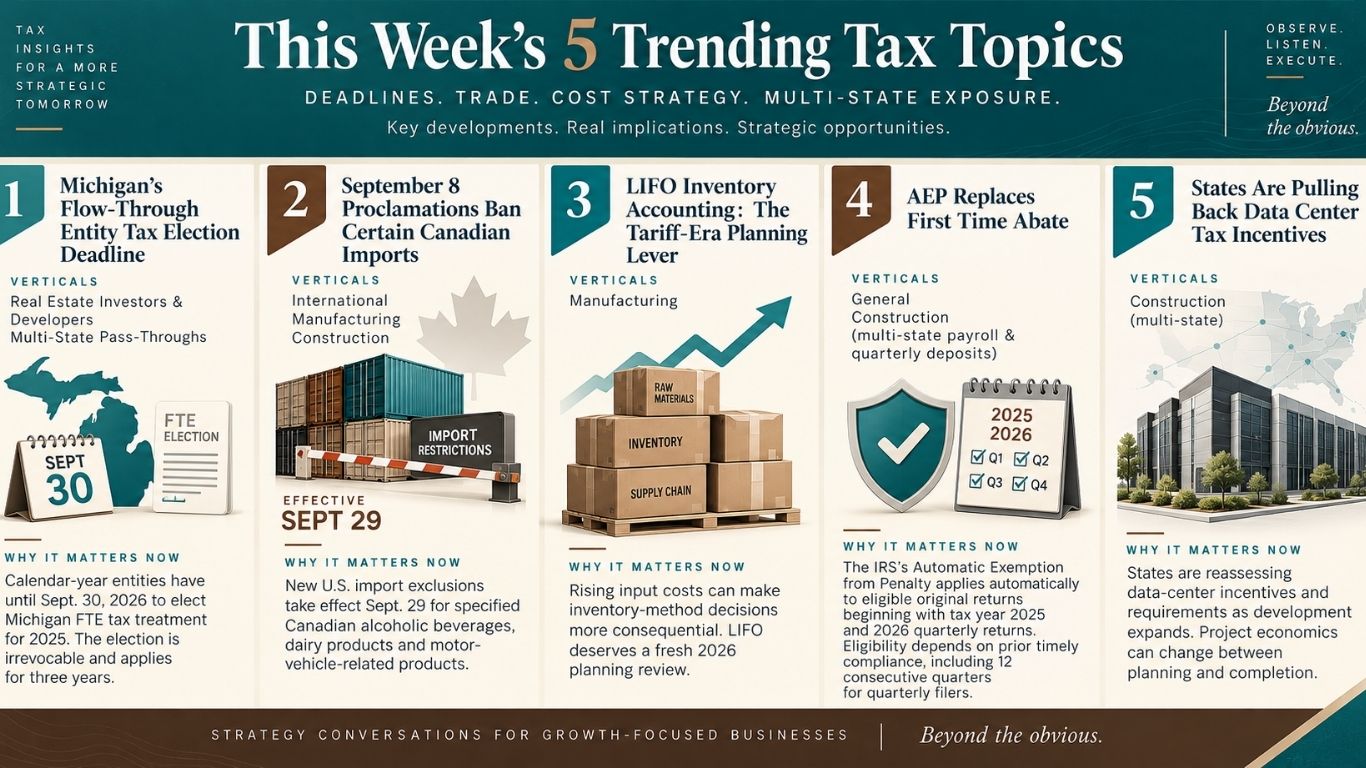
This Week at a Glance
| Development | Primary Industry | Priority |
|---|---|---|
| Michigan FTE Tax Election — September 30 | Real Estate / Multi-State Pass-Throughs | 🔴 Immediate Review |
| September 29 Canadian Import Restrictions | Manufacturing / Construction / International | 🔴 Immediate Review |
| LIFO Planning Amid Rising Input Costs | Manufacturing / Distribution | 🟡 Consider Action |
| IRS Automatic Exemption from Penalty | All Verticals / Multi-Entity Businesses | 🟡 Consider Action |
| State Data Center Incentive Scrutiny | Construction / Multi-State Contractors | 🟡 Monitor / Consider Action |
Weekly Executive Theme
The Assumption You Made Six Months Ago May No Longer Be Safe
Q3 has a way of hiding important tax decisions.
Leadership teams are focused on backlog, budgets, hiring, capital projects, year-end forecasts and 2027 planning. Meanwhile, tax rules and economic assumptions continue moving underneath those decisions.
This week provides five examples.
A Michigan pass-through entity election has a September 30 deadline and locks the entity into a three-year election.
Certain Canadian products are moving beyond additional tariffs into import restrictions beginning September 29.
Rising input costs have brought LIFO inventory accounting back into the tax-planning conversation for manufacturers.
The IRS is changing how historically compliant taxpayers receive certain penalty relief.
And data center construction continues to expand while states reconsider some of the incentives used to attract those projects.
None of these issues should be evaluated from the headline alone.
The strategic question is whether the assumptions built into the business earlier this year still match the rules and economics in effect today.

1. Michigan’s September 30 Flow-Through Entity Election Is a Three-Year Decision
For partnerships and S corporations operating in Michigan, September 30 deserves attention.
Michigan allows qualifying flow-through entities to elect into its Flow-Through Entity Tax, or FTE tax.
For tax years beginning on or after January 1, 2024, a calendar-year entity generally has until the last day of the ninth month following the end of its tax year to make the election.
That means a calendar-year entity considering an election for its 2025 tax year generally has until September 30, 2026.
But this is not simply another form to file.
The election is made by submitting an electronic payment through Michigan Treasury Online.
And once made, the election is generally irrevocable for three years: the election year plus the following two tax years.
Why This Matters for Multi-State Owners
Entity-level pass-through taxes emerged largely as a planning response to the federal limitation on individual state and local tax deductions.
But the federal SALT environment has changed.
That means a decision that looked obvious under an earlier federal tax model deserves to be recalculated under the rules that apply today.
For real estate groups and business owners operating multiple partnerships or S corporations across multiple states, the analysis can become even more complicated.
Each entity may have different:
- Ownership percentages
- State-source income
- Resident and nonresident owners
- Distribution requirements
- Estimated payments
- State tax credits
- Cash-flow needs
The September 30 deadline therefore creates both an opportunity and a responsibility.
Leadership needs to know what it is electing into, not simply whether an election is available.
Questions Leadership Should Ask
- Do any of our partnerships or S corporations have Michigan-source income?
- Has the 2025 Michigan FTE election already been made?
- What is the entity-level benefit under the current federal SALT rules?
- How does the election affect resident and nonresident owners?
- What cash payment is required to make the election?
- Are we comfortable committing the entity to the election for three tax years?
A September 30 election should be evaluated as a three-year tax and cash-flow decision, not a one-day filing deadline.
2. September 29 Changes the Canada Trade Conversation From Price to Availability
Businesses sourcing certain products from Canada face another change beginning September 29, 2026.
Following earlier additional duties on specified Canadian products, September 8 proclamations move certain covered goods into a more restrictive category.
For specified Canadian alcoholic beverages and dairy products covered by the proclamations, importation into the United States is prohibited beginning at 12:01 a.m. Eastern Time on September 29, 2026, subject to the precise product coverage and exceptions in the proclamations.
Separate September 8 actions also affect specified Canadian motor-vehicle-related products.
That distinction matters.
A tariff changes cost.
An import prohibition can change whether the product is available through that supply route at all.
Why Manufacturers and Contractors Should Care
Canadian trade exposure is not limited to companies that consider themselves “international businesses.”
A U.S. contractor may purchase equipment containing Canadian components.
A manufacturer may rely on Canadian suppliers several tiers upstream.
A distributor may have purchase commitments already in transit.
And procurement teams may be working from pricing assumptions created before the latest restrictions were announced.
The immediate task is therefore not simply calculating another tariff percentage.
It is mapping exposure.
Questions Leadership Should Ask
- Do we import affected Canadian products directly?
- Are Canadian goods embedded elsewhere in our supply chain?
- Which purchase orders or shipments could cross the September 29 effective date?
- Have affected HTS classifications been reviewed?
- Do contracts address substitutions, price adjustments or supply interruptions?
- Are alternative suppliers available if a covered product can no longer be imported?
When trade policy moves from a higher price to restricted availability, procurement risk becomes an executive-level planning issue.
3. Rising Input Costs Put LIFO Back on the Manufacturing Planning Table
For manufacturers dealing with higher input costs, one of the most established provisions in the tax code deserves renewed attention:
Last-In, First-Out inventory accounting.
LIFO assumes that the most recently acquired inventory costs are the first costs assigned to goods sold.
During periods of rising prices, that can produce a higher cost of goods sold and lower ending inventory than FIFO.
The result can be lower current taxable income.
That makes LIFO particularly relevant when manufacturers are absorbing higher costs from:
- Tariffs
- Raw materials
- Components
- Energy
- Freight
- Supply-chain disruptions
This is not a new tax provision.
The economic environment is what makes it newly relevant.
Why September Matters
A LIFO election should not begin with a conversation in the final week of December.
Taxpayers adopting LIFO generally make the election on Form 970, filed with the timely filed income-tax return for the first year LIFO is used.
But deciding whether LIFO makes economic sense requires modeling before that return is prepared.
The analysis should consider:
- Inventory inflation
- Inventory turnover
- Product pools
- Cost-accounting systems
- Financial-statement implications
- LIFO conformity requirements
- Future inventory reductions
There is also a tradeoff executives should understand.
If inventory quantities decline significantly, older lower-cost LIFO layers may be liquidated, potentially increasing taxable income.
LIFO can therefore improve current cash-tax timing without necessarily creating a permanent tax reduction.
Questions Leadership Should Ask
- How much have our inventory costs increased during 2026?
- What portion of those increases is attributable to tariffs or supply-chain changes?
- What would 2026 taxable income look like under LIFO versus our current inventory method?
- Can our accounting systems support an appropriate LIFO method?
- What are the financial-reporting implications?
- How sensitive is the projected benefit to future inventory reductions?
In an inflationary or tariff-driven cost environment, inventory accounting can become a cash-flow strategy rather than a back-office convention.
4. The IRS Is Replacing First Time Abate With Automatic Exemption From Penalty
For years, taxpayers with a strong compliance history could request First Time Abate, or FTA, for certain penalties.
Beginning in summer 2026, the IRS is transitioning to a different system:
Automatic Exemption from Penalty, or AEP.
The most important change is contained in the name.
Qualifying taxpayers no longer need to wait for an eligible penalty to be assessed and then contact the IRS to request administrative relief.
Under AEP, qualifying penalties are generally not assessed in the first place when the IRS determines that the taxpayer meets the compliance-history requirements.
AEP begins with eligible 2025 tax-year returns and 2026 quarterly returns, along with future eligible periods.
Covered return series include certain Forms 1040, 1065, 1120, 940, 941, 943, 944, 945 and CT-1.
Compliance History Still Matters
Automatic does not mean universal.
For annual returns, eligibility generally requires timely filing and payment for the preceding three years.
For quarterly filers, the IRS looks to 12 consecutive quarters of timely compliance.
That distinction is particularly relevant for businesses operating multiple legal entities or maintaining significant payroll operations.
One entity's clean record does not automatically cure another entity's compliance history.
And quarterly payroll obligations create many more periods in which a late filing, late payment or deposit issue can affect the analysis.
Why Construction Companies Should Pay Attention
Construction businesses often combine:
- Multiple operating entities
- Multi-state payroll
- Project-based workforces
- Rapid headcount changes
- Quarterly employment returns
- Frequent federal tax deposits
That creates more opportunities for administrative errors than a simple single-entity structure.
AEP may make relief easier for historically compliant taxpayers, but it also makes the quality of each entity's compliance history more important.
Questions Leadership Should Ask
- Which entities qualify for AEP?
- Do we have three clean annual years or 12 consecutive compliant quarters where required?
- Are payroll filings and deposits being tracked entity by entity?
- Have we received an IRS notice confirming automatic relief?
- If a penalty was assessed, should we confirm whether AEP should have applied?
- If AEP does not apply, is reasonable-cause relief potentially available?
Automatic penalty relief reduces administrative friction, but it does not replace disciplined entity-by-entity compliance.
5. Data Center Construction Is Booming While States Reconsider the Incentive Model
Data center development remains one of the most significant construction opportunities created by the expansion of artificial intelligence and cloud infrastructure.
But the tax environment surrounding those projects is becoming less uniform.
According to the National Conference of State Legislatures, 38 states offer dedicated tax incentives for data centers, ranging from sales-and-use-tax exemptions to property-tax abatements.
Those incentives can materially affect project economics.
At the same time, states are increasingly reassessing how those programs should work.
The concerns vary by jurisdiction and include:
- Electricity demand
- Grid infrastructure costs
- Water usage
- Job-creation requirements
- State and local tax revenue
- Environmental requirements
- Community impacts
Some jurisdictions are considering tighter qualification requirements or changes to existing incentive programs, while others continue using incentives to compete aggressively for new development.
For construction companies, that creates a different kind of multi-state risk.
The Bid May Outlive the Incentive Assumption
A large data center can take years to move from site selection through construction and substantial completion.
During that period, the project's incentive environment can change.
Whether an existing project is protected depends on the specific state's law, effective date, grandfathering provisions, development agreements and qualification requirements.
That means contractors and developers should avoid assuming that every incentive available during early project planning will automatically apply unchanged throughout the project's life.
This is especially important where tax benefits influence:
- Project budgets
- Equipment procurement
- Sales-tax assumptions
- Location decisions
- Owner economics
- Contract pricing
The broader regulatory environment is moving as well, with policymakers increasingly focused on who should bear the grid and infrastructure costs associated with large data center projects.
Questions Leadership Should Ask
- Which state and local incentives are included in the project's financial model?
- Have those incentives actually been secured, or are they still assumptions?
- What requirements must be satisfied to preserve them?
- Are existing projects grandfathered if state law changes?
- Who bears the cost if an expected exemption or abatement is reduced?
- Do construction contracts address changes in tax treatment or project incentives?
- Are utility and grid-upgrade costs included in the same sensitivity analysis?
For data center construction, tax incentives should be treated as contractual and legislative variables—not permanent assumptions in a project model.
Executive Perspective
Ten issues of the FPA Executive Tax Brief have reinforced one theme repeatedly:
The tax issue leadership needs to understand is rarely confined to the tax department.
This week makes that especially clear.
Michigan's FTE election affects entity cash flow and owners.
Canadian import restrictions affect procurement and operations.
LIFO affects inventory accounting and working capital.
Automatic penalty relief depends on the operating discipline of individual entities.
Data center incentives can influence construction bids and project economics.
Different departments may own each decision.
But tax connects them.
That is why proactive planning has to happen while the business is operating, not months later when the return is being prepared.
Beyond the obvious means looking past the tax rule itself and understanding what it changes inside the business.
Frequently Asked Questions
When is the Michigan FTE election deadline for a calendar-year 2025 tax year?
For tax years beginning on or after January 1, 2024, Michigan generally requires the FTE election by the last day of the ninth month following the end of the tax year. For a calendar-year 2025 entity, that generally means September 30, 2026.
How long does a Michigan FTE tax election last?
The election generally lasts for three tax years: the election year and the following two years. Once made, it is generally irrevocable.
What happens to certain Canadian imports on September 29, 2026?
September 8 federal actions prohibit importation of specified Canadian products covered by the applicable proclamations beginning September 29, 2026. Businesses should review the exact product classifications and applicable proclamation rather than assuming all Canadian goods are affected.
Why can LIFO reduce taxable income when costs are rising?
LIFO generally assigns newer, higher inventory costs to cost of goods sold first. In an inflationary environment, that can increase current cost of goods sold and reduce taxable income compared with FIFO, although the actual result depends on the taxpayer's inventory and accounting methods.
What is the IRS Automatic Exemption from Penalty?
AEP is the IRS's new administrative penalty-relief process replacing First Time Abate for eligible current and future periods. For qualifying taxpayers with the required compliance history, specified penalties are not assessed during processing rather than requiring the taxpayer to request their removal afterward.
Are states eliminating data center tax incentives?
There is no single national answer. Many states continue to offer significant data center incentives, while others are reconsidering, modifying or attaching additional requirements to them. Project-specific analysis is necessary because rules differ materially by jurisdiction.
About Freese, Peralez & Associates
Freese, Peralez & Associates is a tax-focused CPA firm located in The Woodlands, Texas, serving growth-focused businesses throughout Texas and across the United States.
We specialize exclusively in:
- Strategic Tax Planning
- Tax Consulting
- Business Tax Preparation
Our clients generally generate between $1 million and $100 million in annual revenue and frequently operate through multiple entities, across multiple states, or within increasingly complex domestic and international tax environments.
We work extensively with organizations in the construction, manufacturing, real estate development and international business sectors.
Continue the Conversation
Deadlines are easy to identify.
Assumptions are harder.
The larger risk for an established business is often not missing a date printed on a tax calendar. It is continuing to operate from a tax, cost or regulatory assumption that has quietly changed.
If your organization operates across multiple states, maintains significant inventory, imports goods, manages multiple legal entities or participates in large construction projects, now is an appropriate time to determine whether your 2026 tax strategy still reflects current conditions.
If you are not currently an FPA client, visit our Contact Us page and complete the form to schedule a confidential discovery call.
We would welcome the opportunity to learn more about your organization and determine whether proactive tax planning can help protect cash flow, preserve margins and support your next stage of growth.
Coming Next Week
Our team continues monitoring:
- September 30 state tax elections and deadlines
- Federal OBBBA implementation
- U.S.–Canada trade developments
- Manufacturing inventory and tariff planning
- IRS penalty-relief implementation
- State data center tax incentives
- Construction and real estate tax developments
- Q4 and year-end tax-planning opportunities
Ten issues down.
The objective remains the same: see the tax issue before it becomes a tax problem.