5 Tax & Business Developments Every CEO and CFO Should Know This Week
5 Tax & Business Developments Every CEO and CFO Should Know This Week
FPA Executive Tax Brief™
Strategic Tax Intelligence for Growth-Focused Businesses
Issue No. 002 | Week of July 27 – August 2, 2026
Strategic Tax Intelligence for Growth-Focused Businesses
Estimated Reading Time: 8 Minutes
Executive Snapshot
Who Should Read This
✔ CEOs
✔ CFOs
✔ Controllers
✔ Construction Executives
✔ Manufacturing Leaders
✔ Real Estate Developers
✔ Multi-State Business Owners
This Week at a Glance
| Development | Primary Industry | Priority |
|---|---|---|
| FDDEI & BEAT Changes Under OBBBA | International / Manufacturing | 🔴 High |
| Section 45X Credit & Toyo Solar | Manufacturing | 🟡 Medium |
| Section 179D & 45L Officially Sunset | Construction / Real Estate | 🔴 High |
| IRS Look-Back Interest Calculator | Construction | 🟡 Medium |
| Data Center Construction Outlook | Real Estate / Construction | 🟡 Medium |
Weekly Executive Theme
The One Big Beautiful Bill Act has officially entered its implementation phase.
For months, executives have watched Congress debate tax legislation, waiting to see what would ultimately become law. That conversation is now shifting from what might happen to what businesses should do next.
This week's developments illustrate that transition perfectly.
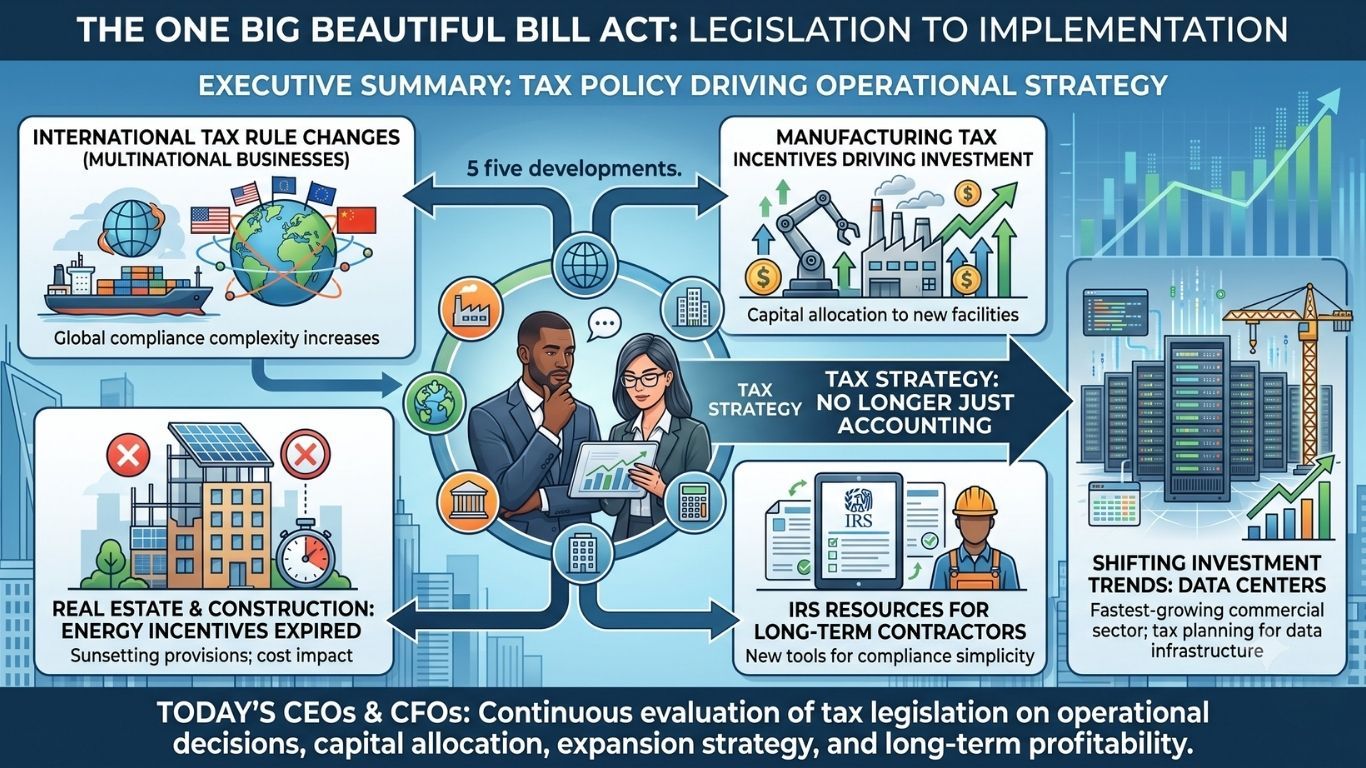
International tax provisions are changing how multinational organizations evaluate U.S. operations. Manufacturing incentives are already influencing capital investment decisions. Energy-efficient construction incentives have officially expired, changing the economics of future developments. The IRS continues modernizing contractor compliance tools, while broader market trends suggest commercial construction investment is beginning to shift toward data centers and digital infrastructure.
For leadership teams, these aren't isolated tax updates; they're strategic business considerations.
The organizations that recognize these changes early are often the ones that preserve cash flow, improve planning, and create long-term competitive advantages.
Executive Overview
Another week brought another reminder that tax strategy no longer lives exclusively inside the accounting department.
This week, nearly every major development stems directly from provisions of the One Big Beautiful Bill Act moving from legislation into real-world implementation.
International tax rules affecting multinational businesses have changed.
Manufacturing tax incentives continue driving investment decisions.
Long-standing construction and real estate energy incentives have officially expired.
The IRS has introduced new resources designed to simplify compliance for long-term contractors.
Meanwhile, construction investment trends continue shifting toward one of the fastest-growing sectors in commercial development: data centers.
Individually, each of these stories deserves attention.
Together, they reinforce a larger message:
Today's CEOs and CFOs must continuously evaluate how tax legislation influences operational decisions, capital allocation, expansion strategy, and long-term profitability.
Below are five developments our team believes deserve the attention of growth-focused leadership teams.

1. The One Big Beautiful Bill Act Reshapes International Tax Planning
One of the most significant international tax developments this week isn't the creation of a new tax incentive, it's the evolution of an existing one.
The One Big Beautiful Bill Act officially renames Foreign-Derived Intangible Income (FDII) as Foreign-Derived Deduction Eligible Income (FDDEI) while increasing the effective deduction rate and raising the Base Erosion and Anti-Abuse Tax (BEAT) rate to 10.5% for tax years beginning after December 31, 2025.
Although the terminology may appear technical, the implications are anything but.
These changes influence how multinational organizations evaluate:
- Intellectual property ownership
- Export income
- Cross-border entity structures
- Intercompany transactions
- U.S. investment decisions
For foreign-owned companies operating in the United States or U.S. companies expanding internationally tax structure has become an even more important competitive consideration.
This isn't simply a compliance update.
It's an opportunity to revisit whether your current international tax structure continues to align with your long-term growth strategy.
Questions Leadership Should Ask
- Have we evaluated how these international tax changes affect our current entity structure?
- Could our global tax model become more efficient under the new rules?
- Are future expansion plans still aligned with our existing tax strategy?
International tax strategy should evolve alongside legislation—not years after it changes.
2. The Section 45X Manufacturing Credit Continues Driving Investment
A recent announcement from Toyo Solar Texas LLC illustrates how federal manufacturing incentives are already influencing business decisions.
The company confirmed its expectation that its Texas manufacturing operations will qualify for the Section 45X Advanced Manufacturing Production Credit for the 2025 tax year.
While headlines often focus on the dollar value of available credits, the larger takeaway is strategic.
Federal manufacturing incentives continue influencing where companies choose to build, expand, and invest.
Businesses considering domestic production should evaluate available incentives before finalizing:
- Facility locations
- Equipment investments
- Production expansion
- Capital budgets
Waiting until after construction begins may eliminate planning opportunities that could have been incorporated during the decision-making process.
Manufacturing executives should increasingly view tax incentives as one factor among many when evaluating long-term capital investments.
Questions Leadership Should Ask
- Have we evaluated all available federal manufacturing incentives before expanding?
- Could future production investments qualify for additional credits?
- Are tax incentives being incorporated into our overall capital budgeting process?
The best time to evaluate tax incentives is before committing capital not after construction begins.
3. Section 179D and Section 45L Have Officially Reached the Finish Line
For years, Sections 179D and 45L provided valuable tax incentives for energy-efficient commercial buildings and residential housing developments.
As of July 1, 2026, those incentives have officially sunset for new construction starts and qualifying unsold homes.
For many developers, builders, architects, and design professionals, this marks the end of an important planning opportunity.
Projects already underway may continue under transition rules where applicable, but future developments should no longer assume these incentives remain available.
This change reinforces an important lesson for growth-focused businesses.
Tax incentives rarely last forever.
Organizations that proactively monitor legislative deadlines are often able to accelerate projects or adjust investment timing before opportunities disappear.
Those who wait frequently discover the window has already closed.
Questions Leadership Should Ask
- Did any current projects qualify before the sunset date?
- Have our future project financial models been updated?
- What incentives should replace 179D or 45L in future planning discussions?
Successful developers don't simply react to tax law changes—they anticipate them before project timelines are finalized.
4. The IRS Introduces a New Tool for Long-Term Construction Contracts
Long-term construction contracts have never been known for simple tax compliance.
Between percentage-of-completion accounting, contract estimates, change orders, retainage, and annual look-back calculations, year-end reporting can become one of the more technically demanding responsibilities for construction finance teams.
Recognizing that challenge, the IRS recently released a new Excel-based Look-Back Interest Calculator designed to assist taxpayers completing Form 8697, the form used to compute look-back interest for certain long-term contracts under IRC Section 460.
At first glance, this may seem like a minor administrative update.
In reality, it signals something much larger.
The IRS continues investing in tools that simplify compliance while expecting taxpayers to maintain increasingly accurate calculations and documentation.
For contractors performing large commercial projects over multiple tax years, look-back interest calculations can affect both tax liabilities and financial reporting. The new calculator should help reduce manual calculations, improve consistency, and minimize computational errors during year-end close.
However, software does not replace planning.
Contract estimates, percentage-of-completion calculations, change order documentation, and project forecasting remain management responsibilities.
Companies with disciplined project accounting generally experience fewer year-end surprises.
Those relying on last-minute adjustments often discover errors when options for correcting them are limited.
Questions Leadership Should Ask
- Are our long-term contracts being reviewed throughout the year rather than only at year-end?
- Have we evaluated whether our current accounting systems support accurate percentage-of-completion reporting?
- Are project managers, finance teams, and tax advisors working from the same assumptions?
Technology can simplify compliance, but proactive project accounting remains the foundation of effective tax planning.
5. Data Centers Continue to Reshape Commercial Construction
Construction activity continues to evolve.
According to recent industry outlooks, data center construction continues to expand while portions of traditional private commercial construction—including office development—remain under pressure.
This shift reflects broader economic changes.
Artificial intelligence, cloud computing, digital infrastructure, and enterprise technology investments continue driving demand for specialized facilities requiring significant capital investment.
For construction companies, this may represent an opportunity to diversify into one of the fastest-growing sectors of commercial development.
For manufacturers, increasing data center demand may influence production requirements for electrical systems, HVAC components, steel fabrication, concrete products, and other specialized materials.
For real estate developers, understanding where investment capital is flowing becomes increasingly important when evaluating future project pipelines.
While no market expands indefinitely, current trends suggest digital infrastructure will remain a meaningful area of commercial investment for the foreseeable future.
Forward-looking organizations are already evaluating how these changes align with their long-term business strategy.
Questions Leadership Should Ask
- Does our current growth strategy align with emerging construction sectors?
- Are there opportunities to serve the expanding digital infrastructure market?
- How should current market trends influence our capital allocation over the next three to five years?
The strongest companies don't simply follow market trends—they position themselves ahead of them.
Executive Perspective
This week's developments reinforce an important shift in modern business leadership.
Tax legislation is no longer something executives review once filing season arrives.
It increasingly influences where companies build, how they structure operations, when they invest capital, and how they evaluate long-term growth opportunities.
The One Big Beautiful Bill Act illustrates this perfectly.
Rather than introducing isolated compliance requirements, its implementation is reshaping conversations around international tax planning, domestic manufacturing investment, commercial development, and strategic capital allocation.
At the same time, broader market forces from construction demand to IRS modernization efforts continue reminding leadership teams that proactive planning consistently outperforms reactive decision-making.
The businesses that create lasting competitive advantages are rarely the ones chasing yesterday's tax changes.
They're the ones preparing for tomorrow's.
About Freese, Peralez & Associates
Freese, Peralez & Associates is a tax-focused CPA firm located in The Woodlands, Texas, serving growth-focused businesses throughout Texas and across the United States.
We specialize exclusively in:
- Strategic Tax Planning
- Tax Consulting
- Business Tax Preparation
Our clients typically generate between $1 million and $100 million in annual revenue, often operate multiple entities, conduct business across multiple states, or face increasingly complex tax considerations.
We work extensively with organizations in the construction, manufacturing, real estate development, and international business sectors, helping executive leadership teams make proactive tax decisions that support sustainable long-term growth.
Continue the Conversation
Every leadership team faces decisions that extend well beyond filing tax returns.
Expansion plans.
Capital investments.
Entity structures.
Multi-state operations.
International growth.
The sooner those conversations begin, the more planning opportunities typically become available.
If your organization is evaluating significant business decisions or you're wondering whether your current tax strategy is keeping pace with your company's growth we invite you to visit our Contact Us page and schedule a confidential discovery call.
Our team would welcome the opportunity to learn more about your business and discuss strategies designed to help protect cash flow, reduce tax exposure, and support your long-term objectives.
Coming Next Week
Our team is currently monitoring:
- New IRS guidance and Treasury releases
- Congressional tax legislation
- International tax developments
- Manufacturing incentives
- Construction market activity
- Real estate investment trends
- Significant federal court decisions affecting business taxpayers
Because understanding tax law is important. Understanding what it means for your business is even more valuable
FAQ SECTION
What is FDDEI?
FDDEI (Foreign-Derived Deduction Eligible Income) is the successor to FDII under the One Big Beautiful Bill Act and affects how certain international income is treated for qualifying businesses.
What is the BEAT tax rate for 2026?
For qualifying tax years beginning after December 31, 2025, the Base Erosion and Anti-Abuse Tax (BEAT) rate increases to 10.5%, subject to applicable provisions of current law.
What is the Section 45X Advanced Manufacturing Credit?
Section 45X provides tax incentives for qualifying domestic manufacturers producing eligible components within the United States.
Has Section 179D expired?
For new construction starts after July 1, 2026, the Section 179D energy-efficient commercial building deduction has sunset under current law.
What is IRS Form 8697?
Form 8697 is used to calculate look-back interest for certain long-term contracts subject to the percentage-of-completion rules under IRC Section 460.