
5 Tax Rules Where the Headline Misses the Details
5 Tax Rules Where the Headline Misses the Details
Follow FPA in Google
Get more timely tax insights from Freese, Peralez & Associates in Google Search.
Add FPA as a Preferred Source →FPA Executive Tax Brief™
Strategic Tax Intelligence for Growth-Focused Businesses
Issue No. 008 | Week of September 7–13, 2026
Estimated Reading Time: 8 Minutes
Executive Snapshot
Who Should Read This
✔ CEOs
✔ CFOs
✔ Controllers
✔ Construction Executives
✔ Manufacturing Leaders
✔ Real Estate Developers
✔ International Business Leaders
✔ Multi-Entity Business Owners
This Week at a Glance
| Development | Primary Industry | Priority |
|---|---|---|
| Residential Construction Method-Change Relief | Construction / Real Estate | 🔴 Immediate Review |
| Section 174A R&D Method-Change Cleanup | Manufacturing / R&D-Heavy Businesses | 🔴 Immediate Review |
| Proposed Section 987 CFC Relief | International / Multi-Entity Businesses | 🟡 Consider Action |
| BOI Reporting After FinCEN Rollback | International / Foreign-Registered U.S. Entities | 🔴 Immediate Review |
| 179D / 45L Documentation After Sunset | Construction / Real Estate | 🟡 Consider Action |
Weekly Executive Theme
Precision Beats Headlines
This week’s developments are a good reminder that tax headlines are often directionally correct and operationally incomplete.
“Residential construction accounting got easier.”
True, but only if the company follows the correct method-change mechanics.
“Domestic R&D expensing is back.”
Also true, but accounting-method cleanup still matters.
“BOI reporting was repealed.”
Not exactly.
“Section 987 relief is coming.”
Potentially, but only through a proposed election with transition rules and downstream foreign tax credit consequences.
“179D and 45L are gone.”
For new projects, yes. For qualifying pre-sunset projects, the real issue has shifted from eligibility to proof.
The biggest tax mistakes often happen in the gap between what leadership thinks changed and what the actual rule requires.
Executive Overview
Five developments deserve attention this week because each converts a broad statutory change into practical administrative rules.
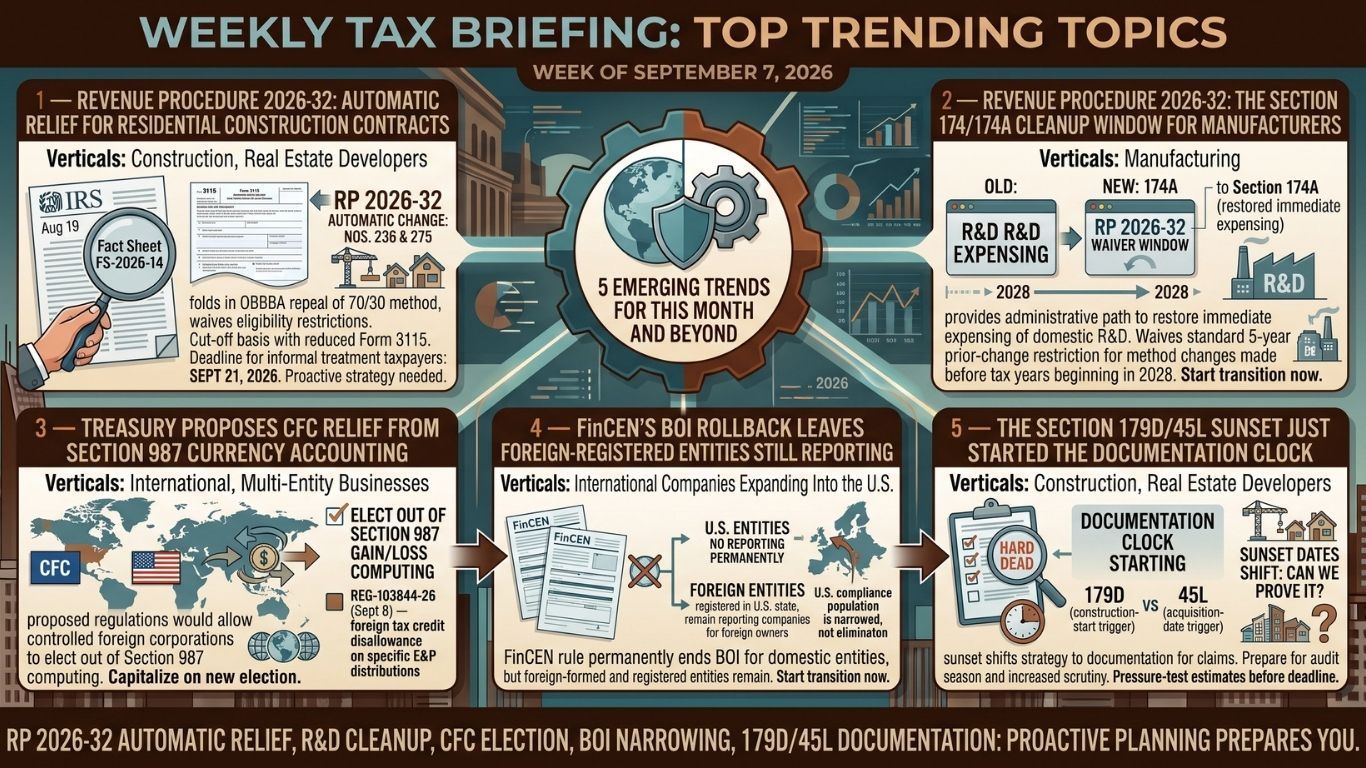
Revenue Procedure 2026-32, issued September 4, gives taxpayers automatic accounting-method procedures for several OBBBA changes, including residential construction contracts and domestic research expenditures.
For builders and developers, that includes cut-off-basis changes and reduced Form 3115 filing requirements.
For manufacturers and other R&D-heavy companies, it provides a cleaner path into the restored Section 174A domestic research rules and temporarily relaxes certain prior-change eligibility restrictions.
Internationally, Treasury has proposed an election that could substantially reduce the compliance burden of Section 987 currency accounting for controlled foreign corporations—but the proposal does not erase prior currency gain or loss and introduces coordination issues that still require modeling.
FinCEN has finalized a major rollback of beneficial ownership reporting, but foreign entities registered to do business in the United States remain within the reporting regime for foreign beneficial owners.
And finally, the June 30 sunset dates for Sections 179D and 45L have changed the nature of those incentives. The question for many taxpayers is no longer “Can we qualify?” but “Can we prove that we qualified before the cutoff?”
Different rules.
Same executive lesson:
Details determine whether the opportunity survives.

The OBBBA expanded the construction-contract exception under Section 460 by replacing the narrower “home construction contract” framework with broader residential construction contract treatment for qualifying contracts.
Revenue Procedure 2026-32 now provides the administrative mechanics for taxpayers who need to change accounting methods to reflect that statutory shift.
For qualifying residential construction contracts entered into in tax years beginning after July 4, 2025, taxpayers may obtain automatic consent to change:
- From the percentage-of-completion method
- From the percentage-of-completion/capitalized-cost method
- To a permissible exempt-contract method
The change is generally made on a cut-off basis, meaning it applies prospectively to contracts entered into on or after the first day of the year of change.
No Section 481(a) adjustment is required for that change.
The IRS also provides a reduced Form 3115 filing requirement.
The designated automatic accounting-method change number for this provision is 275.
The September 21 Transition Rule
One detail is easy to miss.
If a taxpayer filed a federal income tax return on or before September 21, 2026 for a tax year beginning after July 4, 2025, and properly applied the new residential construction treatment, the taxpayer may be deemed to have complied with the accounting-method-change requirements.
That creates a very short review window for taxpayers who already filed under the new treatment without formally navigating the normal procedures.
Questions Leadership Should Ask
- Did we enter into residential construction contracts after July 4, 2025?
- Are any of those contracts currently using percentage-of-completion accounting?
- Did we already file a return using the new treatment?
- Does the September 21 transition rule apply to us?
- Should we change to an exempt-contract method prospectively?
- Has our tax team reviewed whether cost capitalization under Section 263A also changes?
A favorable statutory change creates little value if the accounting method used to implement it is wrong.
2. Revenue Procedure 2026-32 Also Cleans Up the Section 174A Transition for Manufacturers
The same revenue procedure contains another important set of rules for manufacturers and R&D-heavy businesses.
Section 174A restored immediate deductions for qualifying domestic research or experimental expenditures paid or incurred in tax years beginning after December 31, 2024.
Foreign research remains subject to capitalization and 15-year amortization under Section 174.
Revenue Procedure 2026-32 updates the automatic accounting-method procedures used to move taxpayers into the new domestic-R&D regime.
For qualifying domestic expenditures, the rules permit changes to the Section 174A deduction method and related transition methods.
One of the most useful administrative features is the temporary relaxation of certain eligibility restrictions.
The normal prior-change rules that can prevent a taxpayer from making another accounting-method change within a five-year period are waived for qualifying changes made for tax years beginning before January 1, 2028.
That matters for companies that have already changed R&D methods recently and would otherwise face procedural barriers.
Why This Matters Operationally
For manufacturers, R&D costs frequently sit across:
- Engineering payroll
- Process development
- Prototype work
- Tooling design
- Automation development
- Software integration
- Testing and experimentation
The tax law may allow immediate domestic expensing again, but the finance team still needs to separate domestic research from foreign research and apply the correct accounting method consistently.
Questions Leadership Should Ask
- Are domestic and foreign R&D costs being tracked separately?
- Did we make a prior Section 174 accounting-method change within the last five years?
- Can we use the temporary eligibility relief before 2028?
- Are current-year domestic R&D costs being deducted under Section 174A correctly?
- Have old unamortized Section 174 balances been modeled separately from new Section 174A expenditures?
The return of immediate R&D expensing simplifies the economics—but not the accounting discipline required to use it correctly.
3. Treasury Proposes Section 987 Relief for Controlled Foreign Corporations
Section 987 has long been one of the more administratively difficult areas of international tax.
It applies when a qualified business unit operates in a functional currency different from that of its owner.
For controlled foreign corporations, the rules can require taxpayers to compute and recognize foreign-currency gain or loss associated with branch or disregarded-entity activity.
Treasury’s proposed regulations under REG-103844-26 would create a new CFC exemption election.
If finalized as proposed, an electing CFC generally would not compute or recognize Section 987 gain or loss under Section 987(3) while the election is in effect, except in certain specified transactions.
That could substantially reduce compliance burden for multinational groups.
But it is not a full exemption from Section 987.
The CFC would still need to determine and translate taxable income and earnings and profits under Sections 987(1) and (2).
The Legacy Gain-or-Loss Issue
Another important detail:
Making the election does not simply erase pre-election Section 987 gain or loss.
Under the proposal, pre-election Section 987 gain or loss would generally be recognized ratably over 120 months.
That means the election is best understood as a simplification of future Section 987(3) accounting, not a retroactive cleanup.
Questions Leadership Should Ask
- Which CFCs own Section 987 qualified business units?
- How much pre-election currency gain or loss exists?
- Would the proposed exemption meaningfully reduce compliance costs?
- Does the 120-month recognition period create a material earnings or cash-tax effect?
- Do consistency requirements across commonly controlled CFCs limit selective use of the election?
- Are foreign tax credit consequences being modeled alongside the election?
A compliance simplification can still create tax consequences that need to be modeled before the election is made.
4. FinCEN’s BOI Rollback Is Not a Complete Repeal
On August 11, FinCEN finalized a major reduction in Corporate Transparency Act beneficial ownership reporting.
The most widely reported headline is accurate:
U.S. companies are now exempt from BOI reporting.
But that does not mean BOI reporting disappeared entirely.
Certain foreign-formed entities registered to do business in the United States remain reporting companies.
Those entities still generally must report beneficial ownership information for qualifying foreign individuals.
They are not required to report U.S. person beneficial owners or U.S. person company applicants.
For FPA’s international clients expanding into the United States, that distinction matters.
A foreign corporation registering to conduct business in Texas or another state may still have a FinCEN reporting obligation even though a newly formed domestic LLC does not.
Questions Leadership Should Ask
- Was our U.S. operating entity formed domestically or formed overseas and registered in a U.S. state?
- Are any reporting-company owners foreign individuals?
- Did we assume the FinCEN rollback eliminated our filing obligation without checking entity formation?
- Are existing BOI records accurate for foreign beneficial owners?
- Who owns FinCEN compliance within the group?
The BOI rules became narrower—not nonexistent. Foreign expansion structures still require entity-by-entity review.
5. Sections 179D and 45L Have Entered the Documentation Phase
1. Revenue Procedure 2026-32 Gives Residential Developers a Cleaner Accounting-Method Path
The June 30, 2026 sunset dates for Sections 179D and 45L are now behind us.
That means the planning conversation has changed.
For Section 179D, the deduction is unavailable for property whose construction begins after June 30, 2026.
For Section 45L, the credit is unavailable for qualified new energy-efficient homes acquired after June 30, 2026.
For qualifying projects that crossed the relevant threshold before the cutoff, the next issue is substantiation.
Taxpayers may need to demonstrate:
- When construction began
- When a home was acquired
- Whether applicable energy-efficiency standards were satisfied
- Whether prevailing-wage or apprenticeship rules affected the claimed amount
- Which party is entitled to the deduction or credit
- Whether required certifications and project records were preserved
For developers and contractors who moved quickly to preserve eligibility before the sunset date, this is where documentation quality becomes critical.
Why This Matters Now
An incentive that technically qualified in June can still become difficult to defend if the supporting records are incomplete six months later.
Project teams disperse.
Contractors change.
Documentation gets archived.
Employees leave.
That is why post-deadline cleanup should happen while the facts are still easy to reconstruct.
Questions Leadership Should Ask
- Which projects began construction on or before June 30?
- Which qualifying homes were acquired by June 30?
- Do we have dated contracts, permits, invoices, certifications and project records?
- Are energy-efficiency requirements fully documented?
- Have allocation issues been resolved for designer deductions under Section 179D?
- Are files organized now for potential future examination?
Once an incentive sunsets, documentation becomes the asset that preserves the tax benefit.
Executive Perspective
This week’s developments reinforce one of the most important principles in tax strategy:
Precision beats headlines.
Residential construction accounting did become more favorable—but the IRS still expects the correct method-change process.
Immediate domestic R&D expensing is back—but old balances, foreign research and accounting-method mechanics still need to be managed.
Section 987 may become easier for CFCs—but the proposed election does not erase legacy currency gain or loss.
BOI reporting was dramatically reduced—but some foreign-registered entities remain within the system.
And 179D and 45L may be closed to new activity—but qualifying pre-sunset projects now depend on documentation.
The businesses that get the best outcomes are rarely the ones that simply hear about a tax change first.
They are the ones that understand exactly what changed, what did not, and what needs to happen next.
Frequently Asked Questions
What is Revenue Procedure 2026-32?
Revenue Procedure 2026-32 updates automatic accounting-method-change procedures for several OBBBA changes, including domestic research expenditures under Sections 174 and 174A and certain residential construction contracts under Section 460.
What is accounting-method change number 275?
Automatic change number 275 applies to certain method changes involving residential construction contracts entered into in tax years beginning after July 4, 2025.
What is the September 21, 2026 deadline in Revenue Procedure 2026-32?
A transition rule applies to certain taxpayers that filed returns on or before September 21, 2026 and already properly used the new residential-construction accounting treatment. Separate September 21 rules also apply to certain pending nonautomatic Form 3115 requests.
Can manufacturers deduct domestic R&D costs immediately in 2026?
Generally, Section 174A allows immediate deductions for qualifying domestic research or experimental expenditures paid or incurred in tax years beginning after December 31, 2024. Foreign research remains subject to capitalization and 15-year amortization.
Did FinCEN eliminate BOI reporting?
Not entirely. U.S. companies are exempt, but certain foreign-formed entities registered to do business in the United States remain reporting companies for qualifying foreign beneficial owners.
Are Sections 179D and 45L still available?
Only for projects that satisfy the applicable pre-sunset rules. Section 179D does not apply where construction begins after June 30, 2026, and Section 45L does not apply to qualifying homes acquired after June 30, 2026.
About Freese, Peralez & Associates
Freese, Peralez & Associates is a tax-focused CPA firm located in The Woodlands, Texas, serving growth-focused businesses throughout Texas and across the United States.
We specialize exclusively in:
- Strategic Tax Planning
- Tax Consulting
- Business Tax Preparation
Our clients generally generate between $1 million and $100 million in annual revenue and frequently operate through multiple entities, across multiple states, or within increasingly complex domestic and international tax environments.
We work extensively with organizations in the construction, manufacturing, real estate development and international business sectors.
Continue the Conversation
This week’s developments are a reminder that the most important tax question is rarely:
"Did the law change?"
The better question is:
"What does the actual guidance require us to do now?"
If your organization is managing residential construction contracts, domestic R&D, controlled foreign corporations, foreign-registered U.S. entities, or pre-sunset 179D and 45L projects, this is an appropriate time to confirm that your implementation matches the current rules.
If you are not currently an FPA client, visit our Contact Us page and complete the form to schedule a confidential discovery call.
We would welcome the opportunity to learn more about your business and determine whether proactive tax planning can help protect cash flow, preserve margins and support your next stage of growth.
Coming Next Week
Our team continues monitoring:
- IRS and Treasury OBBBA guidance
- Section 174A implementation
- Construction accounting-method changes
- International CFC and Section 987 developments
- FinCEN BOI compliance
- Energy-incentive documentation
- Manufacturing and real estate tax developments
- Year-end planning deadlines affecting growth companies
Because the headline tells you what changed.
The details tell you whether it applies.