
5 Business & Tax Developments Every CEO and CFO Should Know This Week
5 Business & Tax Developments Every CEO and CFO Should Know This Week
FPA Executive Tax Brief™
Issue No. 001 | Week of July 21–27, 2026
Strategic Tax Intelligence for CEOs, CFOs & Growth-Focused Business Owners
Estimated Reading Time: 7 Minutes
Industries Covered This Week
✔ Construction
✔ Manufacturing
✔ Real Estate Development
✔ Multi-State Businesses
Executive Summary
Another week brought another reminder that tax strategy no longer lives solely inside the tax department.
Trade policy shifted.
Congress quietly enacted housing legislation that could influence project timelines.
Manufacturing incentives continued to reshape facility investment decisions.
Construction executives were left navigating material cost volatility while evaluating contractual responsibilities surrounding tariff-related refunds.
Meanwhile, the IRS made the unusual decision to adjust the standard business mileage rate in the middle of the year, a subtle signal that inflationary pressures continue to affect operating costs.
Individually, these developments may appear unrelated.
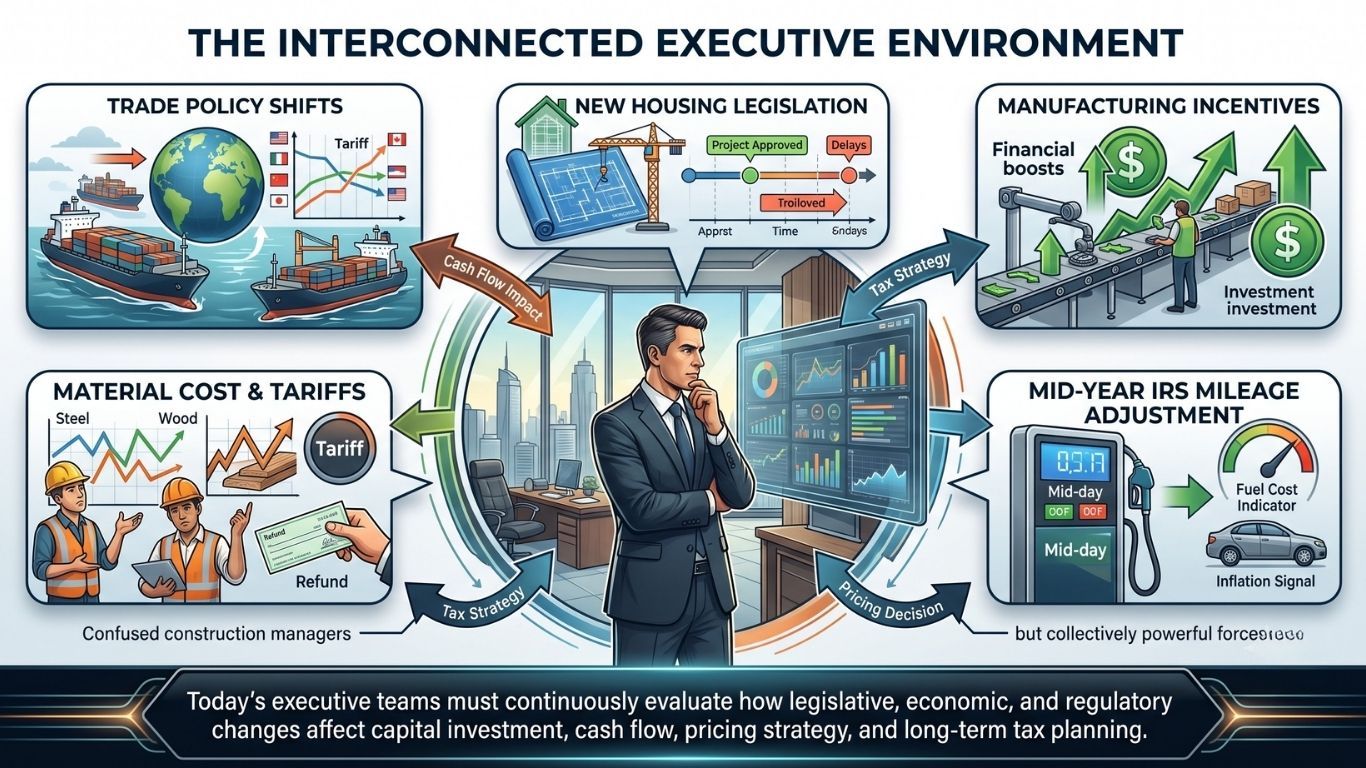
Collectively, they reinforce a larger trend: today's executive teams must continuously evaluate how legislative, economic, and regulatory changes affect capital investment, cash flow, pricing strategy, and long-term tax planning.
Below are five developments our team believes deserve the attention of growth-focused leadership teams.

| Development | Industry | Priority |
|---|---|---|
| Section 122 Tariff Expiration | Manufacturing | 🔴 High |
| NMTC Redevelopment | Manufacturing | 🟡 Medium |
| Housing Act | Real Estate | 🟡 Medium |
| Tariff Contract Language | Construction | 🔴 High |
| IRS Mileage Rate | All Businesses | 🟡 Medium |
1. The Section 122 Tariff Surcharge Has Expired—Now Comes the Real Work
The temporary 10% blanket import surcharge imposed under Section 122 of the Trade Act of 1974 reached the end of its 150-day statutory period this week.
For manufacturers and businesses importing materials, equipment, or components, the expiration creates an opportunity to revisit landed-cost assumptions, supplier pricing, and purchasing strategies.
However, executives should avoid assuming that lower import costs automatically translate into lower operating costs. Other trade mechanisms, including Section 301 tariffs, remain in place and continue to influence global sourcing decisions.
Questions Leadership Should Ask
- Have our landed-cost models been updated?
- Are supplier contracts reflecting the latest tariff changes?
- Should we accelerate or delay future purchasing decisions?
Temporary policy changes can create long-term financial consequences if pricing models are not updated promptly.
2. Manufacturing Facility Redevelopment Incentives Continue to Fly Under the Radar
Two recent manufacturing redevelopment projects, one in Oklahoma and another in Florida, highlighted how the New Markets Tax Credit (NMTC) program continues to support industrial redevelopment in qualifying census tracts.
Many manufacturers evaluate labor availability, transportation infrastructure, and utility access when selecting a new location.
Far fewer evaluate whether the project may qualify for federal incentive programs before committing to a site.
Location decisions often influence financing opportunities long before construction begins.
Questions Leadership Should Ask
- Have we evaluated incentive eligibility before selecting our next facility?
- Could tax credits improve the economics of expansion?
Choosing the right location isn't just an operational decision it can also become a financing decision.
3. New Housing Legislation Could Influence Development Timelines
The 21st Century ROAD to Housing Act officially became law this month.
Among its provisions are changes intended to streamline portions of the federal environmental review process for housing development while also restricting certain institutional acquisitions of single-family homes.
Although implementation will continue to evolve, developers and construction firms should monitor how these changes affect project timelines, permitting expectations, and acquisition strategies.
Questions Leadership Should Ask
- Could upcoming developments benefit from shorter review timelines?
- Will acquisition strategies need to adapt?
Legislative changes rarely affect only compliance, they often reshape competitive advantage.
4. Construction Contracts May Face Their Next Tariff Challenge
Recent discussions at the Associated General Contractors Financial Issues Forum highlighted continued concern over material pricing, supply chain disruptions, and an emerging contractual issue:
If tariff refunds become available later, who ultimately receives the benefit?
Many existing contracts address escalating material costs.
Far fewer clearly address what happens when those costs decrease after the fact.
For contractors operating under fixed-price agreements, the answer could become increasingly important.
Questions Leadership Should Ask
- Do our contracts clearly address tariff adjustments?
- Have legal counsel reviewed escalation and refund provisions?
The strongest contracts anticipate future uncertainty, not just today's prices.
5. Why the IRS Increased the Mileage Rate Mid-Year
Effective July 1, the IRS increased the standard business mileage rate from 72.5 cents to 76 cents per mile.
Mid-year adjustments remain relatively uncommon and reflect rising operating costs driven largely by increased fuel prices.
Although the adjustment itself appears modest, businesses operating vehicle fleets or reimbursing employee travel should ensure reimbursement policies and payroll systems have been updated accordingly.
For organizations with large field teams, even small reimbursement changes can materially affect annual operating expenses.
Questions Leadership Should Ask
- Have reimbursement policies been updated?
- Are expense reporting systems reflecting the new rate?
- Could fleet operating costs require revised budgeting?
Small regulatory updates often create larger financial impacts when multiplied across an entire organization.
Executive Perspective
This week's developments share a common theme.
Tax planning is no longer an annual exercise.
It has become an ongoing business function that intersects with supply chains, real estate decisions, financing strategies, contract negotiations, and operational planning.
The companies best positioned for long-term growth are often those that identify these opportunities early, not after year-end, but while decisions are still being made.
At Freese, Peralez & Associates, we believe proactive tax planning should support business strategy, not simply document it after the fact.
About Freese, Peralez & Associates
Freese, Peralez & Associates is a tax-focused CPA firm located in The Woodlands, Texas, serving growth-focused businesses throughout Texas and beyond.
We specialize exclusively in:
- Strategic Tax Planning
- Tax Consulting
- Business Tax Preparation
Our clients are typically established companies with annual revenues between $1 million and $100 million, often operating across multiple entities or multiple states. We work extensively with businesses in the construction, manufacturing, and real estate industries, helping leadership teams make informed tax decisions that support long-term growth.
Continue the Conversation
Every business faces a unique set of opportunities and challenges.
If your organization is evaluating expansion, capital investments, multi-state operations, or other significant business decisions, we'd be happy to discuss how proactive tax planning can help support your goals.
Visit our Contact Us page to schedule a confidential discovery call with our team.
Coming Next Week
Our team is currently monitoring:
- IRS guidance and announcements
- Congressional tax legislation
- Manufacturing incentives
- Construction market developments
- Real estate policy updates
- International tax and trade changes
- Significant court decisions affecting businesses
Because staying informed is only valuable if it helps you make better business decisions.