
5 Tax and Trade Changes That Could Require CEOs and CFOs to Rethink Their 2026 Strategy
5 Tax and Trade Changes That Could Require CEOs and CFOs to Rethink Their 2026 Strategy
Follow FPA in Google
Get more timely tax insights from Freese, Peralez & Associates in Google Search.
Add FPA as a Preferred Source →FPA Executive Tax Brief™
Strategic Tax Intelligence for Growth-Focused Businesses
Issue No. 003 | Week of August 3–9, 2026
Estimated Reading Time: 8 Minutes
Executive Snapshot
Who Should Read This
✔ CEOs
✔ CFOs
✔ Controllers
✔ Manufacturing Leaders
✔ Construction Executives
✔ Real Estate Developers
✔ International Business Leaders
✔ Multi-Entity Business Owners
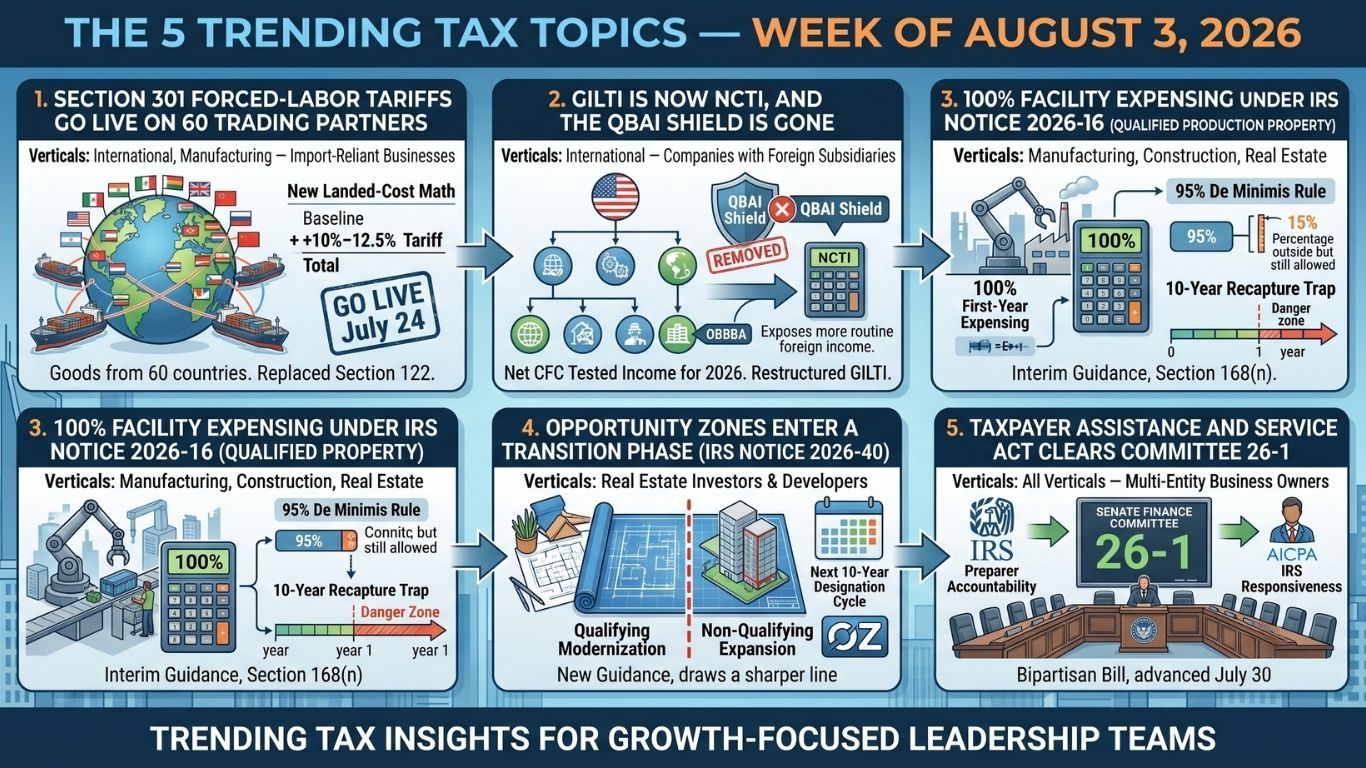
This Week at a Glance
| Development | Primary Industry | Priority |
|---|---|---|
| Section 301 Forced-Labor Tariffs | International / Manufacturing | 🔴 High |
| GILTI Transition to Net CFC Tested Income | International Business | 🔴 High |
| Qualified Production Property Expensing | Manufacturing / Construction / Real Estate | 🔴 High |
| Opportunity Zone Transitional Guidance | Real Estate Investment / Development | 🟡 Medium |
| Taxpayer Assistance and Service Act | All Business Verticals | 🟢 Monitor |
Weekly Executive Theme
Planning Assumptions Have a Shelf Life
One of the greatest risks facing an executive team is not necessarily making a bad decision.
It is making a reasonable decision using assumptions that are no longer current.
A landed-cost model developed in June may no longer reflect today’s tariffs. A production-facility budget may overlook a new first-year depreciation opportunity. A foreign subsidiary structure designed under the previous GILTI framework may produce a different result in 2026.
This week’s developments reinforce a central principle of strategic tax planning:
Business plans must be revisited when the rules underneath them change.
Organizations that review those assumptions regularly are better positioned to preserve margins, protect cash flow, and act before valuable planning windows close.
Executive Overview
The final days of July delivered five developments with direct implications for growth-focused businesses.
New Section 301 tariffs replaced the temporary global surcharge that expired July 24.
The international tax framework formerly known as GILTI has shifted toward Net CFC Tested Income for qualifying tax years beginning after December 31, 2025.
Manufacturers and other businesses developing qualifying production facilities now have interim guidance for a potentially significant 100% first-year depreciation allowance.
Real estate investors and developers have new transitional Opportunity Zone guidance to evaluate as the program moves toward its next designation cycle.
Meanwhile, a broadly supported IRS-reform proposal advanced through the Senate Finance Committee.
These developments affect different industries, but they share one executive consequence:
Tax, trade, and regulatory changes can make existing forecasts, structures, and investment models obsolete faster than leadership teams expect.
Below are five developments that deserve attention now.

1. New Section 301 Tariffs Reset Landed-Cost Models
The expiration of the temporary Section 122 surcharge did not create a return to the previous trade environment.
New Section 301 duties took effect July 24 on products from 60 investigated trading partners. Depending on the jurisdiction and applicable product rules, the additional duties generally range from 10% to 12.5%, with exemptions applying to certain products and raw materials.
For import-reliant manufacturers, distributors, and construction companies, the immediate issue is not merely the tariff rate. It is whether current financial models accurately reflect the new rules.
Potential effects include:
- Higher landed costs for components and materials
- Supplier repricing
- Pressure on fixed-price contracts
- Changes to sourcing strategies
- Reduced gross margins
- New customs-classification and exemption questions
Companies should also avoid assuming that the same rate applies uniformly to every import. Product exclusions, existing duties, country treatment, and contract terms may produce different outcomes.
Questions Leadership Should Ask
- Have our landed-cost models been updated since July 24?
- Which suppliers, products, and purchase orders are affected?
- Do our customer contracts allow tariff-related price adjustments?
- Are potential exemptions being evaluated before duties are accepted as permanent costs?
A trade-policy change becomes a margin problem when financial models and contract terms fail to change with it.
2. GILTI Is Giving Way to Net CFC Tested Income
For tax years of foreign corporations beginning after December 31, 2025, the international inclusion under IRC Section 951A is based on a U.S. shareholder’s Net CFC Tested Income.
The shift is more than a change in terminology.
The previous GILTI framework generally reduced tested income through a deemed return tied to Qualified Business Asset Investment, commonly referred to as the QBAI shield. Under the revised rules, that tangible-asset reduction is removed from the Section 951A calculation.
For U.S. groups with controlled foreign corporations, the result may be greater exposure of routine foreign operating income to current U.S. taxation.
The revised regime can affect:
- Foreign manufacturing subsidiaries
- Intellectual-property structures
- Intercompany pricing
- Foreign tax credit modeling
- Supply-chain arrangements
- Decisions about where capital and personnel are deployed
The revised rules also increase the deemed-paid foreign tax credit percentage applicable to qualifying tested foreign income taxes, making detailed country-by-country modeling essential rather than optional.
Questions Leadership Should Ask
- Has our 2026 international tax forecast been rebuilt under the new calculation?
- How much of our prior benefit depended on QBAI?
- Do foreign tax credits adequately offset the revised U.S. inclusion?
- Does our current foreign operating structure still support our commercial objectives efficiently?
An international structure designed under the old GILTI calculation should not be assumed to remain optimal under Net CFC Tested Income.
3. Qualified Production Property May Receive 100% First-Year Expensing
IRC Section 168(n), supported by interim guidance in IRS Notice 2026-16, creates a temporary 100% first-year depreciation allowance for qualifying production property when a taxpayer makes the required election.
This opportunity is especially significant because it may apply to qualifying portions of nonresidential real property used as an integral part of manufacturing, production, or refining activities.
To qualify, the property must satisfy detailed requirements involving:
- Its use in a qualified production activity
- U.S. location
- Original use or qualifying acquisition rules
- Construction and placed-in-service dates
- A valid taxpayer election
- Exclusion of offices and other nonproduction areas
The rules generally target property whose construction begins after January 19, 2025, and before January 1, 2029, and that is placed in service after July 4, 2025, and before January 1, 2031.
This can materially alter the after-tax cost of building or acquiring a qualifying facility.
However, the opportunity comes with a meaningful condition: if the property ceases to be used as an integral part of a qualified production activity during the applicable 10-year period and is converted to another productive use, depreciation recapture may apply.
Questions Leadership Should Ask
- Does our planned facility contain areas that qualify as production property?
- Have eligible and ineligible building components been separated correctly?
- Does the project timeline satisfy the construction and placed-in-service requirements?
- Can the business reasonably maintain qualifying production use for the required period?
- Has the potential deduction been incorporated into financing and capital-budget models?
A facility decision made without evaluating Section 168(n) may overlook one of the most consequential depreciation opportunities available to domestic producers.
4. Opportunity Zones Enter a Critical Transition Period
IRS Notice 2026-40 provides transitional guidance as the Qualified Opportunity Zone program moves from its original designations toward a new framework beginning in 2027.
The guidance addresses how prior and amended rules interact, including the treatment of previously designated Opportunity Zones and qualifying investments made during the transition.
For real estate investors, developers, and Qualified Opportunity Funds, the main risk is assuming that prior program rules automatically apply to new capital, property acquisitions, or development plans.
Eligibility can depend on:
- When an investment is made
- Which designation cycle governs the location
- When stock, partnership interests, or business property are acquired
- Whether a fund satisfies applicable asset tests
- How the business and property meet operating requirements
A project located in a historically qualifying tract should not be presumed to satisfy every requirement during the transition.
Questions Leadership Should Ask
- Which version of the Opportunity Zone rules governs our proposed investment?
- Does the tract remain eligible under the applicable designation period?
- Do acquisition and development dates fit the transition rules?
- Are our fund documents and financial models based on current guidance?
- Have we confirmed eligibility before committing additional capital?
Opportunity Zone benefits begin with technical eligibility; compelling economics cannot rescue a project that falls outside the governing rules.
5. Bipartisan IRS-Reform Legislation Advances
On July 30, the Senate Finance Committee advanced the Taxpayer Assistance and Service Act by a vote of 26–1.
The proposal includes more than 60 bipartisan reforms intended to strengthen taxpayer rights, modernize IRS operations, improve digital access, increase responsiveness, and strengthen standards for paid tax preparers.
The bill has not yet become law, so immediate operational changes are not required.
Still, its unusually broad support makes it worth monitoring.
For multi-entity businesses, more effective online accounts and digital correspondence could eventually improve how finance teams and tax professionals:
- Review returns and notices
- Respond to IRS correspondence
- Track unresolved account issues
- Confirm filing activity
- Manage authorization and representation processes
Stronger preparer standards may also help distinguish established professional firms from unqualified or poorly supervised providers.
Questions Leadership Should Ask
- Who within our organization owns the response process for IRS notices?
- Can our tax team access and reconcile every entity’s account information efficiently?
- Are unresolved notices or account discrepancies being tracked centrally?
- Does our current tax provider have the experience and controls required for increasingly complex compliance?
Tax administration reform will not replace strong internal controls, but it could make disciplined tax management more efficient.
Executive Perspective
This week’s developments reveal a widening gap between the speed of federal change and the speed of traditional business planning.
Tariffs can change between purchasing cycles.
International tax calculations can change between fiscal years.
A production facility can become materially more attractive after new depreciation guidance.
A real estate investment can lose eligibility when its governing transition rules are misunderstood.
Even IRS administration may evolve faster than a company’s internal notice-management process.
The answer is not to react impulsively to every announcement.
It is to maintain a structured planning process that determines which developments materially affect the business and which do not.
At Freese, Peralez & Associates, that is what “beyond the obvious” tax planning means in practice: monitoring the rules, understanding the business, and translating change into informed executive decisions.
Frequently Asked Questions
What are the new Section 301 forced-labor tariffs?
The new duties generally impose additional tariffs of 10% to 12.5% on covered products from 60 investigated trading partners, subject to country treatment, existing most-favored-nation rates, and product exemptions.
What is Net CFC Tested Income?
Net CFC Tested Income is the revised Section 951A inclusion framework applicable to qualifying tax years beginning after December 31, 2025. Unlike the former GILTI calculation, it does not provide the prior QBAI-based deemed tangible income return.
What is Qualified Production Property?
Qualified Production Property generally includes qualifying portions of nonresidential real property used as an integral part of manufacturing, production, or refining activities and satisfying the timing, use, location, election, and other requirements of IRC Section 168(n).
Does Section 168(n) apply to an entire manufacturing building?
Not automatically. Offices, administrative areas, parking, sales areas, research spaces, software-development areas, and other portions unrelated to qualifying production activity may be excluded.
Is the Taxpayer Assistance and Service Act now law?
No. The Senate Finance Committee approved the proposal 26–1, but additional congressional action and enactment would be required before its provisions become law.
About Freese, Peralez & Associates
Freese, Peralez & Associates is a tax-focused CPA firm located in The Woodlands, Texas, serving growth-focused businesses throughout Texas and across the United States.
We specialize exclusively in:
- Strategic Tax Planning
- Tax Consulting
- Business Tax Preparation
Our clients generally generate between $1 million and $100 million in annual revenue and often operate through multiple entities, conduct business across several states, own substantial business assets, or face complex domestic and international tax considerations.
We work extensively with companies in the construction, manufacturing, real estate development, and international business sectors.
Continue the Conversation
A tax strategy developed at the beginning of the year may no longer reflect the rules, costs, or opportunities affecting your business today.
If your organization imports materials, owns foreign subsidiaries, plans a production facility, invests through Opportunity Zones, or manages multiple entities, a focused midyear review may reveal assumptions that need to be updated.
If you are not currently an FPA client, visit our Contact Us page and complete the form to schedule a confidential discovery call.
We would welcome the opportunity to learn about your business, evaluate whether your tax strategy is keeping pace with its growth, and discuss how proactive planning may help protect cash flow and preserve margins.
Coming Next Week
Our team is monitoring:
- New IRS and Treasury guidance
- Additional Section 301 trade developments
- International tax implementation
- Manufacturing and facility incentives
- Construction-market changes
- Real estate legislation and Opportunity Zone guidance
- Federal court decisions affecting business taxpayers
Because staying informed only creates value when the information leads to better decisions.