
5 Tax & Trade Decisions With Deadlines Already Running
5 Tax & Trade Decisions With Deadlines Already Running
FPA Executive Tax Brief™
Strategic Tax Intelligence for Growth-Focused Businesses
Issue No. 006 | Week of August 24–30, 2026
Estimated Reading Time: 8 Minutes
Executive Snapshot
Who Should Read This
✔ CEOs
✔ CFOs
✔ Controllers
✔ Real Estate Developers
✔ Manufacturing Leaders
✔ Construction Executives
✔ International Business Leaders
✔ Workforce-Heavy Employers
This Week at a Glance
| Development | Primary Industry | Priority |
|---|---|---|
| IRS Office of Conservation Easements | Real Estate / Investment Partnerships | 🟡 Consider Action |
| Polysilicon Tariffs & Onshoring Program | Manufacturing / International | 🔴 Immediate Review |
| Section 48D December 31 Construction Deadline | Semiconductor Manufacturing | 🔴 Immediate Review |
| Employer Trump Account Contributions | Construction / Manufacturing / Workforce-Heavy Employers | 🟡 Consider Action |
| U.S.–Canada Tariffs & September 8 Retaliation | Construction / Manufacturing / International | 🔴 Immediate Review |
Weekly Executive Theme
The Advantage Is Shifting to Companies That Position Early
This week's developments have an unusually consistent message.
Institutions are no longer merely announcing policy.
They are locking systems into place.
The IRS replaced a temporary conservation-easement settlement approach with a permanent specialized office.
The federal government paired future polysilicon import restrictions with an incentive for companies willing to commit capital to U.S. production.
The enhanced semiconductor investment credit has a construction-start deadline only months away.
Employers now have proposed rules describing how a new employee benefit must be structured.
And North American trade friction has progressed from negotiations into tariffs and announced retaliation.
Each development creates a window during which leadership still has choices.
Once those windows close, tax strategy often becomes compliance with decisions that could have been structured differently months earlier.
Executive Overview
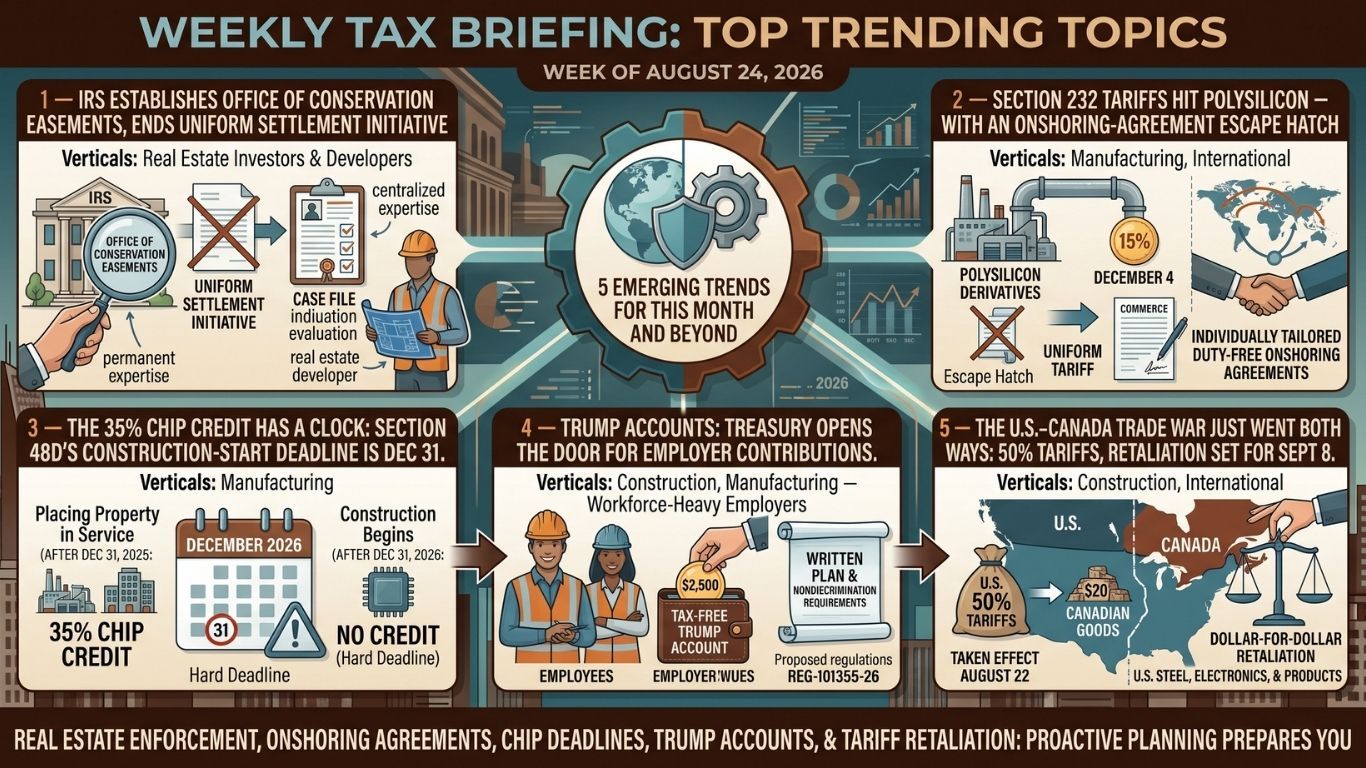
Five developments deserve executive attention this week because each moves a tax, trade, or regulatory concept closer to implementation.
On August 19, the IRS announced the creation of a permanent Office of Conservation Easements and ended the standardized settlement-letter approach used earlier this year.
Manufacturers dependent on polysilicon and related products now have until December to prepare for a new minimum-import-price regime and additional Section 232 duties but companies committing to new U.S. production may have another option.
Semiconductor companies face an even shorter planning runway: the Section 48D Advanced Manufacturing Investment Credit is now 35% for qualifying property placed in service after 2025, but qualifying construction generally cannot begin after December 31, 2026.
Treasury and the IRS are also proposing rules that would allow employers to contribute up to $2,500 annually on a tax-favored basis to Trump Accounts for employees or their dependents, provided the benefit is established under a compliant written program.
Finally, the U.S.–Canada trade dispute has escalated. New U.S. tariffs are now in effect on targeted Canadian goods, while Canada has announced retaliatory measures beginning September 8.
The common thread is not taxation alone. It is positioning.
Businesses that evaluate these changes while implementation details are still actionable retain options that disappear once deadlines pass.

1. The IRS Creates a Permanent Office of Conservation Easements
On August 19, the IRS announced the establishment of a dedicated Office of Conservation Easements.
The development deserves attention from real estate investors, landowners, partnerships, developers, and advisors involved in conservation or historic-preservation easement transactions.
Earlier in 2026, the IRS introduced a time-limited settlement initiative designed to resolve certain conservation-easement disputes. The agency has now concluded that standardized, unsolicited settlement letters with fixed response periods are not well suited to the variety of cases it encounters.
The new office will centralize:
- Technical expertise
- Enforcement strategy
- Policy development
- Case-resolution coordination
- Interaction with IRS Chief Counsel
- Stakeholder engagement
That is a meaningful institutional shift.
It suggests conservation-easement enforcement is not disappearing.
It is becoming more specialized.
For taxpayers with legitimate conservation arrangements, specialization may ultimately create greater consistency.
For partnerships involved in aggressive valuation structures, complex promoter arrangements, or unresolved disputes, it also means the IRS is concentrating expertise in precisely the area being examined.
Questions Leadership Should Ask
- Do any of our entities hold or participate in conservation or historic-preservation easements?
- Are valuations supported by defensible independent evidence?
- Have partnership agreements, insurance arrangements and transaction documentation been reviewed together?
- Are there unresolved examinations or litigation positions that should be reconsidered?
- Does our documentation demonstrate genuine conservation purpose rather than simply a targeted tax result?
When the IRS creates a permanent specialized enforcement office, leadership should assume the issue has moved from temporary initiative to long-term institutional priority.
2. Polysilicon Tariffs Come With Something Unusual: An Onshoring Alternative
An August 6 presidential proclamation under Section 232 established a new trade regime for polysilicon and its derivatives.
Beginning December 4, 2026, covered imports will become subject to minimum import prices, and many downstream polysilicon derivatives will face an additional 15% tariff, subject to country-specific treatment and other provisions.
The minimum import prices include:
- $21 per kilogram for polysilicon
- $100 per kilogram for polysilicon ingots and wafers
- $0.22 per watt for solar cells
- $0.38 per watt for solar modules
For semiconductor, solar and advanced-manufacturing supply chains, that alone would justify attention.
But the more strategically interesting provision is the onshoring program.
The Commerce Secretary is authorized to approve company-specific plans for businesses committing to build, expand or refurbish U.S. production capacity for polysilicon, ingots, wafers and cells.
Companies with approved plans may be allowed to import qualifying production equipment and covered products in specified volumes without paying otherwise applicable Section 232 duties, subject to progress toward their domestic manufacturing commitments.
That changes the executive question considerably.
Instead of simply asking:
"How much will these tariffs cost us?"
certain manufacturers should also be asking:
"Would committing capital to U.S. capacity create a better long-term economic outcome?"
Questions Leadership Should Ask
- How much of our supply chain will be affected beginning December 4?
- Have we modeled the minimum-import-price rules separately from the additional tariff?
- Are we planning U.S. production investments that could support an onshoring application?
- What capital commitments would be commercially reasonable even without the tariff relief?
- How would domestic production affect our tax incentives, financing and supply-chain risk beyond the Section 232 benefit?
The strongest tariff strategy may not be finding a cheaper import. It may be changing where the company produces.
3. The 35% Section 48D Semiconductor Credit Has a December 31 Clock
For semiconductor manufacturers, one of the largest current federal investment incentives has become more valuable—and more time-sensitive.
The Section 48D Advanced Manufacturing Investment Credit applies to qualified investment in facilities whose primary purpose is manufacturing semiconductors or semiconductor manufacturing equipment in the United States.
For qualifying property placed in service after December 31, 2025, the credit rate increases from 25% to 35%.
That is meaningful.
A qualifying $100 million investment could potentially produce a $35 million credit before considering the detailed eligibility rules.
But there is a hard boundary:
The credit generally cannot be claimed for property whose construction begins after December 31, 2026.
For companies still evaluating semiconductor expansion projects, four months is not much time.
The credit generally applies to depreciable or amortizable tangible property integral to an advanced manufacturing facility. Certain office, administrative and unrelated building areas do not qualify.
Eligible taxpayers may also have elective-payment opportunities, subject to registration and filing requirements.
This makes the next several months a coordination exercise involving:
- Tax
- Engineering
- Construction
- Legal
- Finance
- Government incentives teams
Questions Leadership Should Ask
- Has construction technically begun under the applicable Section 48D rules?
- Which portions of the planned investment qualify?
- Are project schedules aligned with the December 31 deadline?
- Have elective-payment requirements been incorporated into the project plan?
- Are prohibited-foreign-entity restrictions relevant to ownership or supply-chain arrangements?
- Would delaying the project materially reduce its after-tax return?
A 35% credit can materially change project economics, but only if the company satisfies the rules before the construction window closes.
4. Trump Accounts Move From Family Planning Tool to Employer Benefit
Trump Accounts have largely been discussed as a new investment vehicle for children.
Treasury's proposed regulations issued August 11 introduce a second dimension:
employer-sponsored contributions.
Under proposed Section 128 regulations, an employer may contribute up to $2,500 per year on a tax-favored basis to the Trump Account of an employee or an employee's dependent.
But this is not simply another payroll payment.
To qualify, an employer contribution program generally must operate through a separate written plan maintained for the exclusive benefit of employees.
The program must provide contributions to qualifying Trump Accounts and satisfy applicable requirements, including nondiscrimination rules intended to prevent the benefit from disproportionately favoring highly compensated employees or their dependents.
For construction and manufacturing companies competing for skilled labor, the strategic question is whether this can eventually become part of the employee-value proposition.
A $2,500 annual contribution may not replace retirement or health benefits.
But for employees raising families, it could become a differentiated benefit with a relatively easy-to-understand purpose: helping build long-term assets for their children.
Because the regulations remain proposed, companies should evaluate the concept carefully rather than rush into implementation.
Comments are due September 25, and a public hearing is scheduled for October.
Questions Leadership Should Ask
- Could Trump Account contributions improve our recruiting or retention strategy?
- Which employees and dependents would be eligible?
- Can the program satisfy nondiscrimination requirements across our workforce?
- How would contributions interact with our existing benefits budget?
- Who would administer account verification and contributions?
- Should we wait for final regulations before formally adopting a program?
A tax-favored benefit creates the most value when it solves a real workforce problem, not simply because the tax code permits it.
5. U.S.–Canada Trade Tensions Are Now Running in Both Directions
The U.S.–Canada trade dispute entered a more consequential phase over the weekend.
After negotiations failed to produce an agreement, the United States moved forward with 50% tariffs affecting roughly $20 billion of specified Canadian goods.
Canada has responded by announcing retaliatory tariffs beginning September 8, targeting U.S. exports on what Prime Minister Mark Carney has described as a dollar-for-dollar basis.
For businesses operating integrated North American supply chains, this creates a problem that is fundamentally different from a one-way import tariff.
A manufacturer may import Canadian materials while simultaneously selling finished products back into Canada.
A construction supplier may source steel, equipment or components north of the border while serving Canadian customers through a related entity.
When both sides impose tariffs, the cost can appear at multiple points in the same supply chain.
Potential consequences include:
- Higher material costs
- Reduced export competitiveness
- Supplier renegotiations
- Inventory timing decisions
- Customer repricing
- Contract disputes
- Working-capital pressure
- Reconsideration of sourcing and production locations
And the situation remains fluid.
Additional U.S. automotive tariff threats announced August 24 illustrate how quickly the negotiating environment can move.
Questions Leadership Should Ask
- What percentage of our revenue and procurement touches Canada?
- Are we exposed on both inbound and outbound transactions?
- Which contracts allow tariff-driven repricing?
- Should inventory timing change before September 8?
- Are alternative U.S., Canadian or third-country suppliers economically viable?
- Could existing entity or transfer-pricing structures amplify the impact?
- Does the current forecast include both U.S. tariffs and Canadian retaliation?
When tariffs move in both directions, trade policy stops being a procurement issue and becomes an enterprise-wide margin issue.
Executive Perspective
This week's developments are less about reacting to headlines than recognizing when institutions are setting the rules that businesses will operate under for years.
The IRS is creating permanent expertise around conservation easements.
Commerce is designing a trade policy that explicitly rewards companies willing to commit capital to domestic production.
Section 48D places a hard deadline on semiconductor construction decisions.
Treasury is defining how a new employer benefit could operate.
And the U.S.–Canada relationship is moving from tariff threats into reciprocal economic consequences.
Leadership teams do not need to chase every federal announcement.
They do need a process for distinguishing between noise and developments that change the economics of an existing decision. That is the value of proactive tax strategy.
The objective is not predicting every policy change. It is maintaining enough visibility and flexibility to act while choices still exist.
Frequently Asked Questions
What is the new IRS Office of Conservation Easements?
The IRS established the Office of Conservation Easements on August 19, 2026, to centralize technical expertise, policy, enforcement and case-resolution strategy involving conservation and historic-preservation easements.
When do the new polysilicon tariffs take effect?
The new Section 232 minimum-import-price program and additional tariffs generally take effect for covered goods entered for consumption on or after December 4, 2026.
What is the Section 48D semiconductor credit rate in 2026?
The Advanced Manufacturing Investment Credit is generally 35% of qualified investment for qualifying property placed in service after December 31, 2025.
What is the Section 48D construction deadline?
The Section 48D credit generally does not apply when construction of the qualified property begins after December 31, 2026.
Can employers contribute to Trump Accounts?
Under proposed Treasury and IRS regulations, employers may establish qualifying written programs and make up to $2,500 per employee per year in tax-favored contributions to Trump Accounts belonging to an employee or the employee's dependents, subject to applicable requirements.
When do Canada's retaliatory tariffs begin?
Canada has announced retaliatory tariffs on U.S. goods beginning September 8, 2026, following the latest escalation in U.S.–Canada trade measures.
About Freese, Peralez & Associates
Freese, Peralez & Associates is a tax-focused CPA firm located in The Woodlands, Texas, serving growth-focused businesses throughout Texas and across the United States.
We specialize exclusively in:
- Strategic Tax Planning
- Tax Consulting
- Business Tax Preparation
Our clients generally generate between $1 million and $100 million in annual revenue and frequently operate through multiple entities, across multiple states, or within increasingly complex domestic and international tax environments.
We work extensively with organizations in the construction, manufacturing, real estate development and international business sectors.
Continue the Conversation
This week's Brief illustrates an important distinction between compliance and strategy.
Compliance asks what the rules require once they apply.
Strategy asks whether the business can still influence the outcome before the rules lock in the decision.
If your organization is evaluating manufacturing expansion, semiconductor investment, cross-border sourcing, workforce benefits, real estate transactions or complex multi-entity activity, these conversations are worth having before year-end.
If you are not currently an FPA client, visit our Contact Us page and complete the form to schedule a confidential discovery call.
We would welcome the opportunity to learn more about your business and determine whether proactive tax planning can help protect cash flow, preserve margins and support your next stage of growth.
Coming Next Week
Our team continues monitoring:
- IRS and Treasury guidance
- Manufacturing and CHIPS incentives
- International trade developments
- U.S.–Canada tariff activity
- Real estate tax enforcement
- Employer-benefit rules
- Construction and manufacturing policy
- Multi-state and international developments affecting growth companies
Because the best time to evaluate an opportunity is usually before its terms are permanent.