
5 Tax Decisions With Deadlines Approaching
5 Tax Decisions With Deadlines Approaching
Follow FPA in Google
Get more timely tax insights from Freese, Peralez & Associates in Google Search.
Add FPA as a Preferred Source →FPA Executive Tax Brief™
Strategic Tax Intelligence for Growth-Focused Businesses
Issue No. 007 | Week of August 31–September 6, 2026
Estimated Reading Time: 8 Minutes
Executive Snapshot
Who Should Read This
✔ CEOs
✔ CFOs
✔ Controllers
✔ Construction Executives
✔ Manufacturing Leaders
✔ Real Estate Developers & Investors
✔ International Business Leaders
✔ Multi-Entity Business Owners
This Week at a Glance
| Development | Primary Industry | Priority |
|---|---|---|
| Section 163(j) Interest Limitation Changes | Construction / Real Estate / Leveraged Businesses | 🔴 Immediate Review |
| FIRE Retirement & Mandatory IRIS Transition | International / Multi-Entity Businesses | 🔴 Immediate Review |
| Opportunity Zones 2.0 & Rural Incentives | Real Estate Investment / Development | 🟡 Consider Action |
| Section 45X Material Assistance Rules | Manufacturing | 🔴 Immediate Review |
| Q4 Interest Rates & September 15 Estimated Taxes | All Verticals | 🔴 Immediate Review |
Weekly Executive Theme
The Rules Are Moving From Legislation Into Execution
The first stage of major tax legislation generates headlines.
The second stage determines what businesses actually have to do.
That is where we are now.
The One Big Beautiful Bill Act changed numerous provisions affecting growth-focused businesses. Treasury and the IRS are increasingly filling in the mechanics surrounding those changes.
At the same time, longstanding systems and strategies are being reconsidered.
A real estate election once considered effectively permanent now has a transitional withdrawal opportunity.
The federal information-return system businesses have relied on for years is being retired.
Opportunity Zones are moving into a permanent framework with enhanced rural incentives.
Manufacturers claiming Section 45X credits have new sourcing calculations to understand.
And businesses are approaching another estimated-tax deadline while IRS underpayment rates remain elevated.
The strategic advantage increasingly belongs to businesses that translate new rules into operational decisions before the deadline forces the issue.
Executive Overview
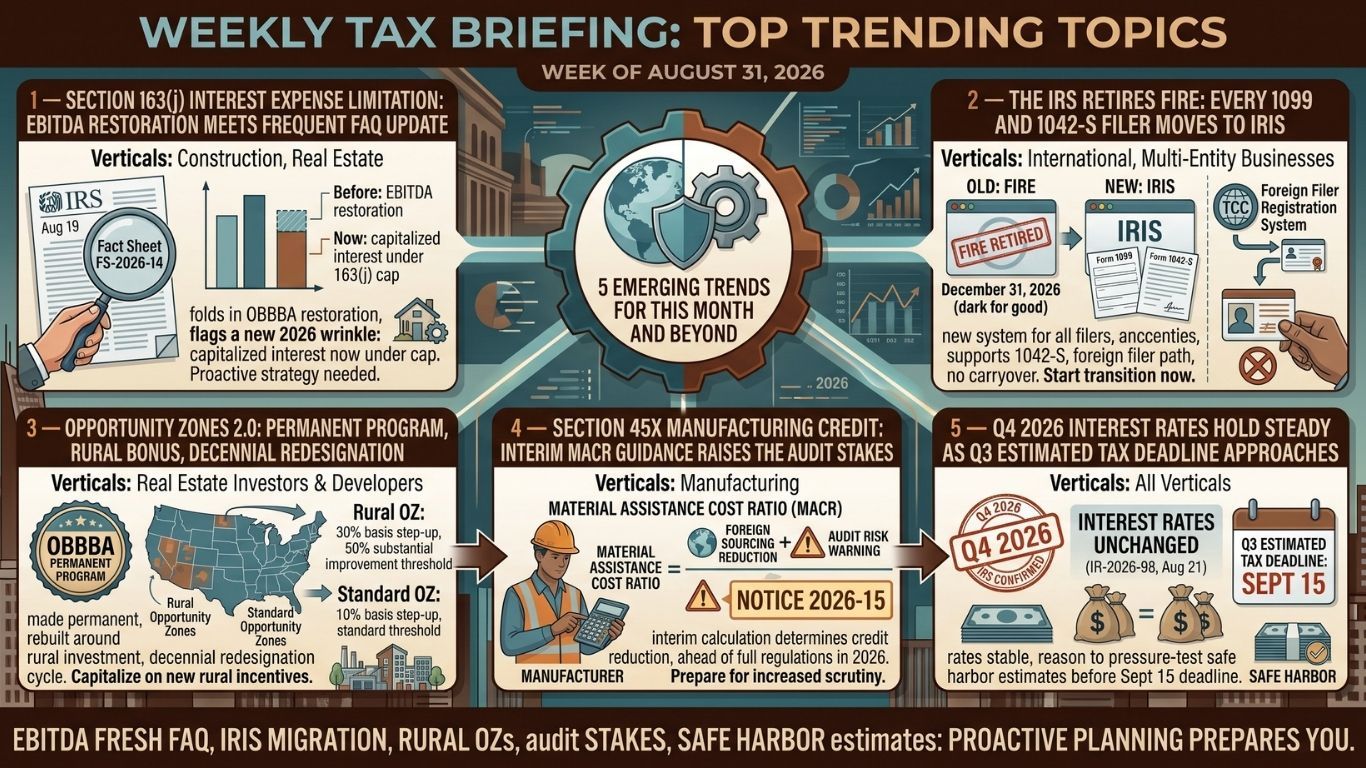
Five developments deserve leadership attention this week.
On August 19, the IRS updated its Section 163(j) guidance to reflect OBBBA changes to the business interest-expense limitation, including the restoration of depreciation, amortization and depletion add-backs when calculating adjusted taxable income.
For real estate businesses that previously elected out of Section 163(j), separate transition guidance also creates an opportunity to revisit a decision that historically was generally irrevocable.
Meanwhile, the IRS is preparing to shut down the FIRE information-return filing system. Businesses using FIRE must move to IRIS, with the last FIRE filing date arriving November 19.
Opportunity Zones are undergoing an even larger transformation. The OBBBA made the incentive permanent, established recurring designation cycles and created enhanced benefits for qualifying rural investments.
Manufacturers face another technical change through Section 45X, where prohibited-foreign-entity sourcing can affect whether eligible components qualify for valuable production credits.
Finally, the IRS confirmed that interest rates will remain unchanged during Q4 while calendar-year taxpayers approach the September 15 estimated-tax deadline.
Different provisions. Different industries. Same leadership question:
What needs to happen now so this does not become a problem later?

1. Section 163(j): EBITDA-Based Interest Capacity Is Back but the Analysis Is Not Simple
The IRS updated FS-2026-14 on August 19 to incorporate OBBBA changes and clarifications to the Section 163(j) business interest-expense limitation.
For many capital-intensive businesses, the biggest change occurred earlier under the new law but is now reflected directly in current IRS guidance.
For tax years beginning after December 31, 2024, depreciation, amortization and depletion deductions are again added back when calculating Adjusted Taxable Income (ATI).
In practical terms, the calculation once again resembles an EBITDA-based limitation rather than the more restrictive EBIT-style approach that applied from 2022 through 2024.
Because Section 163(j) generally limits deductible business interest expense to business interest income plus 30% of ATI, increasing ATI can increase the amount of interest a leveraged business may currently deduct.
That matters to:
- Real estate developers
- Construction companies
- Private-equity-backed businesses
- Highly leveraged manufacturers
- Acquisition structures
- Businesses financing major capital projects
But there is another important issue.
Current IRS guidance clarifies that Section 163(j) generally applies to business interest expense regardless of whether that interest would otherwise be deducted or capitalized under another mandatory or elective capitalization provision, except for interest capitalized under Sections 263(g) or 263A(f).
For companies with substantial construction or development activity, that distinction deserves careful review.
A Second Opportunity for Real Estate Businesses
There is another reason this matters now.
Certain real property trades or businesses can elect to be excepted from Section 163(j).
Historically, that election was generally irrevocable and came with a significant tradeoff: specified real property must use the Alternative Depreciation System, and affected assets are not eligible for Section 168(k) bonus depreciation.
With OBBBA restoring a more favorable ATI calculation and making changes to bonus depreciation, some businesses may view that prior election differently today.
Revenue Procedure 2026-17 provides transitional circumstances in which qualifying taxpayers may withdraw certain prior elections.
Questions Leadership Should Ask
- How much additional interest capacity does the restored ATI calculation create for us?
- Are we carrying forward previously disallowed business interest expense?
- Did any entity previously elect to be an excepted real property trade or business?
- Should that election be reconsidered under the new rules?
- How would withdrawing the election affect depreciation and bonus-depreciation opportunities?
- Are capitalization policies coordinated with our Section 163(j) calculation?
A financing structure designed around the old interest limitation deserves another look now that the economics of Section 163(j) have changed.
2. The IRS Is Retiring FIRE: Information Return Filers Need to Move to IRIS
One of the IRS's longest-running electronic filing systems is approaching retirement.
The Filing Information Returns Electronically system—FIRE—will no longer be the filing platform for information returns after 2026.
Businesses currently using FIRE must transition to the Information Returns Intake System (IRIS) for the 2027 filing season.
And the transition requires more than changing a website bookmark.
Existing FIRE credentials do not automatically authorize a business to file through IRIS.
Current users must complete an IRIS application for a Transmitter Control Code (TCC).
That creates an operational deadline for:
- Payroll departments
- Accounts-payable teams
- Multi-entity businesses
- Tax departments
- Foreign withholding agents
- Third-party filing providers
IRIS now supports numerous information returns, including the Form 1099 series and Form 1042-S, making the transition particularly relevant to businesses making payments to foreign persons.
Non-U.S.-based filers also have access to a Foreign Filer TCC Registration process.
Key FIRE Dates
November 1, 2026 — Last day to file test information returns through the FIRE test system.
November 9, 2026 — Last day to make changes to existing FIRE TCC applications.
November 19, 2026 at 3 p.m. ET — Last day to file information returns through FIRE.
After January 1, 2027, IRIS becomes the IRS electronic filing system for applicable information returns, including current-year returns, prior-year returns and corrections.
Questions Leadership Should Ask
- Which entities currently use FIRE?
- Are filings handled internally or by an outside provider?
- Has an IRIS TCC application already been completed?
- Are authorized users established correctly?
- Do we file Forms 1042-S for foreign recipients?
- Have payroll, accounts payable and tax teams tested the new workflow before year-end?
A filing-system migration becomes a compliance problem when businesses discover during January reporting season that their old credentials no longer work.
3. Opportunity Zones 2.0: The Program Is Permanent and Rural Investments Get More
The Qualified Opportunity Zone program is no longer simply approaching an expiration date.
The OBBBA transformed it into a permanent investment framework.
Beginning in 2027, new Opportunity Zone designations will take effect, with additional designation rounds generally occurring every 10 years.
That creates something investors did not have under the original program:
Long-term visibility.
But one of the most significant changes involves rural Opportunity Zones.
For qualifying investments made after December 31, 2026, an investor generally receives a 10% basis increase after holding the qualifying investment for five years.
For investments in a Qualified Rural Opportunity Fund, that basis increase rises to 30%.
That is a substantial difference.
The OBBBA also reduces the substantial-improvement requirement for property located entirely within qualifying rural Opportunity Zones.
Instead of generally requiring improvements exceeding 100% of the property's adjusted basis, the rural threshold is 50%.
That potentially changes the economics of redevelopment projects that may have struggled to satisfy the original improvement test.
Why Developers Should Be Watching Now
The next Opportunity Zone map is being built now.
States are nominating eligible census tracts for designations that begin January 1, 2027.
For developers and investment groups evaluating land, redevelopment opportunities or future fund structures, that creates a planning opportunity before the new program fully begins.
Questions Leadership Should Ask
- Are any markets in our development pipeline eligible for the next Opportunity Zone designation cycle?
- Could rural projects become more attractive under the 30% basis increase?
- Does the reduced 50% improvement requirement change previously marginal redevelopment opportunities?
- Should site acquisition decisions wait until new designations are finalized?
- How should Opportunity Zone benefits be incorporated into our overall investment underwriting?
Opportunity Zones 2.0 should not be viewed as an extension of the old program; the rural incentives and recurring designation cycle create a materially different investment framework.
4. Section 45X Manufacturing Credits Now Require More Supply-Chain Math
The Section 45X Advanced Manufacturing Production Credit can provide substantial benefits to domestic manufacturers producing eligible components.
But OBBBA restrictions involving Prohibited Foreign Entities (PFEs) mean manufacturers increasingly need to understand not just what they produce—but where the materials and components used in production come from.
IRS Notice 2026-15 provides interim guidance for determining whether an eligible component receives impermissible material assistance from a prohibited foreign entity.
Central to that analysis is the Material Assistance Cost Ratio (MACR).
At a high level, the calculation compares qualifying direct material costs that are not attributable to prohibited foreign entities against total direct material costs.
Whether an eligible component satisfies the applicable threshold can determine whether the manufacturer remains eligible for the Section 45X credit.
For manufacturers with complex international supply chains, that turns sourcing information into tax-credit documentation.
It may require companies to understand:
- Supplier identity
- Country of origin
- Direct material costs
- Component sourcing
- PFE status
- Applicable safe-harbor rules
The IRS has indicated that additional regulations and safe-harbor guidance are expected.
Until then, taxpayers may rely on specified interim rules for eligible Section 45X components sold during applicable periods.
Why Documentation Matters
A valuable manufacturing credit creates little benefit if the taxpayer cannot substantiate eligibility.
Manufacturers claiming Section 45X should therefore consider whether procurement, accounting and tax systems are capturing the information necessary to support the MACR calculation.
This is particularly important for companies whose supply chains include China or other jurisdictions and entities potentially affected by the PFE restrictions.
Questions Leadership Should Ask
- Which eligible components currently generate Section 45X credits?
- Can we identify the origin and cost of the direct materials used in those components?
- Have suppliers been evaluated for potential PFE status?
- Are procurement and tax teams working from the same sourcing data?
- Could alternative sourcing preserve a tax credit that might otherwise be lost?
- Is documentation being retained contemporaneously in anticipation of future examination?
When tax-credit eligibility depends on the supply chain, procurement decisions become tax decisions.
5. IRS Interest Rates Stay at 7% as September 15 Approaches
The IRS announced on August 21 that interest rates will remain unchanged for the fourth quarter of 2026.
For Q4:
- The general underpayment rate remains 7%
- The individual overpayment rate remains 7%
- The corporate overpayment rate remains 6%
- The large corporate underpayment rate remains 9%
- Corporate overpayments exceeding $10,000 remain subject to a 4.5% rate on the applicable portion
These rates are compounded daily.
For CFOs, the immediate relevance is not simply knowing the percentage.
It is the approaching September 15 estimated-tax deadline.
Calendar-year corporations generally make their third estimated-tax installment on September 15.
Individuals—including many owners of pass-through businesses—also face a September 15 estimated-tax payment date for the applicable payment period.
For companies whose profitability has changed materially during 2026, relying blindly on an estimate prepared months ago may create unnecessary exposure.
This Is Particularly Relevant When:
- Revenue significantly exceeded forecast
- Margins changed
- A major asset was sold
- Bonus depreciation materially changed taxable income
- R&D deductions or credits changed
- Interest deductions changed under Section 163(j)
- Partnership or S corporation income shifted
- Estimated payments were based on outdated projections
Large corporations should be especially careful when considering prior-year tax assumptions because the estimated-tax rules restrict the ability of large corporations to rely on the prior year's tax beyond the first installment.
Questions Leadership Should Ask
- Does our current estimated-tax forecast reflect year-to-date results?
- Have OBBBA changes been incorporated into the projection?
- Are significant transactions through August included?
- Are entity-level and owner-level estimates coordinated?
- Are we holding excess cash while simultaneously exposing the company or owners to underpayment interest?
- Should annualized-income or other permissible methods be evaluated?
September 15 should be treated as a forecasting checkpoint not simply another payment date on the tax calendar.
Executive Perspective
This week's developments demonstrate why the distinction between tax compliance and tax strategy matters.
Section 163(j) is not merely an interest-deduction calculation when a prior election can affect depreciation strategy.
IRIS is not merely a new IRS website when a business's information-return infrastructure depends on obtaining new credentials before FIRE disappears.
Opportunity Zones are not simply a real estate incentive when new rural provisions can change project underwriting.
Section 45X is not simply a manufacturing credit when supplier decisions can determine eligibility.
And estimated taxes are not simply quarterly payments when the underlying forecast has changed materially since the last calculation.
Each rule becomes more valuable—or more dangerous—when it intersects with an operational decision.
That is why proactive tax planning should happen throughout the year.
The objective isn't simply to file correctly after decisions have been made. It is to understand the tax consequences while leadership still has choices.
Frequently Asked Questions
What changed with Section 163(j) under the OBBBA?
For tax years beginning after December 31, 2024, depreciation, amortization and depletion are again added back when calculating adjusted taxable income for purposes of the Section 163(j) business interest-expense limitation.
When does the IRS FIRE system shut down?
The last day to file information returns through FIRE is November 19, 2026 at 3 p.m. Eastern Time. IRIS becomes the electronic filing system for applicable information returns after January 1, 2027.
Do FIRE credentials transfer to IRIS?
No. Existing FIRE users must separately apply for authorization to use IRIS, including obtaining the appropriate IRIS Transmitter Control Code.
Are Opportunity Zones permanent now?
Yes. The OBBBA made the Opportunity Zone incentive permanent and establishes new designation rounds beginning in 2027 and generally recurring every 10 years.
What is the new rural Opportunity Zone benefit?
For qualifying investments after December 31, 2026, investments in Qualified Rural Opportunity Funds can receive a 30% basis increase after five years, compared with 10% for qualifying non-rural investments. Rural Opportunity Zone property also benefits from a reduced 50% substantial-improvement threshold.
What is the IRS underpayment interest rate for Q4 2026?
The general IRS underpayment interest rate remains 7% annually, compounded daily, for the fourth quarter of 2026. Large corporate underpayments are subject to a 9% rate.
About Freese, Peralez & Associates
Freese, Peralez & Associates is a tax-focused CPA firm located in The Woodlands, Texas, serving growth-focused businesses throughout Texas and across the United States.
We specialize exclusively in:
- Strategic Tax Planning
- Tax Consulting
- Business Tax Preparation
Our clients generally generate between $1 million and $100 million in annual revenue and frequently operate through multiple entities, across multiple states, or within increasingly complex domestic and international tax environments.
We work extensively with organizations in the construction, manufacturing, real estate development and international business sectors.
Continue the Conversation
The tax rules affecting established businesses increasingly change throughout the year—not simply during filing season.
And in many cases, the most important question isn't whether a new provision applies.
It's whether leadership still has time to influence the outcome.
If your organization is managing significant debt, evaluating real estate investments, claiming manufacturing incentives, operating multiple entities, filing international information returns or preparing for major year-end decisions, now is an appropriate time to review whether your tax strategy reflects the rules currently in effect.
If you are not currently an FPA client, visit our Contact Us page and complete the form to schedule a confidential discovery call.
We would welcome the opportunity to learn more about your business and determine whether proactive tax planning can help protect cash flow, preserve margins and support your next stage of growth.
Coming Next Week
Our team continues monitoring:
- IRS and Treasury OBBBA guidance
- Section 163(j) implementation
- Opportunity Zone 2027 designations
- Manufacturing and Section 45X incentives
- International information reporting
- Construction and real estate tax developments
- Year-end tax planning opportunities
- Federal regulatory changes affecting growth-focused businesses
Because knowing what changed is useful. Knowing what to do before the window closes is strategy.