
5 Tax Decisions Already Affecting 2026
5 Tax Decisions Already Affecting 2026
Follow FPA in Google
Get more timely tax insights from Freese, Peralez & Associates in Google Search.
Add FPA as a Preferred Source →FPA Executive Tax Brief™
Strategic Tax Intelligence for Growth-Focused Businesses
Issue No. 009 | Week of September 14–20, 2026
Estimated Reading Time: 8 Minutes
Executive Snapshot
Who Should Read This
✔ CEOs
✔ CFOs
✔ Controllers
✔ Construction Executives
✔ Manufacturing Leaders
✔ Real Estate Investors & Developers
✔ International Business Leaders
✔ Multi-Entity Business Owners
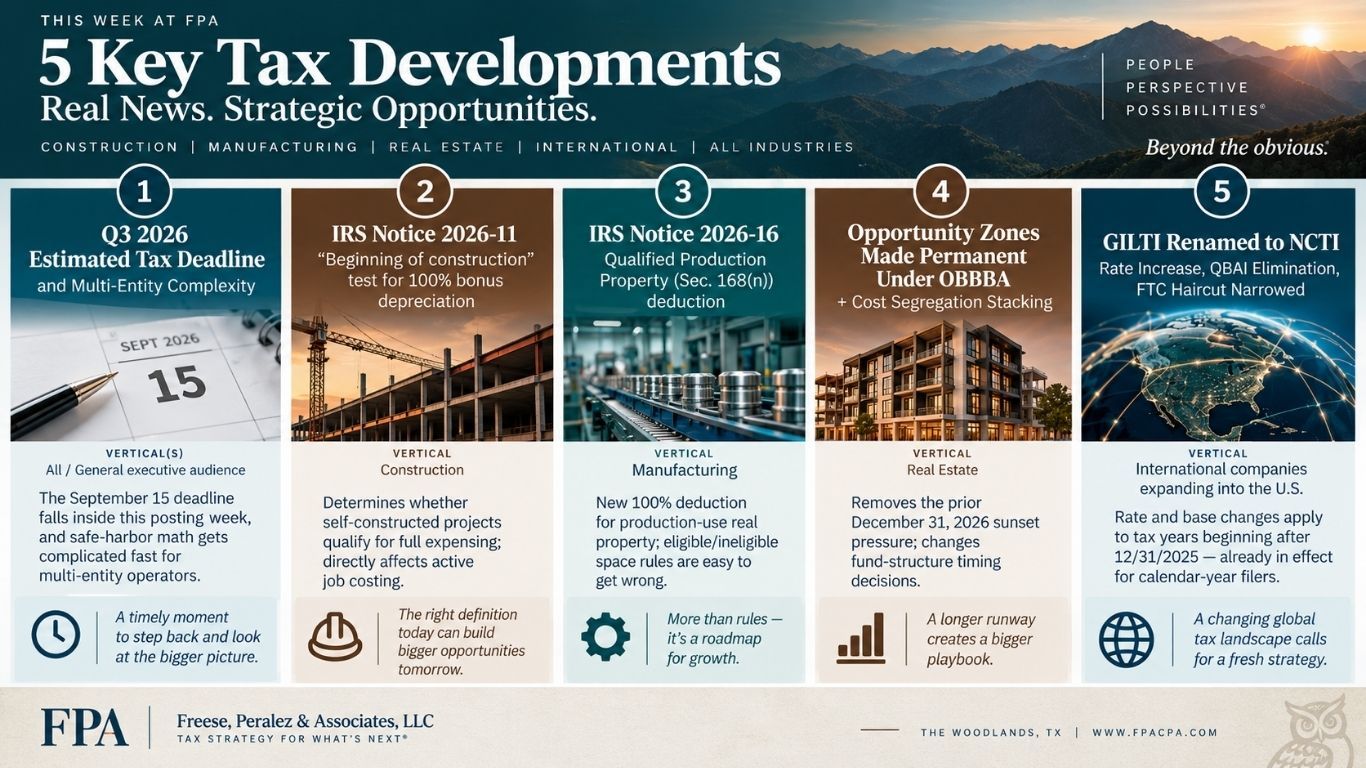
This Week at a Glance
| Development | Primary Industry | Priority |
|---|---|---|
| September 15 Estimated-Tax Deadline | All Verticals / Multi-Entity Businesses | 🔴 Immediate Review |
| 100% Bonus Depreciation & Self-Constructed Property | Construction / Capital-Intensive Businesses | 🔴 Immediate Review |
| Section 168(n) Qualified Production Property | Manufacturing | 🔴 Immediate Review |
| Permanent Opportunity Zones & Cost-Segregation Planning | Real Estate | 🟡 Consider Action |
| GILTI Transition to Net CFC Tested Income | International / Multinational Businesses | 🔴 Immediate Review |
Weekly Executive Theme
The Tax Rules Have Changed. The Operating Model Has to Catch Up.
Many of the biggest tax provisions enacted under the One Big Beautiful Bill Act are no longer theoretical.
They are already affecting 2026 calculations.
That matters because the difference between knowing about a tax change and actually benefiting from it often comes down to operational details.
A construction company may qualify for 100% bonus depreciation, but acquisition and construction timing still matter.
A manufacturer may have access to a new 100% deduction on production real estate but only the qualifying portions of the facility count.
A real estate investor may hear that Opportunity Zones are now permanent but legacy investments still face their original December 31, 2026 gain-recognition event.
And a U.S. company with foreign subsidiaries may still be modeling “GILTI” even though the calculation has materially changed for 2026.
The tax law may change in Washington. The value is created when leadership adjusts the business model around it.

1. September 15 Is More Than an Estimated-Tax Payment Date
September 15 is one of the most consequential tax dates of the third quarter.
For calendar-year corporations, it is generally the due date for the third installment of 2026 estimated tax.
For individuals including many owners of partnerships, S corporations and other pass-through businesses, it is also the third estimated-tax payment deadline.
For a simple business structure, that may be relatively straightforward.
For an established owner operating multiple entities, the calculation can become significantly more complicated.
Consider a business owner with:
- Multiple partnerships
- S corporations
- Real estate entities
- Large capital purchases
- Deferred gains
- International activity
- Significant bonus depreciation
- Varying levels of distributions
One change in projected taxable income can affect multiple entities and ultimately change the owner-level tax requirement.
That is why September 15 should not be viewed simply as a payment date.
It should be treated as a forecasting checkpoint.
Safe Harbor Is Not the Same as Tax Planning
Estimated-tax rules may provide ways to limit underpayment exposure, but simply meeting a safe harbor does not necessarily mean the company or owner is positioned efficiently.
A rapidly growing business could satisfy an estimated-payment requirement and still face a substantial April balance due.
Likewise, a business that experienced a weaker year may be unnecessarily tying up cash through outdated estimates.
Questions Leadership Should Ask
- Do our estimates reflect actual year-to-date performance?
- Have major capital purchases been incorporated?
- Are pass-through entities coordinated with owner-level estimates?
- Have recent OBBBA changes been reflected in the forecast?
- Are we expecting gains from asset sales, distributions or other transactions before year-end?
- Are we preserving excess cash unnecessarily through overpayments?
Estimated taxes should reflect the business you are operating today not the forecast you made six months ago.
2. 100% Bonus Depreciation Is Permanent but Construction Timing Still Matters
One of the most significant OBBBA changes for capital-intensive companies is the restoration of permanent 100% bonus depreciation.
IRS Notice 2026-11 provides interim guidance for eligible property acquired after January 19, 2025.
For contractors, developers and companies building assets for their own use, one technical question matters more than it appears:
When was the property actually acquired for bonus-depreciation purposes?
For purchased property, the analysis can often focus on acquisition agreements and contractual obligations.
For self-constructed property, existing bonus-depreciation rules generally look to when manufacturing, construction or production begins.
The regulations generally treat construction as beginning when physical work of a significant nature begins.
There is also a cost-based safe harbor under which significant physical work may be treated as beginning once the taxpayer has incurred or paid more than 10% of the total project cost, excluding land and certain preliminary activities such as planning, design and financing.
Why Construction Companies Should Care
Construction projects rarely begin with a single clean date.
There may be:
- Design work
- Preconstruction services
- Equipment deposits
- Site preparation
- Fabrication
- Off-site component construction
- Mobilization
- Physical construction
Those activities do not necessarily carry the same significance under the tax rules.
Notice 2026-11 also permits taxpayers in certain circumstances to elect to treat qualifying acquired or self-constructed components of a larger self-constructed property separately for purposes of bonus depreciation.
That creates planning opportunities but also documentation responsibilities.
Questions Leadership Should Ask
- Which 2025 and 2026 projects contain qualifying depreciable property?
- When did physical construction actually begin?
- Have project costs crossed the applicable safe-harbor threshold?
- Are invoices, contracts and construction schedules sufficient to support the timing?
- Should qualifying components be analyzed separately?
- Are bonus-depreciation assumptions reflected correctly in current job-costing and tax forecasts?
A 100% deduction is only valuable if the business can substantiate when the qualifying property entered the tax rules.
3. Manufacturers Can Now Expense Certain Production Buildings Under Section 168(n)
Manufacturers received something unusual under the OBBBA:
A temporary opportunity to immediately deduct certain nonresidential real property.
Section 168(n) allows taxpayers to elect a special depreciation allowance of up to 100% of the unadjusted depreciable basis of Qualified Production Property, or QPP.
This is significant because buildings generally do not receive the same accelerated treatment available to shorter-lived machinery and equipment.
Qualified Production Property generally must be used as an integral part of:
- Manufacturing
- Chemical production
- Agricultural production
- Refining
and the activity must result in substantial transformation of a qualified product.
The property generally must satisfy several timing requirements, including construction beginning after January 19, 2025 and before January 1, 2029, and placement in service after July 4, 2025 and before January 1, 2031.
The Entire Building May Not Qualify
This is where the planning gets more sophisticated.
Section 168(n) excludes portions of property used for activities such as:
- Offices
- Administrative services
- Lodging
- Parking
- Sales
- Research
- Software development
- Engineering
- Certain storage activities
- Other functions unrelated to the qualifying production activity
The IRS allows reasonable methods to allocate basis between qualifying and nonqualifying portions, including square footage, architectural plans, engineering documentation, construction invoices and cost segregation data.
That makes facility design itself potentially relevant to tax planning.
Questions Leadership Should Ask
- Is the planned facility performing a qualifying production activity?
- Which portions of the property are actually integral to production?
- Have office, engineering, administrative and storage areas been separated?
- Can architectural and cost-segregation records support the allocation?
- Does the project satisfy the construction and placed-in-service dates?
- What happens to projected cash flow if a substantial portion of the building is immediately deductible?
For manufacturers, facility layout is no longer just an operational decision it can directly affect how much of the real estate qualifies for immediate tax recovery.
4. Opportunity Zones Are Permanent but Legacy Investments Still Have a 2026 Tax Event
The Opportunity Zone program is undergoing its largest structural change since it was created.
The OBBBA made the program permanent, with a new round of Opportunity Zone designations beginning January 1, 2027 and future designation cycles generally occurring every 10 years.
That changes the strategic conversation for real estate investors.
The program is no longer something investors need to rush into simply because the entire regime is disappearing.
But there is an important distinction:
The original Opportunity Zone rules still matter for existing investments.
Investors who deferred gains under the original regime generally still recognize those deferred gains no later than December 31, 2026, even if they continue holding the QOF investment.
For new qualifying investments made after December 31, 2026, the redesigned rules generally provide a five-year deferral period tied to the investment date rather than a universal 2026 inclusion date.
Rural Opportunity Zones Become More Attractive
The new framework also creates enhanced incentives for qualified rural investments.
After five years, qualifying investments generally receive a 10% basis increase.
For a Qualified Rural Opportunity Fund, that increase rises to 30%.
The law also reduced the substantial-improvement threshold for property in qualifying rural Opportunity Zones from 100% to 50%.
Where Cost Segregation Fits
Cost segregation does not replace Opportunity Zone requirements.
But where a qualifying QOF or operating business owns depreciable real estate, a properly structured cost-segregation analysis may identify shorter-lived components eligible for accelerated depreciation under otherwise applicable rules.
That creates a broader underwriting conversation:
- Gain deferral
- Long-term appreciation
- Property improvement requirements
- Depreciation timing
- Basis allocation
- Capital planning
These strategies need to be modeled together because one tax benefit can affect the economics of another.
Questions Leadership Should Ask
- Are we holding an original QOF investment with deferred gain that will be recognized in 2026?
- What liquidity will be required for that tax?
- Are we evaluating investments under the old rules or the new 2027 framework?
- Could rural QOZ incentives materially change project returns?
- Does the reduced substantial-improvement threshold alter redevelopment economics?
- Should cost segregation be incorporated into the investment model after the Opportunity Zone structure is established?
Opportunity Zones becoming permanent reduces one kind of deadline pressure—but it makes thoughtful project selection and tax modeling even more important.
5. GILTI Is Now NCTI and the Change Is More Than a New Name
For tax years beginning after December 31, 2025, the international tax regime previously known as Global Intangible Low-Taxed Income, or GILTI, has changed materially.
The new regime is referred to as Net CFC Tested Income, or NCTI.
IRS draft 2026 forms already reflect the new terminology, including Form 8992 and Form 8993.
But this is not simply a branding change.
QBAI Is Eliminated
Under the former GILTI regime, taxpayers generally reduced tested income by a deemed return based on Qualified Business Asset Investment.
That tangible-asset return has been eliminated from the new NCTI calculation.
The result can be especially significant for U.S. companies with capital-intensive foreign subsidiaries.
Under the old rules, large amounts of foreign machinery, plants or other tangible assets could reduce the GILTI inclusion.
Under NCTI, that benefit disappears.
The Section 250 Deduction Changes
For corporate U.S. shareholders, the Section 250 deduction associated with NCTI is now 40%, down from the prior 50%.
At a 21% corporate income-tax rate, that generally produces a 12.6% effective U.S. tax rate before foreign tax credits, compared with 10.5% under the prior 50% deduction.
The Foreign Tax Credit Haircut Improves
There is also a favorable adjustment.
The deemed-paid foreign tax credit percentage increased from 80% to 90%, reducing the foreign tax credit haircut from 20% to 10%. Current IRS guidance confirms the new 90% deemed-paid percentage.
That means the overall impact will vary significantly depending on:
- Foreign effective tax rates
- CFC profitability
- Tangible asset intensity
- Foreign tax credits
- Expense allocation
- Previously taxed earnings and profits
Why This Matters for Companies Expanding Internationally
A foreign investment model prepared under the old GILTI framework may no longer describe the actual 2026 tax cost.
Capital-heavy foreign operations deserve particular attention because removing QBAI can broaden the U.S. inclusion base even where significant operating assets exist overseas.
Questions Leadership Should Ask
- Which foreign subsidiaries are controlled foreign corporations?
- How much did QBAI reduce our prior GILTI inclusion?
- What does the same structure look like under NCTI?
- How much foreign tax is available for the revised 90% deemed-paid credit?
- Have transfer-pricing and entity-structure assumptions been updated for 2026?
- Does the revised regime change where future capital should be deployed?
When the tax base, deduction and foreign tax credit all change at once, last year’s international model should not be reused without recalculation.
Executive Perspective
This week’s five developments have very different technical rules, but they lead to the same executive conclusion.
2026 tax planning is increasingly about timing, classification and coordination.
Estimated taxes require current forecasting.
Bonus depreciation requires acquisition and construction timing.
Qualified Production Property requires distinguishing production space from nonproduction space.
Opportunity Zones require separating legacy 2026 obligations from the new permanent regime.
And NCTI requires multinational companies to rebuild calculations that may have been designed around GILTI.
None of these issues should begin with the tax return.
They begin with decisions already being made inside finance, operations, construction, procurement, real estate and international expansion teams.
That is where proactive tax planning creates value.
The best tax outcome is often determined before anyone opens the tax software.
Frequently Asked Questions
When is the third estimated-tax payment due for 2026?
For calendar-year taxpayers, the third estimated-tax installment is generally due September 15, 2026. This applies to calendar-year corporations and many individuals required to make estimated payments.
Is 100% bonus depreciation permanent again?
Yes. The OBBBA restored permanent 100% additional first-year depreciation for qualifying property generally acquired after January 19, 2025, subject to applicable eligibility and timing rules.
What is Qualified Production Property under Section 168(n)?
Qualified Production Property is generally qualifying nonresidential real property used as an integral part of manufacturing, chemical production, agricultural production or refining. Eligible taxpayers may elect a special depreciation allowance of up to 100% of qualifying basis.
Did Opportunity Zones expire?
No. The OBBBA made the Opportunity Zone incentive permanent, with new designations beginning in 2027 and future designation cycles generally occurring every 10 years. Existing investments under the original regime still generally face the December 31, 2026 deferred-gain recognition rule.
What replaced GILTI?
Beginning with applicable 2026 tax years, the former GILTI regime is now known as Net CFC Tested Income, or NCTI. The calculation also changed materially, including removal of the QBAI-based return and revisions to the Section 250 deduction and foreign tax credit rules.
About Freese, Peralez & Associates
Freese, Peralez & Associates is a tax-focused CPA firm located in The Woodlands, Texas, serving growth-focused businesses throughout Texas and across the United States.
We specialize exclusively in:
- Strategic Tax Planning
- Tax Consulting
- Business Tax Preparation
Our clients generally generate between $1 million and $100 million in annual revenue and frequently operate through multiple entities, across multiple states, or within increasingly complex domestic and international tax environments.
We work extensively with organizations in the construction, manufacturing, real estate development and international business sectors.
Continue the Conversation
The tax provisions affecting established businesses are increasingly intertwined with operational decisions.
When a project begins.
Where production occurs.
How a facility is designed.
When capital is deployed.
Where foreign subsidiaries operate.
Those decisions can influence tax results long before the return is prepared.
If your organization is making substantial capital investments, operating through multiple entities, expanding internationally, developing real estate or preparing for year-end tax decisions, now is an appropriate time to determine whether your 2026 strategy reflects the rules currently in effect.
If you are not currently an FPA client, visit our Contact Us page and complete the form to schedule a confidential discovery call.
We would welcome the opportunity to learn more about your business and determine whether proactive tax planning can help protect cash flow, preserve margins and support your next stage of growth.
Coming Next Week
Our team continues monitoring:
- IRS and Treasury OBBBA guidance
- Bonus depreciation implementation
- Qualified Production Property
- Opportunity Zone 2027 designations
- International NCTI guidance
- Manufacturing incentives
- Construction tax developments
- Year-end planning opportunities for growth-focused businesses
Because understanding the rule is only the beginning.
The real value comes from understanding how the rule changes the decision.