
5 Tax Deadlines & Decisions That Cannot Wait Until April
5 Tax Deadlines & Decisions That Cannot Wait Until April
Follow FPA in Google
Get more timely tax insights from Freese, Peralez & Associates in Google Search.
Add FPA as a Preferred Source →FPA Executive Tax Brief™
Strategic Tax Intelligence for Growth-Focused Businesses
Issue No. 005 | Week of August 17–23, 2026
Estimated Reading Time: 8 Minutes
Executive Snapshot
Who Should Read This
✔ CEOs
✔ CFOs
✔ Controllers
✔ Construction Executives
✔ Manufacturing Leaders
✔ Real Estate Developers
✔ International Business Leaders
✔ Multi-Entity Business Owners
This Week at a Glance
| Development | Primary Industry | Priority |
|---|---|---|
| 2026 Overtime Reporting — W-2 Code TT | Construction / Manufacturing | 🔴 Immediate Review |
| Remittance Tax & Form 5472 Exposure | International / Foreign-Owned U.S. Businesses | 🔴 Immediate Review |
| Manufacturing Input Costs & Canadian Tariffs | Manufacturing / Construction | 🔴 Immediate Review |
| $32M Small-Contractor Accounting Threshold | Construction | 🟡 Consider Action |
| December 31 Opportunity Zone Gain Recognition | Real Estate Investment / Development | 🔴 Immediate Review |
Weekly Executive Theme
The Deadline Is Moving Closer to the Business Decision
For years, many executives could reasonably think of tax as something that happened after the operating year ended.
That model is becoming increasingly difficult to defend.
This week alone, employers need payroll systems capable of identifying a specific type of overtime compensation. Foreign-owned businesses face expensive information-reporting consequences. Manufacturers are managing persistent raw-material inflation while a new tariff becomes effective. Contractors may qualify for accounting methods that materially change income recognition. And original Opportunity Zone investors need to prepare for a tax event that may occur without generating a corresponding cash distribution.
These are not April problems, they are operational decisions with tax consequences attached to them.
The closer tax rules move toward payroll, procurement, contracts, accounting systems and liquidity management, the more valuable year-round planning becomes.
Executive Overview
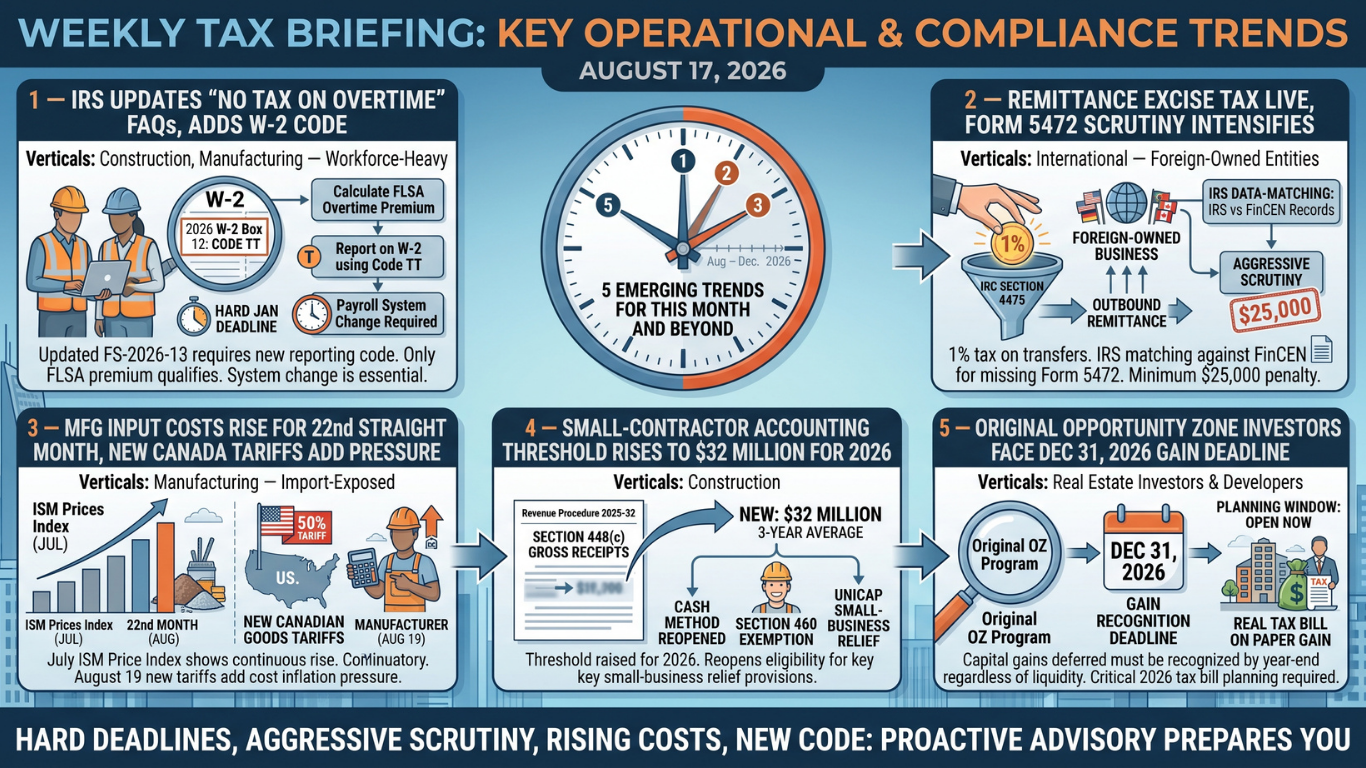
Five developments deserve attention from growth-focused leadership teams this week.
The IRS has updated its guidance on the new deduction for qualified overtime compensation and confirmed that employers must separately report qualifying amounts beginning with 2026 Forms W-2.
Cross-border businesses are operating under a new 1% remittance-transfer excise tax while foreign-owned U.S. entities continue to face potentially severe penalties for missed Form 5472 reporting.
Manufacturers are dealing with their 22nd consecutive month of rising raw-material prices just as new 50% tariffs on specified Canadian products take effect August 19.
Construction companies have a different opportunity to consider: the inflation-adjusted gross-receipts threshold used by several small-business tax provisions increases to $32 million for 2026.
And real estate investors who deferred gains into original Qualified Opportunity Funds face a mandatory recognition event on December 31, 2026 even if the underlying investment remains unsold.
The common thread is timing.
In every case, the business has something to evaluate before the tax return is prepared.

1. “No Tax on Overtime” Now Requires a Payroll-System Response
The IRS updated its qualified-overtime guidance in FS-2026-13 on August 6.
For employers, one requirement deserves immediate attention:
Beginning with tax year 2026, qualified overtime compensation must be separately reported on Form W-2, Box 12, using Code TT.
That sounds simple.
For workforce-heavy construction companies and manufacturers, it may not be.
The deduction does not apply to every dollar an employer casually describes as “overtime.”
Qualified overtime compensation generally represents the portion required under Section 7 of the Fair Labor Standards Act that exceeds the employee’s regular rate.
For a typical employee earning time-and-a-half for hours above 40 in a workweek, that generally means the additional half-time premium, not the entire overtime payment.
Overtime created solely by:
- Company policy
- State law
- A collective bargaining agreement
- Weekend premiums
- Holiday premiums
- Daily overtime rules
may not automatically qualify unless it also represents overtime required under the applicable FLSA rules.
That means payroll systems need to distinguish between different categories of premium pay.
And because Forms W-2 will be prepared shortly after year-end, the time to determine whether payroll software can make that distinction is now.
Questions Leadership Should Ask
- Can our payroll system separately identify FLSA-qualified overtime?
- Are payroll and HR using the same definition of qualifying overtime?
- Have we tested how Code TT will appear on 2026 Forms W-2?
- Do union, daily-overtime or premium-pay arrangements require additional review?
- Who will verify the year-end reported amount before Forms W-2 are issued?
When tax reporting depends on payroll data, discovering the requirement in January is already too late.
2. Cross-Border Compliance: A 1% Remittance Tax and a $25,000 Form 5472 Risk
Foreign-owned U.S. companies have more than one cross-border compliance issue worth reviewing in 2026.
The first is the new IRC Section 4475 remittance-transfer excise tax.
Effective for qualifying transfers occurring after December 31, 2025, Section 4475 imposes a 1% excise tax on certain remittance transfers.
Importantly, the tax is narrower than many headlines suggest.
It generally applies when a sender funds the qualifying remittance using:
- Cash
- A money order
- A cashier’s check
- Or another similar physical instrument
The sender bears the tax, while the remittance-transfer provider generally collects and remits it.
For businesses, this is most relevant when ownership groups, employees or cross-border operations rely on remittance channels that fall within those rules.
But the larger compliance discussion for foreign-owned U.S. companies remains Form 5472.
Certain 25%-foreign-owned U.S. corporations and certain foreign-owned disregarded entities may have Form 5472 reporting obligations when reportable related-party transactions occur.
The consequence of missing that filing is significant:
The initial penalty for failing to file a complete and correct Form 5472 can be $25,000.
Additional continuation penalties may apply when failures remain unresolved after IRS notice.
For a business operating several U.S. entities, this is not an area to manage casually.
Questions Leadership Should Ask
- Which U.S. entities in our structure have foreign ownership?
- Have all related-party transactions been identified?
- Are capital contributions, distributions, loans and management charges being captured correctly?
- Does any part of our cross-border payment process involve transfers subject to Section 4475?
- Who owns international information-reporting compliance across the organization?
International reporting failures can create penalties completely disproportionate to the underlying transaction.
3. Manufacturers Face Their 22nd Straight Month of Rising Input Costs With Another Tariff Arriving
July’s ISM Manufacturing Prices Index registered 71.1, indicating that raw-material prices increased for the 22nd consecutive month.
That alone deserves attention.
But manufacturers are also approaching another cost variable.
On August 19, new Section 338 tariffs impose an additional 50% duty on specified Canadian-origin goods, including certain cement, motor vehicles, dairy products and alcoholic beverages.
Covered products are subject to the additional duty regardless of whether they otherwise qualify as originating goods under USMCA, although important product exclusions remain.
For manufacturers and contractors dependent on Canadian supply chains, the issue is larger than customs compliance.
It affects:
- Gross-margin forecasting
- Supplier negotiations
- Inventory timing
- Customer pricing
- Capital purchasing
- Fixed-price contracts
- Cash requirements
This arrives at a time when manufacturers are already reporting sustained cost increases.
A margin model created six months ago may no longer describe the economics of the business today.
Questions Leadership Should Ask
- Which inputs continue experiencing the greatest price pressure?
- How much Canadian-origin exposure exists within our direct and indirect supply chain?
- Have August 19 tariff changes been incorporated into current forecasts?
- Can pricing be adjusted quickly enough to preserve margin?
- Do contracts address unexpected tariff-driven increases?
- Should purchasing schedules change before additional inventory commitments are made?
Revenue growth means little if input-cost inflation and tariffs quietly consume the margin underneath it.
4. The Small-Contractor Gross-Receipts Threshold Increases to $32 Million
For tax years beginning in 2026, the inflation-adjusted gross-receipts threshold under IRC Section 448(c) rises to $32 million.
The calculation generally looks at average annual gross receipts during the prior three-tax-year period.
For construction companies hovering around that threshold, this deserves more attention than it usually receives.
Why?
Because the Section 448(c) gross-receipts test is incorporated into several tax provisions affecting smaller businesses and contractors.
Depending on the company’s facts, satisfying the test may influence eligibility for:
- The cash method of accounting
- The small-contractor exception from the Section 460 percentage-of-completion method
- Certain UNICAP exemptions
For long-term construction contracts, the Section 460 exception also includes additional requirements, including the expected contract-completion period.
The important point is that $32 million is not simply another inflation adjustment.
For a contractor that previously exceeded the threshold, the new limit may justify reevaluating accounting-method eligibility.
That does not mean a company should automatically change methods.
Nor does a change occur simply because revenue falls within the threshold.
Accounting-method changes may require additional procedural steps and modeling.
But for contractors near the line, there may be a meaningful cash-flow conversation to have.
Questions Leadership Should Ask
- What is our three-year average gross receipts calculation for 2026?
- Are related entities required to be aggregated when applying the test?
- Do any long-term contracts satisfy the separate Section 460 requirements?
- Would a different permissible accounting method improve cash-flow timing?
- What are the financial-statement and tax consequences of changing methods?
Crossing an accounting threshold in either direction should trigger analysis, not an automatic election.
5. Opportunity Zone Investors Are Running Out of Deferral Time
For investors who participated in the original Qualified Opportunity Zone program, one of its central tax benefits is approaching a hard deadline.
Eligible gains invested into a Qualified Opportunity Fund under the original program could generally be deferred until the earlier of:
- A qualifying inclusion event, or
- December 31, 2026
For investors who still hold their qualifying investment at year-end, the remaining deferred gain generally becomes includible for the tax year containing December 31, 2026.
That creates an unusual planning challenge.
Tax may become due even though the investor has not sold the QOF investment or received cash from it.
For real estate owners and development groups with substantial deferred gains, this makes liquidity planning critical.
Leadership teams should already be modeling:
- The deferred gain remaining
- Basis adjustments
- Federal tax exposure
- State tax consequences
- Estimated-payment requirements
- Sources of liquidity
One important distinction should not be overlooked.
Recognizing the original deferred gain does not necessarily eliminate the separate potential benefit associated with appreciation in a qualifying QOF investment held for at least ten years, provided applicable requirements continue to be satisfied.
So this is not necessarily the end of the Opportunity Zone strategy.
It is the end of the original gain-deferral period.
Questions Leadership Should Ask
- How much deferred gain remains outstanding?
- What basis adjustments apply to our investment?
- What federal and state tax liabilities should be modeled for 2026?
- Do we have sufficient liquidity to fund the tax without disrupting the investment?
- Have estimated-payment requirements been incorporated into the cash forecast?
- Does the investment remain positioned for potential long-term QOF benefits?
A tax liability without a corresponding cash event is exactly the kind of risk that should be modeled months—not weeks—before year-end.
Executive Perspective
This week’s developments highlight something more important than any individual tax provision:
Execution is becoming the dividing line between knowing about a rule and benefiting from it.
Knowing that an overtime deduction exists does not help if payroll cannot produce the required data.
Knowing that Form 5472 exists does not prevent a $25,000 penalty if foreign-owned entities and related-party transactions are not tracked.
Knowing that manufacturing costs are rising does not protect margins unless forecasts and contracts change accordingly.
Knowing that the small-contractor threshold increased does not create better cash flow unless eligibility is evaluated and the appropriate accounting-method decisions are made.
And knowing that Opportunity Zone gains must be recognized by December 31 does not produce the cash required to pay the tax.
That is the role proactive tax planning should play inside a growing business.
Not merely identifying rules.
Connecting those rules to decisions early enough for leadership to act.
Frequently Asked Questions
What is Form W-2 Code TT?
Beginning with 2026 Forms W-2, employers must use Box 12, Code TT to separately report qualified overtime compensation for purposes of the new federal overtime deduction.
Does all overtime qualify for the new overtime deduction?
No. Qualified overtime generally relates to overtime compensation required under Section 7 of the Fair Labor Standards Act that exceeds an employee’s regular rate. Premium compensation not required by the FLSA does not automatically qualify.
What is the penalty for failing to file Form 5472?
The IRS generally assesses an initial $25,000 penalty when a reporting corporation fails to timely file a complete and correct Form 5472. Additional continuation penalties can apply after IRS notice if the failure remains unresolved.
What is the small-business gross-receipts threshold for 2026?
For tax years beginning in 2026, the Section 448(c) gross-receipts threshold is $32 million, generally measured using average annual gross receipts from the preceding three-tax-year period.
When do original Opportunity Zone deferred gains become taxable?
For qualifying investments under the original Opportunity Zone regime, deferred gain is generally recognized upon an earlier inclusion event or December 31, 2026, whichever occurs first.
About Freese, Peralez & Associates
Freese, Peralez & Associates is a tax-focused CPA firm located in The Woodlands, Texas, serving growth-focused businesses throughout Texas and across the United States.
We specialize exclusively in:
- Strategic Tax Planning
- Tax Consulting
- Business Tax Preparation
Our clients generally generate between $1 million and $100 million in annual revenue and frequently operate through multiple entities, across multiple states, or within increasingly complex domestic and international tax environments.
We work extensively with businesses in the construction, manufacturing, real estate development and international business sectors.
Continue the Conversation
Tax rules rarely create value simply because a business knows they exist.
Value comes from understanding when the rule affects your company, what decision needs to be made, and how much time remains to make it.
If your organization is managing a large workforce, conducting cross-border activity, absorbing rising manufacturing costs, approaching the $32 million contractor threshold, or holding Qualified Opportunity Fund investments, this week’s developments deserve more than passive attention.
If you are not currently an FPA client, visit our Contact Us page and complete the form to schedule a confidential discovery call.
We would welcome the opportunity to learn more about your business and determine whether proactive tax planning can help protect cash flow, preserve margins and support your next stage of growth.
Coming Next Week
Our team continues monitoring:
- IRS and Treasury guidance
- Federal tax legislation
- Payroll-reporting developments
- International business taxation
- Construction accounting rules
- Manufacturing cost and tariff activity
- Opportunity Zone transition guidance
- Multi-state developments affecting growth companies
Because the value is not simply knowing what changed. It is knowing what your business should do next.