
5 Tax Changes CEOs and CFOs Should Know This Week
5 Tax Changes CEOs and CFOs Should Know This Week
Follow FPA in Google
Get more timely tax insights from Freese, Peralez & Associates in Google Search.
Add FPA as a Preferred Source →FPA Executive Tax Brief™
Strategic Tax Intelligence for Growth-Focused Businesses
Issue No. 004 | Week of August 10–16, 2026
Estimated Reading Time: 8 Minutes
Executive Snapshot
Who Should Read This
✔ CEOs
✔ CFOs
✔ Controllers
✔ Construction Executives
✔ Manufacturing Leaders
✔ Real Estate Developers
✔ International Business Leaders
✔ Multi-Entity Business Owners
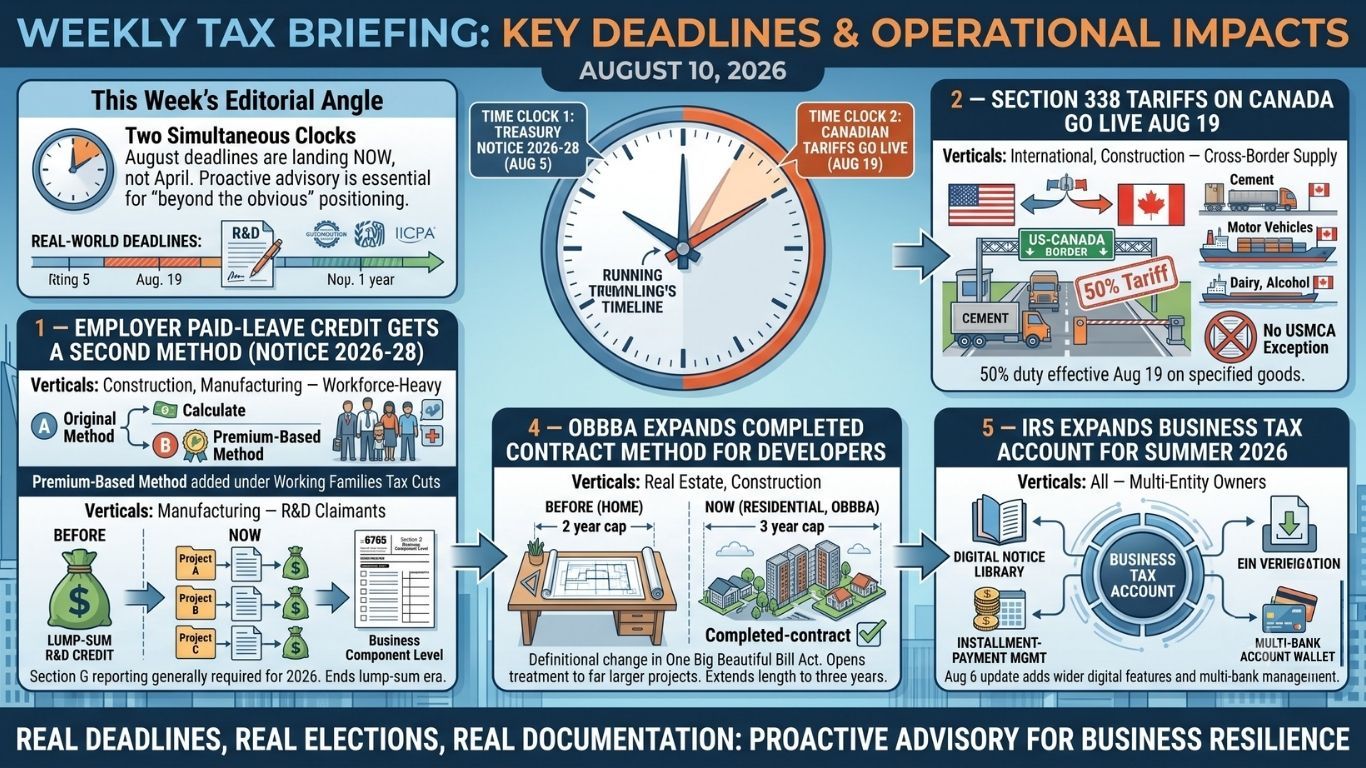
This Week at a Glance
| Development | Primary Industry | Priority |
|---|---|---|
| Expanded Paid Family & Medical Leave Credit | Construction / Manufacturing | 🟡 Consider Action |
| 50% Section 338 Tariffs on Canadian Goods | International / Construction / Manufacturing | 🔴 Immediate Review |
| Form 6765 Project-Level R&D Reporting | Manufacturing / R&D-Intensive Businesses | 🔴 Immediate Review |
| Expanded Completed Contract Method | Real Estate Development / Construction | 🔴 Immediate Review |
| Expanded IRS Business Tax Account | Multi-Entity Businesses | 🟢 Monitor / Implement |
Weekly Executive Theme
April Is Too Late for Decisions That Have to Be Made in August
Tax planning is often treated as a filing-season exercise.
This week's developments demonstrate why that model no longer works for established businesses.
Employers have a new decision to make about how they calculate a federal paid-leave credit.
Importers have days, not months to evaluate the economics of new Canadian tariffs.
Manufacturers claiming the R&D credit need substantially better project-level documentation beginning with 2026 tax years.
Residential developers may have access to a fundamentally different method of recognizing income on qualifying contracts.
And multi-entity businesses now have more tools for managing IRS administration digitally.
None of these decisions begins with a tax return.
They begin with operations, systems, documentation, contracts, and executive planning.
The businesses most capable of using tax law strategically are usually the ones discussing it before the filing deadline forces the conversation.
Executive Overview
This week's five developments sit at the intersection of tax strategy and operational execution.
Treasury and the IRS issued new guidance August 5 expanding how employers may calculate the federal credit for paid family and medical leave.
Meanwhile, companies dependent on Canadian materials or products are approaching an August 19 effective date for new 50% tariffs on specified imports.
Manufacturers claiming R&D credits face another operational challenge: beginning with tax years after 2025, Form 6765 generally requires business-component-level reporting that demands far more connection between technical project records and tax documentation.
Real estate developers and contractors have a different opportunity to evaluate. Changes to IRC Section 460 broaden the residential construction contracts eligible for exceptions from the percentage-of-completion method.
And while it may not command the headlines of a 50% tariff, the IRS's continued expansion of Business Tax Account is making administration across business entities increasingly digital.
For CEOs and CFOs, the lesson is not to memorize five new tax rules.
It is to recognize where those rules intersect with decisions leadership is already making.

1. Employers Now Have Two Ways to Calculate the Paid Family and Medical Leave Credit
Treasury and the IRS issued Notice 2026-28 on August 5, providing new guidance for the employer credit for paid family and medical leave under IRC Section 45S.
Beginning in 2026, qualifying employers have an important new option.
Historically, the credit centered on qualifying wages actually paid to employees while they were on eligible family or medical leave.
The expanded rules now allow an employer maintaining qualifying paid-family-and-medical-leave insurance to elect a premium-based method, using eligible insurance premiums rather than wages paid during leave to calculate the credit.
The law also expands the employee population potentially covered. Among the changes, qualifying employees may include workers with at least six months of service and qualifying part-time employees customarily working 20 hours or more per week.
For workforce-heavy businesses including construction companies and manufacturers the significance goes beyond another available tax credit.
It creates a reason for finance, HR, benefits providers, and tax advisors to review the design of the company's leave program together.
The right question isn't simply:
"Do we qualify for the credit?"
Leadership should also ask:
"Which calculation method produces the more appropriate result for the benefit program we actually operate?"
Questions Leadership Should Ask
- Does our current paid-leave program satisfy the requirements of Section 45S?
- Are we using insurance to provide some or all of the benefit?
- Should we evaluate the wage method against the new premium method?
- Has HR provided finance with the employee eligibility and benefit information needed to model the credit?
- Are we documenting the election contemporaneously rather than reconstructing it during tax preparation?
When tax credits depend on employee-benefit design, tax planning has to begin with HR and finance not with the return preparer months later.
2. A 50% Canadian Tariff Takes Effect August 19 and USMCA Status Does Not Automatically Protect Covered Goods
For businesses with Canadian supply chains, one of this month's most immediate deadlines arrives on August 19, 2026.
Three presidential proclamations issued July 20 under Section 338 of the Tariff Act of 1930 impose an additional 50% ad valorem duty on specified Canadian-origin products.
Covered categories include products such as cement, motor vehicles, dairy products, alcoholic beverages, and other specified goods.
Importantly, for goods covered by the proclamations, qualification under the U.S.-Mexico-Canada Agreement does not itself remove the new Section 338 duty.
There are exclusions including energy, potash, products subject to Section 232 duties, and certain other specified products so companies should evaluate actual HTS classifications rather than applying a blanket assumption to everything sourced from Canada.
For construction and manufacturing executives, this is primarily a margin-management problem.
A 50% additional duty can materially alter:
- Landed cost
- Procurement strategy
- Supplier economics
- Fixed-price construction contracts
- Inventory purchasing
- Project budgets
- Customer pricing
And because the effective date is approaching quickly, waiting for the effect to appear in September invoices is not strategic planning.
Questions Leadership Should Ask
- Which materials or components do we currently source from Canada?
- Have those imports been mapped to the covered tariff classifications?
- Do existing purchase orders cross the August 19 effective date?
- Can alternative suppliers be evaluated without creating greater operational risk?
- Do customer or construction contracts permit tariff-driven adjustments?
- How much margin exposure exists if the additional cost cannot be passed through?
A 50% tariff does not belong solely on a customs report. It belongs in the CFO's forecast and the CEO's pricing conversation.
3. R&D Credit Reporting Is Becoming a Project-Level Documentation Exercise
The R&D tax credit remains one of the most important incentives available to innovative manufacturers.
But beginning with tax years after 2025, the documentation environment becomes substantially more demanding for many claimants.
The IRS's Form 6765 instructions generally require businesses completing Section G—Business Component Information to report qualified research expenses at the business-component level.
Rather than presenting R&D expenditures primarily as one company-wide pool, affected taxpayers must connect qualifying costs to identifiable:
- Products
- Processes
- Software
- Techniques
- Formulas
- Inventions
For companies required to complete Section G, the IRS generally calls for reporting business components covering at least 80% of total qualified research expenses, subject to a maximum of 50 components, with remaining components reported in aggregate.
There are important exceptions. For example, certain qualified small businesses claiming the reduced payroll-tax credit and certain taxpayers meeting both the $1.5 million QRE and $50 million average-gross-receipts thresholds may not be required to complete Section G on an original return.
For mid-market manufacturers outside those exceptions, however, the operational message is clear:
If you're waiting until tax season to identify what your engineering teams worked on during 2026, you're already behind.
Project-level reporting depends on better communication between:
- Engineering
- Operations
- Finance
- Payroll
- Tax
It also raises the stakes around contemporaneous documentation.
A credible R&D position should already be supported by records showing the technical uncertainty addressed, experimentation performed, employees involved, and associated qualified costs.
Questions Leadership Should Ask
- Do our engineering and technical teams track projects in enough detail to support Section G?
- Can payroll costs be tied reasonably to individual business components?
- Are qualifying activities identified throughout the year or reconstructed after year-end?
- Does our current R&D-credit methodology match the IRS's 2026 reporting framework?
- Are finance and engineering aligned on what documentation should be preserved?
For 2026 R&D claims, the question is no longer only whether the company performed qualifying research. It is whether the company can demonstrate where that research occurred and what it cost.
4. Residential Developers Have a Broader Completed-Contract Opportunity
A change enacted under the One Big Beautiful Bill Act significantly expands the construction contracts that may qualify for exceptions from the percentage-of-completion method under IRC Section 460.
The law changes the terminology from certain "home construction contracts" to a broader category of "residential construction contracts."
It also provides a modified timing test for residential construction contracts that are not home construction contracts, substituting a three-year expected completion period for the traditional two-year requirement when applying the relevant exception.
For real estate developers and construction companies involved in larger residential projects, this deserves serious attention.
Why?
Under the percentage-of-completion method, taxable income from a long-term contract is generally recognized progressively as the project advances.
Qualifying for a completed-contract exception may instead defer recognition until the contract is completed.
That can materially influence:
- Taxable income timing
- Cash-tax obligations
- Project cash flow
- Estimated tax payments
- Financing forecasts
This is not a universal election available to every residential development.
The contract must satisfy Section 460's requirements, and the accounting-method implications should be modeled before changing treatment.
But for qualifying projects, the expanded definition could materially change when income becomes taxable.
Questions Leadership Should Ask
- Do any current or upcoming projects fall within the new residential-construction definition?
- Are qualifying contracts expected to satisfy the new three-year completion requirement?
- What would completed-contract treatment do to our near-term cash-tax projections?
- Would changing methods create consequences elsewhere in our financial reporting or tax structure?
- Have our 2026 project models been updated for the enacted Section 460 changes?
For developers, the method used to recognize project income can be almost as important to cash flow as the margin earned on the project itself.
5. The IRS Business Tax Account Is Becoming More Useful for Multi-Entity Companies
Not every important tax development involves a new deduction, credit, or rate.
Sometimes reducing administrative friction has meaningful value of its own.
The IRS continues expanding Business Tax Account, its digital platform for businesses and authorized users.
Summer 2026 additions include a broader library of digital IRS notices and the ability for designated officials to download a digital CP575 EIN verification notice, which can substitute for prior EIN-verification documentation in common situations such as working with banks and financial institutions.
Business Tax Account currently supports multiple organizational forms, including S corporations, C corporations, certain partnerships through eligible partners, government entities, tax-exempt organizations, and sole proprietors meeting applicable requirements.
For owners managing several entities, the strategic value is straightforward:
Tax administration becomes more manageable when leadership has better visibility into:
- Balances
- Payments
- Payment history
- Available transcripts
- IRS notices
- Business information
- Tax compliance status
This does not eliminate the need for a tax professional, in many cases, it makes collaboration with one easier.
Questions Leadership Should Ask
- Have the appropriate company officials established Business Tax Account access?
- Who is responsible for monitoring digital IRS correspondence across our entities?
- Are tax notices centrally tracked rather than sitting with individual subsidiaries?
- Can we quickly verify EIN information when banking or transaction needs arise?
- Do our internal controls clearly define who may access and act on IRS account information?
For a multi-entity business, tax administration should operate like a system—not a collection of disconnected passwords, notices, and filing calendars.
Executive Perspective
This week's developments all point to the same conclusion:
Tax strategy increasingly requires operational readiness.
The paid-leave credit depends on how employee benefits are structured.
Tariffs require procurement and pricing teams to update assumptions before goods cross the border.
The R&D credit increasingly depends on technical teams capturing project information while the work is happening.
Completed-contract opportunities require developers to model tax consequences while projects are still being structured.
And IRS digital tools are giving finance teams greater ability to centralize tax administration across complex organizations.
None of this is fundamentally about April 15.
It is about how well the tax function connects with the rest of the business throughout the year.
At Freese, Peralez & Associates, that is central to how we think about proactive tax planning.
The objective isn't simply to calculate tax correctly after business decisions have been made.
It is to understand those decisions early enough that tax strategy can help support the outcome.
Frequently Asked Questions
What changed with the paid family and medical leave tax credit in 2026?
Beginning in 2026, qualifying employers may calculate the Section 45S credit using either qualifying wages paid during family and medical leave or, when applicable, premiums paid for qualifying paid-leave insurance. Eligibility was also expanded for certain employees.
When do the new Canadian Section 338 tariffs take effect?
The additional 50% duties on specified covered Canadian products take effect at 12:01 a.m. Eastern Time on August 19, 2026.
Does USMCA status eliminate the new Section 338 Canadian tariffs?
No. The White House states that the new Section 338 tariffs apply to covered goods regardless of whether those goods qualify as originating goods under USMCA. Specific exclusions and product classifications still matter.
Is Form 6765 Section G mandatory for 2026?
For tax years beginning after 2025, Section G is generally required, subject to specific exceptions provided in the Form 6765 instructions.
What changed for residential construction contracts under Section 460?
The enacted law expands the relevant exception from home construction contracts to residential construction contracts and provides a three-year expected-completion test for qualifying residential construction contracts that are not home construction contracts.
About Freese, Peralez & Associates
Freese, Peralez & Associates is a tax-focused CPA firm located in The Woodlands, Texas, serving growth-focused businesses throughout Texas and across the United States.
We specialize exclusively in:
- Strategic Tax Planning
- Tax Consulting
- Business Tax Preparation
Our clients generally generate between $1 million and $100 million in annual revenue and frequently operate across multiple entities, multiple states, or increasingly complex tax environments.
We work extensively with businesses in the construction, manufacturing, real estate development, and international business sectors.
Continue the Conversation
This week's Brief illustrates why sophisticated tax planning cannot begin when the return is ready to file.
Some decisions require new documentation.
Some require modeling.
Others have deadlines measured in days.
If your organization is growing, investing in facilities, conducting R&D, managing a large workforce, developing residential projects, importing materials, or operating multiple entities, now is the time to determine whether these changes affect your strategy.
If you are not currently an FPA client, visit our Contact Us page and complete the form to schedule a confidential discovery call.
We would welcome the opportunity to understand your business and determine whether proactive tax planning can help protect cash flow, preserve margins, and support your next stage of growth.
Coming Next Week
Our team continues monitoring:
- IRS and Treasury guidance
- Federal tax legislation
- International trade developments
- Construction and real estate tax policy
- Manufacturing incentives
- R&D tax-credit administration
- Multi-state developments affecting growth companies
Because the value isn't simply knowing what changed.
It's knowing whether you need to do something about it.