
The Year-End Decisions That Matter
The Year-End Decisions That Matter
Follow FPA in Google
Get more timely tax insights from Freese, Peralez & Associates in Google Search.
Add FPA as a Preferred Source →FPA Executive Tax Brief™
Strategic Tax Intelligence for Growth-Focused Businesses
Issue No. 015 | Week of November 2–8, 2026
Estimated Reading Time: 9 Minutes
Executive Snapshot
Who Should Read This
- CEOs
- CFOs
- Controllers
- Construction Executives
- Manufacturing Leaders
- Real Estate Investors & Developers
- International Business Leaders
- Multi-Entity Business Owners
This Week at a Glance
| Development | Primary Industry | Priority |
|---|---|---|
| New Form W-2 Qualified Overtime Reporting | Construction | 🔴 Immediate Review |
| Section 168(n) Qualified Production Property | Manufacturing | 🟡 Consider Action |
| December 31 Opportunity Zone Gain Recognition | Real Estate / Investors | 🔴 Immediate Review |
| Section 250 Proposed FDDEI Asset-Sale Rules | International / Manufacturing | 🟡 Consider Action |
| Employer Contributions to Trump Accounts | All Verticals / Business Owners | 🟡 Consider Action |
Weekly Executive Theme
The Year-End Decisions That Cannot Wait Until Filing Season
For many established businesses, tax planning becomes a priority when financial statements are finalized and returns are being prepared.
But by then, some of the most important decisions have already been made.
Employees have been paid.
Construction projects have progressed.
Manufacturing facilities have been placed in service.
Investment gains have been deferred.
Assets have been sold.
And employee benefit arrangements have been established—or overlooked.
This week's developments reinforce why the final months of the year are not simply a period for estimating taxable income.
They are an opportunity to confirm that the business has the reporting systems, documentation, liquidity, and tax structure needed to support the result it expects.
The question for leadership is not only what the 2026 tax return will report. It is whether the business is making the right decisions before the year closes.
Executive Overview
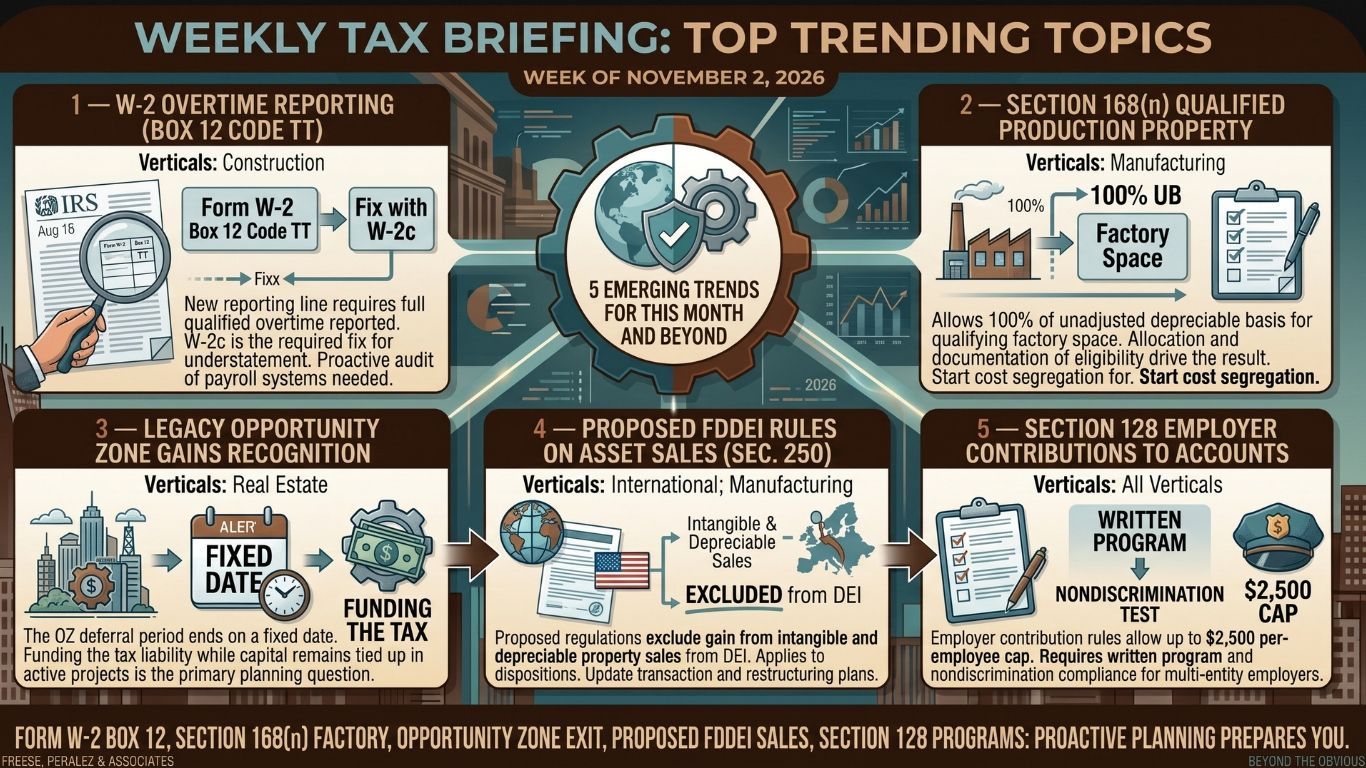
Five developments deserve attention as businesses move into November.
Construction employers face new reporting requirements for qualified overtime compensation on 2026 Forms W-2.
Manufacturers evaluating facility investments may be eligible for a special depreciation allowance under Section 168(n), but only qualifying property and qualifying uses are covered.
Real estate investors holding legacy Opportunity Zone investments face a December 31 recognition date for previously deferred gains, potentially creating a tax obligation without a corresponding distribution of cash.
International businesses must consider proposed Section 250 regulations that would exclude certain asset disposition income from deduction eligible income.
And employers now have a new option to contribute to Trump accounts for employees or their dependents, subject to program requirements and nondiscrimination considerations.
The common theme is preparation.
Each development requires something more than identifying a potential tax benefit.
It requires understanding how the rule will be implemented.

1. New Form W-2 Overtime Reporting Creates an Immediate Payroll Compliance Priority
For construction businesses with significant overtime, the 2026 Form W-2 introduces a new reporting requirement.
Employers must separately report qualified overtime compensation in Box 12 using Code TT.
The IRS reinforced this requirement in its updated August 2026 guidance, including clarification about the amount that must be reported and how errors must be corrected.
What Counts as Qualified Overtime?
The reporting requirement is tied to the federal deduction for qualified overtime compensation under Section 225.
Generally, qualifying overtime is the compensation required under Section 7 of the Fair Labor Standards Act that exceeds the employee's regular rate of pay.
For a typical employee receiving time-and-a-half for qualifying overtime, the additional half-time premium is the relevant amount—not the entire overtime payment.
Consider a simplified example.
An employee earns $30 per hour and works five qualifying overtime hours paid at $45 per hour.
The total overtime compensation is $225.
But the qualifying overtime premium is generally $75:
Five hours multiplied by the additional $15 per hour.
That $75—not the entire $225—is the amount generally relevant to Code TT reporting for those hours.
Actual calculations may be more complicated when bonuses, multiple pay rates, or other FLSA rules affect the regular rate.
Employers Must Report the Full Qualified Amount
The employer's reporting obligation is not limited by the amount the employee may ultimately deduct.
For example, an employee may receive $30,000 in qualified overtime compensation during 2026.
The employer must report the full $30,000 in Box 12, Code TT, even though the employee's deduction is subject to separate statutory limitations.
Why Corrections Matter
If an employer discovers that Code TT is incorrect, the IRS requires a corrected Form W-2c.
This is particularly important when qualified overtime has been understated.
The IRS has explained that an employee may be unable to claim a deduction for qualifying compensation omitted from the employer-furnished statement if the employer does not provide the required correction.
Why Construction Companies Should Review Payroll Now
Construction employers often have employees working across:
- Multiple job sites
- Different pay classifications
- Overtime-heavy project schedules
- Prevailing-wage arrangements
- Multiple states
- Variable compensation structures
Those factors can complicate the determination of qualified overtime.
A payroll system that accurately calculates gross overtime pay may not automatically calculate the amount required for Code TT.
Questions Leadership Should Ask
- Has our payroll provider activated Code TT reporting for 2026?
- Are we distinguishing qualified FLSA overtime premiums from total overtime wages?
- Are bonuses and multiple pay rates reflected in the regular-rate calculation where required?
- Can we reconcile Code TT amounts to payroll records?
- Are employees working across multiple states being handled correctly?
- Do we have a process for identifying and correcting W-2 reporting errors before forms are issued?
For employers with substantial overtime, year-end payroll accuracy is now directly connected to employees' ability to claim a federal tax deduction.
2. Section 168(n): Manufacturing Facility Depreciation Depends on How the Space Is Used
Manufacturers planning new facilities, expansions, or qualifying improvements have a significant federal tax provision to evaluate.
Section 168(n) permits an election for a special depreciation allowance of up to 100% of the unadjusted depreciable basis of qualified production property.
The IRS issued Notice 2026-16 in February to provide interim guidance on the provision.
The potential benefit can be substantial.
But the eligibility requirements are more specific than simply owning a factory.
What Is Qualified Production Property?
Generally, qualified production property is certain nonresidential real property used as an integral part of a qualified production activity.
Qualifying production activities can include:
- Manufacturing
- Chemical production
- Agricultural production
- Refining
The activity generally must involve the substantial transformation of property into a qualified product.
The special allowance is subject to statutory acquisition, construction, original-use, and placed-in-service requirements.
Qualified property generally must be placed in service after July 4, 2025, and before January 1, 2031, with additional statutory timing requirements applying.
The Allocation Question
Not every square foot of a manufacturing facility necessarily qualifies.
A building may contain:
- Production areas
- Warehousing and storage
- Administrative offices
- Employee facilities
- Distribution operations
- Research and development space
The tax treatment may differ depending on how those areas are used and whether they satisfy the applicable rules.
This makes allocation and documentation essential.
A manufacturer should be able to substantiate which portions of a project are integral to qualifying production activities and which are not.
Why Documentation Should Begin During Construction
Waiting until a facility is complete can make it harder to reconstruct how costs were allocated.
Project accounting records, engineering plans, invoices, construction schedules, and placed-in-service documentation can all become important.
The analysis may also need to coordinate Section 168(n) with other depreciation provisions to prevent overlapping deductions.
Questions Leadership Should Ask
- Are we constructing or acquiring facilities used in qualifying production activities?
- Which portions of each building are integral to production?
- Are project costs separately tracked by qualifying and nonqualifying use?
- Have acquisition, construction-start, and placed-in-service requirements been evaluated?
- Could the Section 168(n) election materially change our projected taxable income?
- Have depreciation recapture consequences been considered?
- Is our tax team involved before facility costs are finalized?
The potential deduction is significant, but the value depends on identifying, allocating, and documenting the property that actually qualifies.
3. Legacy Opportunity Zone Gains Return to the Tax Calculation on December 31
For real estate investors who deferred eligible gains through Qualified Opportunity Fund investments under the original Opportunity Zone framework, December 31, 2026, is a critical date.
Under the original deferral rules, deferred gains generally must be recognized on the earlier of:
- An applicable inclusion event, or
- December 31, 2026.
That recognition requirement applies even if the investor continues holding the Qualified Opportunity Fund investment.
The Liquidity Problem
Opportunity Zone investments frequently involve long-term real estate projects.
Capital may be committed to:
- Development
- Construction
- Property acquisition
- Rehabilitation
- Infrastructure
- Long-term operations
But recognizing a deferred gain does not necessarily produce cash.
An investor may therefore face a federal income-tax obligation while the original investment remains tied up in a project.
A Simplified Example
Consider an investor who deferred $1 million of eligible capital gain through a qualifying Opportunity Fund investment.
Assuming no earlier inclusion event, the remaining deferred gain generally enters the 2026 federal tax calculation.
The actual amount recognized may be affected by applicable basis adjustments and other rules.
But the key issue remains:
The investor may owe tax without receiving a corresponding cash distribution.
That creates a funding decision.
The New Opportunity Zone Framework Is Different
The OBBBA introduced a new framework for qualifying Opportunity Zone investments beginning in 2027.
That framework includes different deferral mechanics.
It should not be confused with the original program's December 31, 2026, recognition date.
A new investment structure does not automatically extend the deferral associated with an existing legacy investment.
Questions Leadership Should Ask
- Which owners or entities hold legacy Qualified Opportunity Fund investments?
- What amount of deferred gain remains outstanding?
- Have applicable basis adjustments been calculated?
- Has any earlier inclusion event occurred?
- How much additional federal and state tax may become payable?
- Is sufficient liquidity available outside the investment?
- Have estimated tax payment obligations been reviewed?
- Could planned distributions or financing arrangements help address the tax liability?
A deferred tax liability is still a liability. For Opportunity Zone investors, the immediate planning issue may be how to fund it without disrupting the underlying investment.
4. Proposed Section 250 Rules Could Change the Treatment of Certain International Asset Sales
For U.S. corporations selling products and services into foreign markets, Section 250 can provide an important deduction related to foreign-derived deduction eligible income, or FDDEI.
But proposed regulations released in August 2026 clarify that certain asset disposition income would be excluded from deduction eligible income.
The proposal, REG-117130-25, addresses income and gain from the sale or other disposition of:
- Intangible property
- Depreciable property
- Amortizable property
- Depletable property
The relevant statutory change applies to dispositions occurring after June 16, 2025.
Why This Matters for International Businesses
A manufacturer may earn foreign-derived income through ordinary product sales.
But the sale of intellectual property, equipment, or other business assets can raise a different Section 250 question.
The proposed rules distinguish qualifying operating income from categories of disposition income excluded under the amended statute.
That distinction may affect the tax modeling for:
- Intellectual property transfers
- Equipment dispositions
- Corporate reorganizations
- Foreign business restructurings
- Sales of depreciable business assets
- International transaction planning
Proposed Regulations Are Not Final Regulations
The underlying statutory amendment is already relevant to qualifying dispositions.
The proposed regulations address how that amendment would be interpreted and implemented.
Businesses should therefore distinguish between the enacted exclusion and regulatory details that remain proposed.
The Transaction Planning Issue
Consider a U.S. manufacturer contemplating the sale of equipment or intangible property to a foreign buyer.
The business may reasonably expect foreign-derived income from the transaction.
But the Section 250 deduction analysis cannot stop at the buyer's location.
It must consider the character of the asset, the nature of the transaction, the statutory exclusion, and the applicable tax year.
Questions Leadership Should Ask
- Are we planning sales or transfers of intangible or depreciable assets?
- Were any relevant dispositions completed after June 16, 2025?
- Have we separated ordinary product-sale income from excluded asset-disposition income?
- Do transaction models reflect the Section 250 statutory changes?
- Could the proposed regulations affect our calculations?
- Are intercompany transactions being evaluated under applicable transfer pricing rules?
- Have planned dispositions been reviewed before contracts are finalized?
Foreign customers do not automatically make every category of income eligible for a foreign-derived income deduction. The character of the transaction matters.
5. Employer Contributions to Trump Accounts Introduce a New Benefits Planning Option
Employers have a new tax-advantaged benefit to consider.
Under Section 128, qualifying employer contributions to Trump accounts may be excluded from an employee's gross income, subject to an annual limit of $2,500 per employee, adjusted for inflation after 2027.
The employer may contribute to a qualifying account established for an employee or an employee's dependent.
The IRS issued proposed regulations under REG-101355-26 in August, and additional temporary Trump account regulations appeared in Internal Revenue Bulletin 2026-44.
How the Employer Contribution Works
Trump accounts are a new type of tax-advantaged account established for eligible children.
Qualifying employer contributions may provide an additional benefit alongside traditional compensation and employee benefit arrangements.
However, employers must establish a qualifying contribution program.
The proposed regulations address matters including:
- Written program requirements
- Employee eligibility
- Nondiscrimination
- Contributions for eligible dependents
- Employer administration
- Coordination with applicable annual contribution limits
The employer contribution limit is separate from, but counts toward, the account's general annual contribution limit.
Why Multi-Entity Employers Should Pay Attention
Businesses operating through multiple companies may need to consider controlled-group and related-employer rules when evaluating benefit eligibility and nondiscrimination.
A company cannot assume that offering a benefit through one entity isolates it from the requirements applicable to related employers.
This is particularly relevant for:
- Construction groups with multiple operating entities
- Manufacturing companies with subsidiaries
- Real estate businesses with management companies
- Family-owned businesses
- Organizations with different employee populations across entities
A Benefits Decision, Not Just a Tax Decision
The program may provide employers with another way to support employees and their families.
But the tax treatment is only one consideration.
Management should also evaluate administrative cost, employee interest, payroll reporting, and coordination with existing benefit programs.
For 2026 Forms W-2, qualifying Section 128 employer contributions are separately reported using Box 12, Code TA.
Questions Leadership Should Ask
- Would this benefit be valuable to our workforce?
- Are we eligible to establish a qualifying Section 128 contribution program?
- Have the proposed written-program requirements been reviewed?
- Do related entities need to be considered together?
- Could nondiscrimination rules affect program design?
- Can payroll administer and report contributions correctly?
- How would this benefit fit alongside our existing compensation and retirement programs?
A new tax-advantaged employee benefit can be valuable, but it should be evaluated as part of a coordinated compensation strategy not implemented solely because a tax exclusion is available.
Executive Perspective
The final quarter of the year is often when businesses begin estimating their tax liability.
But this week's developments demonstrate why the more valuable exercise may be reviewing the decisions that create that liability.
For construction companies, accurate overtime reporting requires payroll systems to distinguish qualified premiums from ordinary compensation.
For manufacturers, Section 168(n) requires careful identification of qualifying production property.
For real estate investors, legacy Opportunity Zone deferrals create a liquidity issue that cannot be solved by simply continuing to hold the investment.
For international businesses, the character of an asset disposition can determine whether a Section 250 deduction is available.
And for employers considering Trump account contributions, the benefit depends on appropriate program design and administration.
Different rules.
Different industries.
One consistent lesson:
The quality of the year-end tax result depends on the decisions and records established before the year closes.
That is why proactive tax planning should be part of the operating calendar—not merely the filing calendar.
Frequently Asked Questions
What is Form W-2 Box 12 Code TT?
Code TT is used beginning with 2026 Forms W-2 to report total qualified overtime compensation. Generally, this means the overtime premium required under the Fair Labor Standards Act, rather than the entire time-and-a-half payment.
Can a manufacturer deduct 100% of a new factory building under Section 168(n)?
Qualifying manufacturers may elect a special depreciation allowance of up to 100% of the unadjusted depreciable basis of qualified production property. However, not all factory space or building costs necessarily qualify. Eligibility depends on the property's use and other statutory requirements.
Do Opportunity Zone investors have to sell their investments in 2026?
No. Under the legacy framework, remaining deferred gains generally must be recognized no later than December 31, 2026, even if the investor continues holding the Qualified Opportunity Fund investment.
Are all foreign asset sales eligible for the Section 250 deduction?
No. The amended statute excludes certain income and gain from sales or dispositions of intangible, depreciable, amortizable, and depletable property from deduction eligible income. Proposed regulations provide further implementation details.
Can employers contribute $2,500 to an employee's Trump account?
Under Section 128, qualifying employers may contribute up to $2,500 annually to eligible Trump accounts for employees or their dependents, subject to applicable program requirements, contribution limits, and nondiscrimination rules.
About Freese, Peralez & Associates
Freese, Peralez & Associates is a tax-focused CPA firm located in The Woodlands, Texas, serving growth-focused businesses throughout Texas and across the United States.
We specialize exclusively in:
- Strategic Tax Planning
- Tax Consulting
- Business Tax Preparation
Our clients generally generate between $1 million and $100 million in annual revenue and frequently operate through multiple entities, across multiple states, or within increasingly complex domestic and international tax environments.
We work extensively with organizations in the construction, manufacturing, real estate development, and international business sectors.
Continue the Conversation
Year-end tax planning is most effective when it begins before the final numbers are reported.
Payroll classifications, manufacturing property allocations, deferred investment gains, international transaction structures, and employee benefit programs can all influence the outcome.
For established businesses, the opportunity is to identify those decisions early enough to act.
If your organization is managing complex payroll, investing in manufacturing facilities, holding Opportunity Zone investments, operating internationally, or evaluating new employee benefits, now may be an appropriate time to review whether your tax strategy reflects the latest developments.
If you are not currently an FPA client, visit our Contact Us page and complete the form to schedule a confidential discovery call.
We would welcome the opportunity to learn more about your organization and determine whether proactive tax planning can help protect cash flow, preserve margins, and support your next stage of growth.
Coming Next Week
Our team continues monitoring:
- 2026 Form W-2 reporting requirements
- Section 168(n) qualified production property guidance
- Legacy Opportunity Zone gain recognition
- Section 250 international tax regulations
- Trump account implementation and employer reporting
- Manufacturing and construction tax developments
- International business tax planning
- Q4 and year-end tax strategy
Because a tax return records what happened.
A proactive tax strategy helps determine what happens next.