
Five developments where documentation, valuation, and legal details determine the outcome
Five developments where documentation, valuation, and legal details determine the outcome
Follow FPA in Google
Get more timely tax insights from Freese, Peralez & Associates in Google Search.
Add FPA as a Preferred Source →FPA Executive Tax Brief™
Strategic Tax Intelligence for Growth-Focused Businesses
Issue No. 013 | Week of October 19–25, 2026
Estimated Reading Time: 9 Minutes
Executive Snapshot
Who Should Read This
- CEOs
- CFOs
- Controllers
- Real Estate Investors
- Developers
- Manufacturing Executives
- Construction Business Owners
- International Business Leaders
- Multi-Entity Operators
This Week at a Glance
| Development | Primary Industry | Priority |
|---|---|---|
| Conservation Easement Valuation Decisions | Real Estate / Developers | 🔴 Immediate Review |
| ERC Supply-Chain Suspension Ruling | Manufacturing | 🔴 Immediate Review |
| Section 385 Related-Party Debt Review | International / Multi-Entity | 🟡 Monitor / Consider Action |
| 2027 USMCA Joint Review | Manufacturing / Construction / International | 🟡 Consider Action |
| Fine and Fixed-Date IRS Consent Forms | Construction / Multi-Entity Businesses | 🔴 Immediate Review |
Weekly Executive Theme
The Details That Decide the Outcome
Business owners often evaluate tax strategies by their expected financial benefit.
A deduction reduces taxable income.
A credit improves cash flow.
An intercompany loan provides financing flexibility.
A trade agreement supports international expansion.
An examination agreement provides additional time to resolve a dispute.
But the expected outcome is only one side of the equation.
The other is whether the position can withstand scrutiny.
This week's developments illustrate how a valuation, a government order, a related-party financing arrangement, a trade classification, or even the wording of a signed IRS form can change the result.
A tax position is only as strong as the facts, documentation, and legal requirements supporting it.

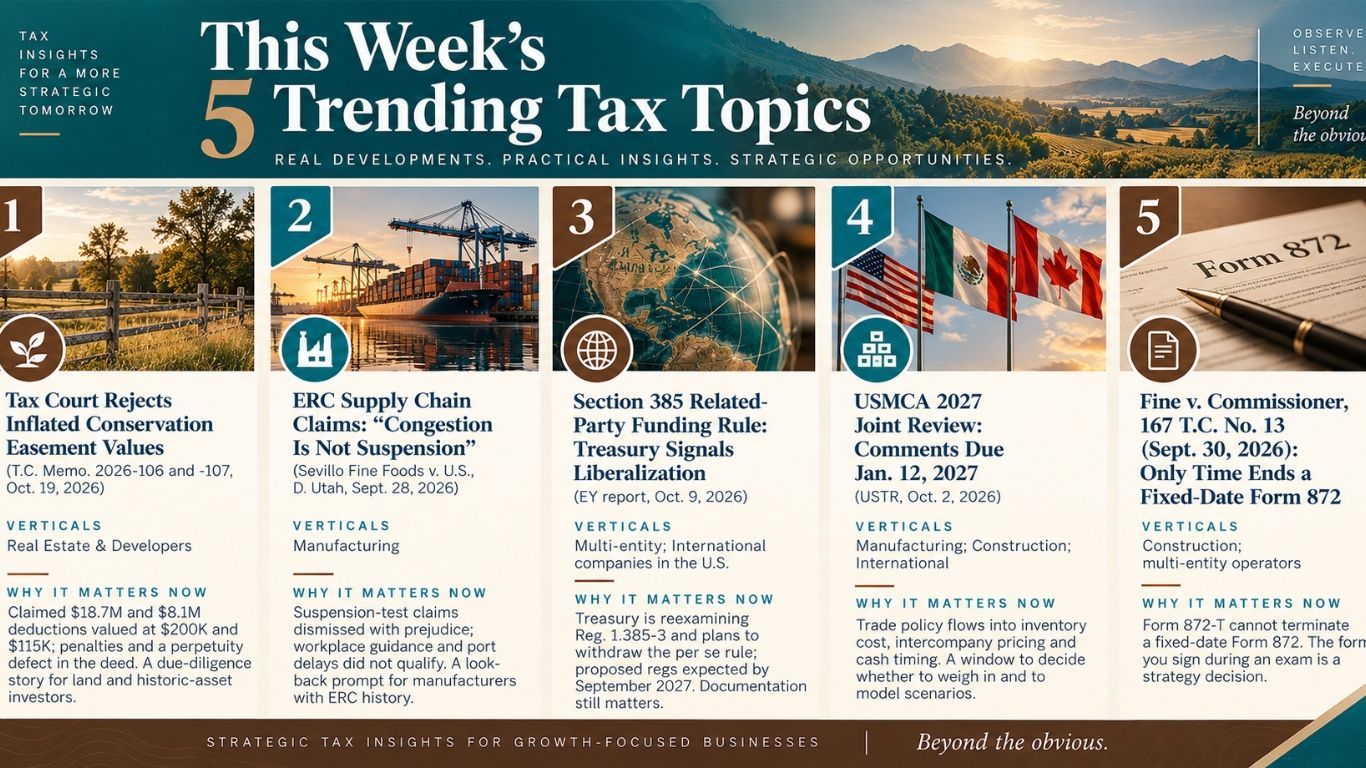
1. Conservation Easement Decisions Reinforce the Importance of Defensible Valuations
Two recent U.S. Tax Court memorandum opinions, T.C. Memo. 2026-106 and T.C. Memo. 2026-107, place conservation easement deductions back in the spotlight.
The cases involve claimed charitable contribution deductions of approximately $18.7 million and $8.1 million, respectively.
The Court determined substantially lower values—approximately $200,000 and $115,000—and addressed additional compliance defects and penalties.
The magnitude of the differences is striking.
But the more important lesson for real estate investors is not simply that the IRS challenged aggressive valuations.
It is that conservation easement deductions depend on several independent requirements.
Valuation Is Only Part of the Analysis
A qualifying conservation contribution generally requires more than an appraisal showing that land may be worth less after development rights are restricted.
The taxpayer must satisfy applicable statutory and regulatory requirements, including those concerning:
- Qualified real property interests
- Conservation purposes
- Qualified appraisals
- Substantiation
- Conservation restrictions protected in perpetuity
- Applicable limitations on partnership contributions
- Accurate reporting and supporting documentation
A valuation dispute can dramatically reduce a deduction.
A separate deed defect can threaten eligibility even when some conservation value exists.
That distinction matters for investors considering agricultural land, environmentally sensitive property, or historic assets.
The Strategic Issue for Developers
Land development value is often sensitive to assumptions.
Potential density, zoning approvals, infrastructure availability, market demand, and development costs can all influence an appraisal.
But an appraisal based on hypothetical development potential must be supported by credible facts and realistic assumptions.
For an established real estate investor, the decision should begin with the underlying investment and conservation objectives—not the size of a projected deduction.
Questions Leadership Should Ask
- Does the proposed conservation transaction have a legitimate business or conservation purpose independent of the tax deduction?
- Are development assumptions supported by zoning, market, engineering, and financial evidence?
- Has an independent qualified appraisal been obtained?
- Do the deed restrictions satisfy the applicable perpetuity requirements?
- Have partnership-specific limitations been reviewed?
- Could the transaction create exposure to valuation-related or other penalties?
The value of a conservation easement deduction depends on what can be legally and economically substantiated—not the amount presented in a promotional appraisal.
2. ERC Supply-Chain Claims Face Another Judicial Test
The Employee Retention Credit remains an important area of federal tax controversy.
In Sevillo Fine Foods LLC v. United States, decided September 28, 2026, the U.S. District Court for the District of Utah rejected the manufacturer's argument that pandemic-related supply-chain difficulties established a qualifying suspension of operations.
The company relied on a Turkish supplier whose products were shipped through the Port of Long Beach.
It alleged that COVID-related restrictions contributed to port congestion, shipping delays, reduced production, and canceled customer orders.
Those operational difficulties were real concerns.
But the Court distinguished commercial disruption from the statutory requirements for an ERC suspension claim.
Congestion Is Not the Same as a Government-Ordered Suspension
For the relevant ERC suspension test, the employer needed to establish that an appropriate governmental order caused a qualifying full or partial suspension of operations.
The Court found that the cited government measures did not establish the required causal connection.
The supplier continued producing and shipping goods.
The port continued operating, despite congestion and delays.
And the relationship between workplace guidance, transportation conditions, and the manufacturer's operations was too indirect to support the claimed suspension.
The Court dismissed the suspension-based claims with prejudice.
Importantly, the company's separate gross-receipts-based claims remained pending.
Why Manufacturers Should Revisit Their ERC Files
Many manufacturers experienced genuine supply-chain disruptions during 2020 and 2021.
But the ERC did not provide a credit simply because a business faced:
- Increased freight costs
- Delayed shipments
- Material shortages
- Reduced production
- Customer cancellations
- General pandemic-related uncertainty
Eligibility depended on satisfying one of the applicable statutory tests.
A business may have experienced substantial disruption without meeting the suspension test.
That makes the documentation supporting historical ERC claims especially important.
Questions Leadership Should Ask
- Did we claim the ERC based on supply-chain disruption?
- Which specific governmental order supported the claim?
- Did that order actually suspend a supplier's operations?
- Can we demonstrate a direct connection between the order and our inability to operate?
- Was the claim based on the suspension test, the gross-receipts test, or both?
- Were our claims prepared internally or by an outside promoter?
- Do we have the documentation needed to respond to an IRS examination?
A genuine business disruption does not automatically establish eligibility for a tax credit. The legal cause of that disruption matters.
3. Treasury's Section 385 Review Could Change Related-Party Financing Decisions
For businesses operating through multiple entities, intercompany financing is often a normal part of growth.
A parent company may lend money to a subsidiary.
An international group may finance a U.S. expansion through a related-party note.
A real estate holding company may provide capital to an operating entity.
These arrangements can serve legitimate commercial purposes.
But federal tax rules may treat certain related-party instruments as equity rather than debt.
Section 385 gives Treasury authority to prescribe rules for distinguishing debt from equity.
One particularly significant provision is Treasury Regulation Section 1.385-3, which can recharacterize certain related-party debt instruments as stock when issued in specified transactions.
Treasury Signals Potential Liberalization
Recent October reporting indicates that Treasury is reviewing the existing related-party funding rules and intends to withdraw the per se rule contained in the current regulations.
Proposed regulations are reportedly anticipated by September 2027.
That is a meaningful development for multinational businesses.
However, it is not an immediate repeal.
Until Treasury issues and finalizes changes, taxpayers must continue evaluating the rules currently in effect.
Why Documentation Still Matters
Even if a particular regulatory recharacterization rule is eventually withdrawn, the broader debt-versus-equity question does not disappear.
Tax authorities and courts may still examine whether a purported loan functions as genuine debt.
Relevant considerations can include:
- Written loan agreements
- Fixed maturity dates
- Interest obligations
- Repayment expectations
- Borrower creditworthiness
- Actual payment behavior
- Creditor enforcement rights
- Economic substance
For a business expanding into the United States, those details should be addressed when financing is structured.
Trying to reconstruct them years later can be difficult.
Questions Leadership Should Ask
- Which entities have outstanding related-party loans?
- Are those loans supported by written agreements?
- Do the terms resemble arrangements between unrelated lenders and borrowers?
- Are interest payments and principal repayments consistent with the agreements?
- Could current Section 385 rules affect any outstanding instruments?
- Would proposed changes influence future capital structures?
- Are international withholding and interest-deduction implications being modeled?
Possible regulatory relief does not eliminate the need to structure and document intercompany financing as a genuine commercial transaction.
4. The 2027 USMCA Review Creates a Strategic Planning Window for North American Businesses
The United States-Mexico-Canada Agreement plays an important role in North American manufacturing, construction supply chains, and cross-border investment.
On October 2, the Office of the U.S. Trade Representative opened a public consultation process ahead of the agreement's 2027 joint review.
Written comments and requests to participate in the public hearing are due January 12, 2027, at 11:59 p.m. Eastern Time.
This is not a new tariff or immediate change to the agreement.
It is an opportunity for businesses and industry groups to identify issues that may influence future negotiations and implementation.
Why CFOs Should Be Paying Attention
The USMCA affects more than customs departments.
For manufacturers with North American supply chains, trade rules can influence:
- Supplier selection
- Rules-of-origin qualification
- Customs duties
- Inventory costs
- Cross-border pricing
- Capital investment
- Production locations
- Working capital
Construction companies can also be affected through imported materials, equipment, components, and machinery.
For a company operating in multiple countries, even modest changes to sourcing requirements or trade treatment can influence project margins and cash flow.
The Transfer Pricing Connection
Customs valuation and income-tax transfer pricing are related but distinct areas.
A change in trade costs may require management to revisit how related companies price goods, allocate risks, and absorb additional expenses.
But a customs adjustment does not automatically justify a corresponding income-tax transfer pricing adjustment.
The two systems must be analyzed under their respective rules.
What Businesses Can Do Now
The review creates time for scenario analysis before the next round of policy decisions.
Companies may want to evaluate:
- Their dependence on Canadian and Mexican suppliers
- Which products rely on preferential USMCA treatment
- Whether existing origin documentation remains sufficient
- How higher duties or new sourcing requirements would affect margins
- Whether alternative production or sourcing arrangements are economically viable
- Whether direct comments or an industry association submission would be useful
Questions Leadership Should Ask
- How much of our supply chain depends on USMCA treatment?
- Which imported products would materially affect margins if trade costs increased?
- Are our rules-of-origin records current?
- Have we modeled alternative sourcing scenarios?
- Could trade changes affect related-party pricing?
- Would our organization benefit from participating in the consultation process?
- Who is responsible for monitoring developments before January 12?
The USMCA review is not a reason to predict a specific trade outcome. It is an opportunity to understand the business's exposure before the next rules are negotiated.
5. Fine v. Commissioner: The IRS Form You Sign Can Determine How Long an Examination Remains Open
Tax examinations involve more than questions about income, deductions, and credits.
They also involve procedural decisions that can materially affect a taxpayer's rights.
In Fine v. Commissioner, 167 T.C. No. 13, issued September 30, 2026, the U.S. Tax Court addressed an important distinction involving agreements extending the IRS assessment period.
The case concerns Form 872, Consent to Extend the Time to Assess Tax, and Form 872-T, a form generally associated with terminating certain special consents.
The Court concluded that a fixed-date Form 872 was not terminated by submitting Form 872-T.
Instead, the consent remained governed by its specified expiration date.
Why the Type of Consent Matters
When the IRS examines a return, it may ask the taxpayer to extend the period during which additional tax can be assessed.
That can provide additional time for both sides to develop facts, resolve issues, and potentially avoid litigation.
But not every consent agreement operates the same way.
A fixed-date consent establishes a specific expiration date.
Other consent arrangements may have different termination mechanisms.
A taxpayer should not assume that a form designed to terminate one type of agreement will necessarily terminate another.
A Procedural Decision With Financial Consequences
For established businesses, examinations can involve:
- Multiple tax years
- Related entities
- Partnership adjustments
- Depreciation methods
- Business interest deductions
- Employment taxes
- International transactions
Extending an assessment period can be appropriate.
But the decision should be deliberate.
Management and advisers should understand the issues under examination, the additional time being requested, and the consequences of signing.
Questions Leadership Should Ask
- Which entities and tax years are currently under examination?
- Have we signed any Forms 872 or other limitations-period consents?
- What is the exact expiration date of each agreement?
- Does the consent apply to all issues or only specified matters?
- Are there alternative approaches to managing the examination timeline?
- Who reviews and approves procedural agreements before they are signed?
- Have we documented the strategic reasons for extending the assessment period?
During an IRS examination, the wording of a procedural agreement can matter just as much as the tax position being examined.
Executive Perspective
The five developments in this week's brief reinforce a fundamental principle of sophisticated tax planning.
A tax strategy must be defensible, not merely attractive.
A conservation easement deduction needs a credible valuation and compliant legal structure.
An ERC claim needs facts that satisfy the actual eligibility requirements.
A related-party loan needs genuine debt characteristics.
An international supply chain needs to account for trade rules and changing costs.
And an IRS examination consent needs to be understood before it is signed.
These are not isolated tax department issues.
They affect capital allocation, transaction negotiations, financing, operations, and enterprise risk.
For CEOs and CFOs, the most useful question is not always:
How much could this strategy save?
Sometimes the more important question is:
What evidence would we need to defend it three years from now?
That is where proactive tax planning moves beyond the obvious.
Frequently Asked Questions
Can the IRS challenge a conservation easement deduction even when an appraisal exists?
Yes. The IRS can challenge the valuation methodology, underlying assumptions, appraisal compliance, deed restrictions, and other statutory requirements. An appraisal alone does not guarantee that a charitable contribution deduction is allowable.
Do supply-chain delays automatically qualify a manufacturer for the Employee Retention Credit?
No. In Sevillo Fine Foods, the court rejected suspension-based ERC claims where port congestion and shipping delays did not establish the required governmental-order causation. A business may separately qualify under an applicable gross-receipts test.
Are the Section 385 related-party funding regulations being repealed?
Treasury has reportedly signaled plans to revise or withdraw aspects of the Section 385 funding rules, but anticipated proposed regulations are not final law. Existing rules and general debt-versus-equity principles remain relevant.
When are comments due for the 2027 USMCA review?
The USTR's deadline for written comments and requests to appear at the public hearing is January 12, 2027, at 11:59 p.m. Eastern Time.
Can Form 872-T terminate a fixed-date Form 872?
The Tax Court's decision in Fine v. Commissioner indicates that Form 872-T does not terminate the fixed-date consent at issue. Taxpayers should review the exact consent agreement and applicable procedures before assuming that an assessment extension has ended.
About Freese, Peralez & Associates
Freese, Peralez & Associates is a tax-focused CPA firm located in The Woodlands, Texas, serving growth-focused businesses throughout Texas and across the United States.
We specialize exclusively in:
- Strategic Tax Planning
- Tax Consulting
- Business Tax Preparation
Our clients generally generate between $1 million and $100 million in annual revenue and frequently operate through multiple entities, across multiple states, or within increasingly complex domestic and international tax environments.
We work extensively with organizations in the construction, manufacturing, real estate development, and international business sectors.
Continue the Conversation
Tax strategies often look straightforward when viewed through their projected financial benefit.
But the details supporting those strategies matter.
Valuations.
Government orders.
Financing agreements.
Trade classifications.
Examination deadlines.
For established businesses, these details can determine whether a tax position produces the intended result or becomes a costly dispute.
If your organization is managing complex real estate investments, historical ERC claims, intercompany financing, North American supply chains, or an IRS examination, now may be an appropriate time to review the assumptions and documentation supporting those positions.
If you are not currently an FPA client, visit our Contact Us page and complete the form to schedule a confidential discovery call.
We would welcome the opportunity to learn more about your organization and determine whether proactive tax planning can help protect cash flow, preserve margins, and support your next stage of growth.
Coming Next Week
Our team continues monitoring:
- Conservation easement litigation
- Employee Retention Credit examinations and court decisions
- Section 385 regulatory developments
- The 2027 USMCA joint review
- IRS examination and procedural rulings
- Manufacturing and construction tax developments
- International business tax planning
- Q4 and year-end tax strategy
Because a favorable tax result begins with a sound strategy. And a sound strategy begins with defensible facts.