
5 tax and trade developments where the details matter
5 tax and trade developments where the details matter
Follow FPA in Google
Get more timely tax insights from Freese, Peralez & Associates in Google Search.
Add FPA as a Preferred Source →FPA Executive Tax Brief™
Strategic Tax Intelligence for Growth-Focused Businesses
Issue No. 014 | Week of October 26–November 1, 2026
Estimated Reading Time: 9 Minutes
Executive Snapshot
Who Should Read This
- CEOs
- CFOs
- Controllers
- Construction Executives
- Manufacturing Leaders
- Real Estate Investors & Developers
- International Business Leaders
- Multi-Entity Business Owners
This Week at a Glance
| Development | Primary Industry | Priority |
|---|---|---|
| Siemens and IRS Acquiescence Under Section 245A | International / Manufacturing | 🔴 Immediate Review |
| Section 355 Spin-Off Regulations Partially Withdrawn | Manufacturing / Real Estate | 🟡 Consider Action |
| October 30 Canadian Tariff Classification Changes | Construction / Manufacturing | 🔴 Immediate Review |
| IRS Late-Election Relief Letter Rulings | Real Estate / Multi-Entity Businesses | 🟡 Consider Action |
| Section 232 Wind Turbine Import Proclamation | Construction / Manufacturing | 🟡 Monitor / Consider Action |
Weekly Executive Theme
A Change in the Rules Is Not the End of the Analysis
One of the easiest mistakes in business tax planning is treating a favorable headline as a final answer.
A court invalidates a regulation.
Treasury withdraws a proposed rule.
A product disappears from a tariff list.
The IRS grants a taxpayer more time to make an election.
A presidential proclamation announces action on imported equipment.
Each development sounds decisive.
But what matters to the business is often what remains in place afterward.
This week, that distinction is especially important.
The IRS has accepted the result of a significant Section 245A decision without embracing all of the Court's reasoning.
Treasury has removed a controversial proposed corporate spin-off test without eliminating the underlying statutory requirements.
Canadian tariff changes create potential savings for some imported products while increasing costs for others.
Private letter rulings demonstrate that missed elections can sometimes be corrected, but relief is neither automatic nor universally available.
And a new wind turbine proclamation directs negotiations without imposing a new tariff.
For executives, the question is not simply what changed. It is what the business can actually do differently because of that change.
Executive Overview
As businesses approach November, year-end tax planning is intersecting with several developments that deserve attention beyond the tax department.
International groups may need to reconsider positions involving foreign subsidiary distributions.
Manufacturers and real estate businesses evaluating corporate restructurings face a changing regulatory framework.
Construction companies and manufacturers importing Canadian goods have a new tariff classification deadline.
Multi-entity organizations may discover that an overlooked tax election warrants closer review.
And businesses involved in renewable-energy infrastructure need to understand whether potential future trade restrictions could affect project economics.
These developments are not interchangeable.
Some involve existing law, some concern proposed regulations, and others involve administrative or trade-policy actions.
Understanding those differences is essential to evaluating the opportunities and risks.

1. Siemens: The IRS Accepts the Court's Result but Preserves Its Other Arguments
The IRS has issued Action on Decision 2026-2 in response to Siemens Medical Solutions USA, Inc. v. Commissioner, 167 T.C. No. 5.
The underlying Tax Court decision, issued July 15, 2026, concerned the validity of certain extraordinary disposition rules under Section 245A.
Section 245A generally provides a deduction for qualifying foreign-source portions of dividends received by eligible U.S. corporate shareholders from specified foreign corporations.
For U.S. multinational businesses, that deduction can materially affect the tax consequences of repatriating foreign earnings.
What the Court Decided
The Tax Court concluded that the extraordinary disposition rules in Treasury Regulation Section 1.245A-5T exceeded Treasury's rulemaking authority because they conflicted with the statutory language.
The IRS subsequently announced that it would acquiesce in the result only.
That wording matters.
The IRS will accept the result concerning the challenged extraordinary disposition rules, including when disposing of other cases involving temporary or final versions of those rules.
But it has not adopted every aspect of the Court's legal reasoning.
What the IRS Is Still Prepared to Challenge
The IRS has expressly maintained that other provisions remain available, including certain extraordinary reduction rules and anti-abuse provisions.
It also continues to reserve arguments under broader tax principles, including economic substance and substance-over-form doctrines.
In other words, the decision does not make every foreign subsidiary distribution automatically eligible for the Section 245A deduction.
Why International Manufacturers Should Care
Manufacturers with foreign subsidiaries frequently make decisions involving:
- Repatriation of foreign earnings
- Subsidiary reorganizations
- Intercompany transactions
- Foreign asset dispositions
- Cross-border acquisitions
- Dividend planning
A previously restricted deduction may warrant renewed analysis where the invalidated extraordinary disposition rules were material.
However, any review must consider the taxpayer's actual transaction, other applicable rules, procedural deadlines, and documentation.
Questions Leadership Should Ask
- Did our organization previously reduce or deny a Section 245A deduction because of the extraordinary disposition rules?
- Are any affected tax years still open?
- Would the Siemens result materially change our tax position?
- Do extraordinary reduction or other anti-abuse provisions remain relevant?
- Have we evaluated the transaction's economic substance and business purpose?
- Are amended returns or refund claims worth examining?
A favorable court decision can reopen an important tax question, but the surviving rules determine whether the opportunity is available.
2. Section 355: Treasury Withdraws a Controversial Spin-Off Test
Corporate restructurings can help established businesses separate operations, reorganize ownership, or prepare for future investment.
For example, a manufacturer may consider separating an operating business from a distinct division.
A corporate real estate group may evaluate whether certain business activities should be held in different corporations.
Section 355 can permit qualifying distributions of controlled corporation stock without immediate recognition of gain or income.
But the requirements are technical.
On October 20, Treasury and the IRS announced the partial withdrawal of proposed regulations originally issued in 2016 under REG-134016-15.
The withdrawal became effective upon publication in the Federal Register on October 21.
What Was Withdrawn?
The withdrawn provisions included a proposed per se device rule that would have treated certain distributions as impermissible based on specified nonbusiness-asset percentages.
Related proposed anti-abuse rules were also withdrawn.
The rules had attracted criticism because they could produce unfavorable results based on rigid asset-percentage tests, even where a transaction had other legitimate business considerations.
What Remains?
The withdrawal was partial.
The underlying statutory prohibition against using a Section 355 distribution principally as a device for distributing corporate earnings and profits remains.
The active trade or business requirements also remain.
Importantly, Treasury did not withdraw all proposed uses of the nonbusiness-asset percentage as a device factor.
Nor did it withdraw the proposed 5% active-business-asset requirement.
Other statutory requirements, regulatory provisions, and judicial doctrines may still apply.
Why This Matters for Corporate Restructuring
A company considering a spin-off should not assume that removal of the per se test means a transaction automatically qualifies.
Instead, the development changes one element of the analytical framework.
The broader analysis still needs to address:
- Corporate business purpose
- Active trade or business requirements
- Business and nonbusiness assets
- Ownership and control
- Distribution structure
- Potential device concerns
- Other applicable anti-abuse rules
Questions Leadership Should Ask
- Are we considering separating business divisions or corporate assets?
- Does the proposed transaction have a documented business purpose?
- How much of each corporation's value is attributable to active business operations?
- Are nonbusiness assets significant?
- Would the partial withdrawal change an earlier restructuring analysis?
- Which proposed rules remain unresolved?
- Have the transaction's tax consequences been evaluated before implementation?
Removing a proposed bright-line restriction creates flexibility, but it does not eliminate the need for a defensible restructuring strategy.
3. October 30 Canadian Tariff Changes Could Alter Project and Manufacturing Costs
For construction companies and manufacturers sourcing products from Canada, October 30 introduces another change to import costs.
An October 23 presidential proclamation revised the list of Canadian products subject to additional duties under Section 338 of the Tariff Act of 1930.
The revised scope takes effect at 12:01 a.m. Eastern Time on October 30, 2026, for covered goods entered for consumption or withdrawn from warehouse for consumption.
The action removes 22 tariff classification lines and adds 100.
The applicable additional duty is 50% for covered products, subject to the governing tariff provisions.
Some Products Leave the List. Others Enter.
Products removed from the additional-duty scope include certain:
- Plywood sheets
- Paper and packaging products
- Refrigeration and temperature-treatment machinery
- Filling and packing machinery
- Other specified equipment
Products added include certain:
- Valves
- Carpets and floor coverings
- Wood products
- Air-conditioning equipment
- Paints and related materials
- Waste products
- Power tools
- Other classified goods
The exact Harmonized Tariff Schedule classification determines coverage.
Product descriptions alone are not sufficient to establish whether a shipment is affected.
Why This Matters for Contractors
Consider a contractor preparing a fixed-price bid involving imported equipment or materials.
A change in tariff treatment could alter the cost of a product between the original estimate and its customs entry date.
That can affect:
- Project margins
- Cost-to-complete forecasts
- Supplier quotations
- Procurement timing
- Contract change-order discussions
- Inventory valuation
- Working capital
The issue is equally important for manufacturers importing production equipment or components.
The October 30 Decision Point
Businesses should distinguish between the date an item was ordered, the date it was shipped, and the date it was entered for consumption.
The proclamation's effective-date language makes customs entry timing especially important.
The revised Section 338 duties may also apply in addition to applicable Section 232 duties, and qualifying USMCA origin does not automatically remove the Section 338 duty.
Questions Leadership Should Ask
- Which Canadian products are included in our current purchasing pipeline?
- Have their HTS classifications been reviewed against the revised lists?
- Are any shipments expected to enter the United States on or after October 30?
- Do current cost estimates reflect the revised duty treatment?
- Are suppliers passing tariff changes through to our company?
- Do customer contracts contain applicable change-in-law or tariff adjustment provisions?
- Could procurement or sourcing alternatives reduce exposure?
A tariff change does not become a business cost until it intersects with the product classification, entry date, and contract terms.
4. IRS Letter Rulings Show Why Missed Tax Elections Deserve a Second Look
An overlooked tax election can have consequences that extend well beyond the year in which the filing was missed.
For multi-entity businesses, elections influence how income is reported, how property basis is adjusted, and how certain investment structures are treated.
During the week ending October 23, the IRS released several private letter rulings addressing requests for relief involving late or defective elections.
The rulings included matters involving entity classification, partnership basis adjustments, Opportunity Fund filings, and other specialized tax elections.
Why These Rulings Matter
Under certain circumstances, Treasury Regulations Sections 301.9100-1 through 301.9100-3 permit the IRS to grant additional time to make a regulatory election.
However, relief depends on the specific election and the facts supporting the request.
Taxpayers generally must demonstrate that they acted reasonably and in good faith and that granting relief would not prejudice the government's interests.
A favorable private letter ruling for one taxpayer does not establish a universal extension for everyone else.
Private letter rulings generally cannot be cited as precedent by other taxpayers.
The Section 754 Example
For partnerships, a Section 754 election can permit certain adjustments to the basis of partnership property following qualifying transfers of partnership interests or property distributions.
Those adjustments may materially affect depreciation and future gain calculations.
If a partnership intended to make the election but failed to do so properly, the resulting issue can extend into future years.
In an appropriate case, late-election relief may be worth investigating.
Why Real Estate Groups Are Especially Exposed
Real estate investors frequently operate through multiple partnerships, LLCs, holding companies, and special-purpose entities.
Each entity may have its own filing obligations and elections.
That complexity can create opportunities for administrative oversights.
The same problem can arise when:
- Ownership changes
- A new entity is formed
- An investment fund is established
- A partnership interest is transferred
- A corporate tax status is elected
- A subsidiary's tax classification changes
Questions Leadership Should Ask
- Do we maintain a centralized inventory of tax elections for every entity?
- Were all intended elections made on time?
- Have partnership ownership changes been reviewed for potential Section 754 implications?
- Are entity classification elections documented?
- Do any investment vehicles have unresolved filing or certification issues?
- Could an overlooked election affect future deductions or gain calculations?
- Is late-election relief potentially available under the applicable rules?
A missed election should not automatically be treated as an irreversible mistake—but relief requires a careful review of the governing rules and facts.
5. Section 232 Wind Turbine Review: No New Tariff Yet, but Contracts Deserve Attention
On October 22, a presidential proclamation addressed imports of wind turbines and their components under Section 232 of the Trade Expansion Act of 1962.
The action followed a Commerce Department investigation into the national-security implications of imported wind turbine equipment.
Rather than immediately imposing a new tariff, the proclamation directed the Secretary of Commerce and the U.S. Trade Representative to pursue negotiations with relevant foreign trading partners.
Officials must provide an update on those negotiations within 180 days.
Additional trade measures remain possible depending on the outcome.
Why Construction Companies Should Care
Wind energy projects often require substantial commitments before equipment is delivered.
Developers and contractors may negotiate:
- Turbine purchase agreements
- Equipment procurement schedules
- Transportation arrangements
- Construction contracts
- Financing agreements
- Long-term service arrangements
If the trade treatment of imported equipment changes after those commitments are made, the project economics may change.
The Contractual Question
The immediate issue is not calculating a tariff that has not been imposed.
It is understanding how contracts allocate the risk of a future change.
For example, a project agreement may specify whether the owner, contractor, equipment supplier, or another party bears additional import duties.
That can depend on the agreement's:
- Change-in-law provisions
- Tariff adjustment clauses
- Force majeure language
- Procurement responsibilities
- Price escalation mechanisms
- Delivery obligations
Existing tariffs on certain components may also remain applicable independently of the October 22 proclamation.
Questions Leadership Should Ask
- Do any current or proposed projects depend on imported wind turbine equipment?
- Which components are sourced internationally?
- What duties already apply to those components?
- Do contracts address future changes in tariffs or import restrictions?
- Who bears additional costs if trade measures change?
- Are procurement and delivery schedules sufficiently flexible?
- Have alternative sourcing and cost scenarios been evaluated?
The best time to negotiate responsibility for a potential tariff is before that tariff becomes a project cost.
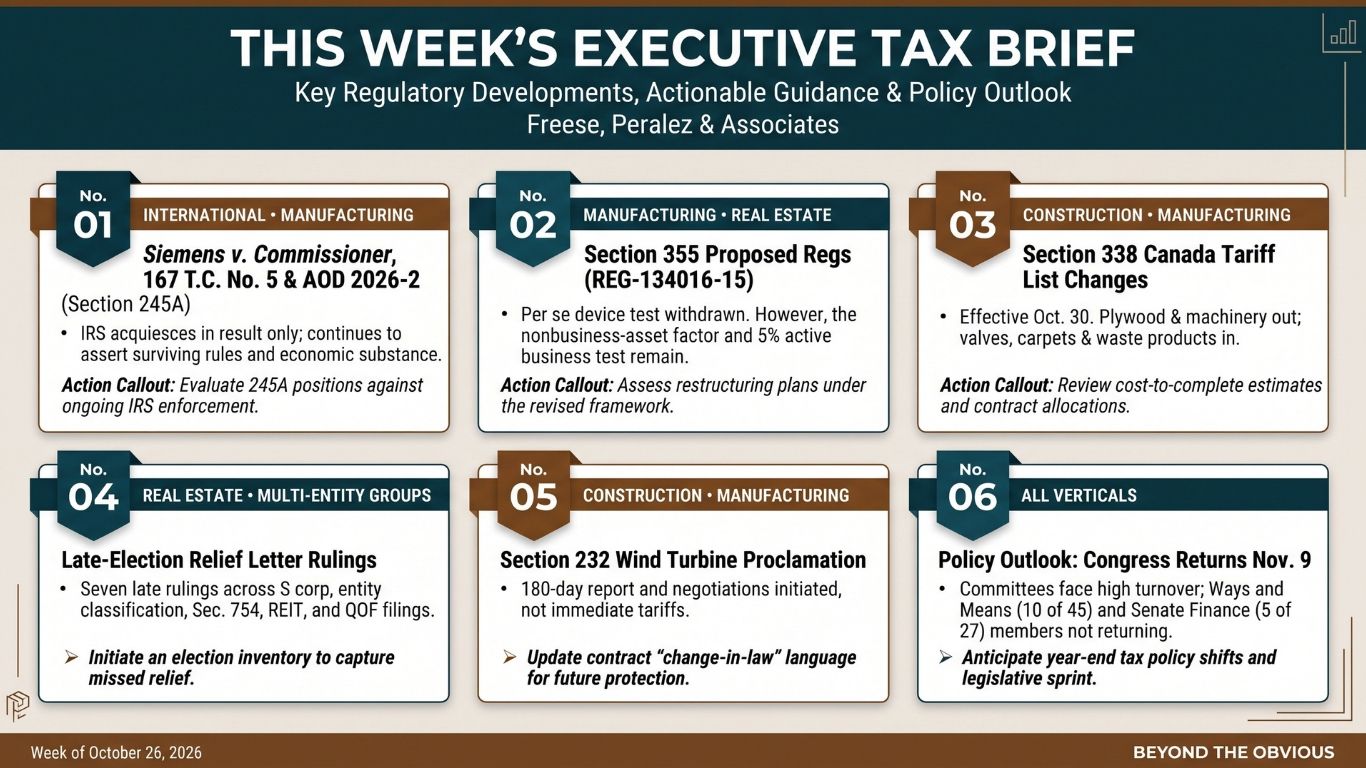
Executive Perspective
Five developments. Five different technical issues.
But one consistent executive lesson:
A change in tax or trade rules should trigger a review of assumptions—not an automatic change in strategy.
The Siemens decision may create opportunities involving foreign subsidiary distributions, but surviving anti-abuse rules still matter.
The Section 355 withdrawal changes the proposed restructuring framework without eliminating the core requirements.
Canadian tariff revisions affect some products favorably and others unfavorably, making classification and timing essential.
Late-election rulings show that administrative mistakes may sometimes be corrected, but the relief process is fact-specific.
And the wind turbine proclamation creates a reason to review contractual exposure before additional trade measures are known.
For established businesses, the value of proactive tax planning lies in understanding these distinctions before they affect financial results.
The strongest strategy is rarely based on a headline alone.
It is built on the details beneath it.
Frequently Asked Questions
What did the IRS decide in response to Siemens under Section 245A?
In AOD 2026-2, the IRS acquiesced in the result of the Tax Court's decision invalidating certain extraordinary disposition regulations under Section 245A. However, the IRS did not adopt all of the Court's reasoning and continues to assert other applicable rules and anti-abuse doctrines.
Did Treasury eliminate the Section 355 device test?
No. Treasury partially withdrew proposed regulations, including a proposed per se device rule. The underlying statutory device prohibition and active trade or business requirements remain.
When do the revised Canadian Section 338 tariffs take effect?
The revised product classifications apply to covered Canadian goods entered for consumption or withdrawn from warehouse for consumption beginning October 30, 2026, at 12:01 a.m. Eastern Time.
Can a business correct a missed tax election?
Sometimes. Certain regulatory elections may qualify for late-election relief under Treasury Regulations Section 301.9100. Eligibility depends on the election and the taxpayer's facts; relief is not automatic.
Did the October 22 wind turbine proclamation impose new tariffs?
No. The proclamation directed federal officials to pursue negotiations and report on progress within 180 days. It did not itself impose new tariffs, although previously applicable duties may still apply.
About Freese, Peralez & Associates
Freese, Peralez & Associates is a tax-focused CPA firm located in The Woodlands, Texas, serving growth-focused businesses throughout Texas and across the United States.
We specialize exclusively in:
- Strategic Tax Planning
- Tax Consulting
- Business Tax Preparation
Our clients generally generate between $1 million and $100 million in annual revenue and frequently operate through multiple entities, across multiple states, or within increasingly complex domestic and international tax environments.
We work extensively with organizations in the construction, manufacturing, real estate development, and international business sectors.
Continue the Conversation
Tax rules are rarely as simple as their headlines suggest.
A court decision may invalidate one regulation while leaving other restrictions intact.
A withdrawn proposal may create flexibility without guaranteeing tax-free treatment.
A tariff change may help one product category while increasing costs in another.
And an overlooked election may still have a potential remedy.
If your organization operates internationally, manages multiple legal entities, imports goods, or is considering a significant corporate restructuring, now may be an appropriate time to review whether your tax strategy reflects the latest developments.
If you are not currently an FPA client, visit our Contact Us page and complete the form to schedule a confidential discovery call.
We would welcome the opportunity to learn more about your organization and determine whether proactive tax planning can help protect cash flow, preserve margins, and support your next stage of growth.
Coming Next Week
Our team continues monitoring:
- Section 245A litigation and IRS guidance
- Corporate restructuring regulations
- Canadian import tariffs and trade developments
- Late-election relief and entity tax compliance
- Section 232 trade investigations
- Manufacturing and construction tax developments
- International business tax planning
- Q4 and year-end planning opportunities
Because understanding what changed is only the beginning.
The real value comes from knowing what still applies.