Section 179 vs Bonus Depreciation
Section 179 vs Bonus Depreciation
Section 179 vs Bonus Depreciation: Which Strategy Is Right for Mid-Market Companies?
Section 179 and bonus depreciation both allow businesses to expense asset purchases, but they serve different strategic purposes. Section 179 provides controlled, targeted deductions, while bonus depreciation allows broader, accelerated write-offs. The right approach depends on profitability, future tax expectations, and long-term planning.
Should you use Section 179 or bonus depreciation?
Most mid-market companies should use both. Section 179 allows for controlled, income limited deductions, while bonus depreciation enables full acceleration of large investments. The optimal strategy coordinates both based on current income, future tax rates, and growth plans.
Most business owners ask:
“Which one should we use?”
The better question is:
“What outcome are we trying to achieve?”
Section 179 and bonus depreciation are not competing tools.
They are complementary strategies and when used correctly, they can significantly improve tax efficiency and cash flow.

What Is Section 179?
Section 179 allows businesses to immediately expense qualifying assets, subject to limitations.
Key characteristics include:
- Immediate expensing of selected assets
- Annual dollar limits
- Income based limitations (cannot exceed taxable income)
When Section 179 Makes Sense
Section 179 is ideal when you want:
- Controlled, intentional deductions
- To avoid creating or increasing a loss
- Targeted reduction of taxable income
This makes it particularly useful for companies that want precision over timing, rather than maximum acceleration.
What Is Bonus Depreciation?
Bonus depreciation allows businesses to accelerate depreciation on qualifying assets with fewer restrictions.
Key characteristics include:
- No annual cap
- Can create or increase Net Operating Losses (NOLs)
- Applies automatically unless elected out
When Bonus Depreciation Makes Sense
Bonus depreciation is ideal when:
- You are making large capital investments
- Immediate cash flow is a priority
- You want to accelerate deductions aggressively
This is often beneficial during high-growth or reinvestment cycles, especially in capital intensive industries.
Section 179 vs Bonus Depreciation: What’s the Difference?
| Feature | Section 179 | Bonus Depreciation |
|---|---|---|
| Deduction Type | Targeted | Broad |
| Annual Limits | Yes | No |
| Income Limitation | Yes | No |
| Can Create Losses | No | Yes |
| Control | High | Low (automatic unless elected out) |
Section 179 gives you control. Bonus depreciation gives you speed.
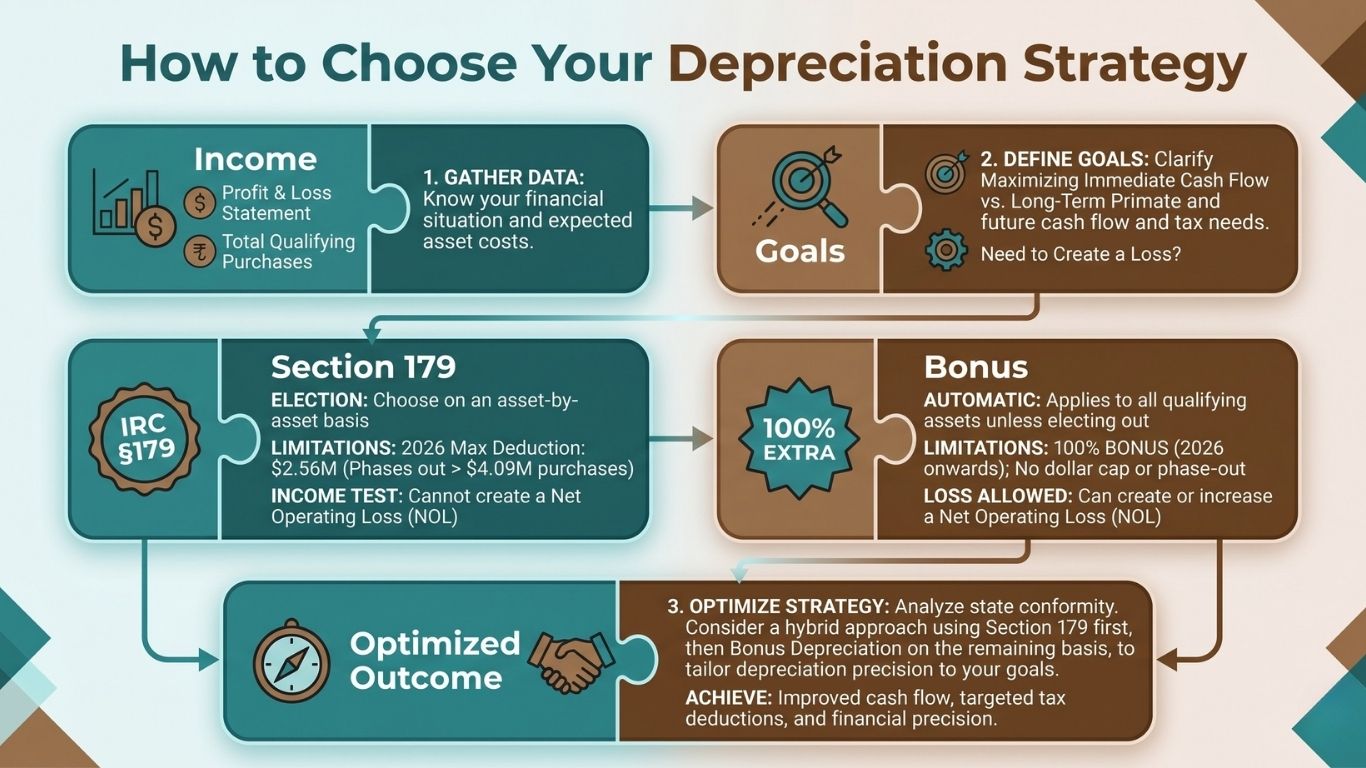
The Real Decision: How to Coordinate Both
The most effective strategy is not choosing one over the other.
It’s coordinating both based on:
- Current profitability
- Expected future income
- Net Operating Loss (NOL) position
- Growth trajectory and reinvestment plans
For example:
- Use Section 179 to reduce taxable income to a target level
- Use
bonus depreciation to accelerate additional deductions when appropriate
This is not a “which is better” decision it’s a coordination strategy.
The Strategic Layer Most Companies Miss
Many businesses default to:
“Take everything available now.”
That approach often ignores:
- Future tax rate changes
- Planned growth or margin expansion
- Upcoming liquidity events
A more strategic approach aligns depreciation with:
- Long-term tax positioning
- Cash flow planning
- Exit strategy
The Bottom Line
The most effective companies don’t choose between Section 179 and bonus depreciation.
They use both intentionally.
If your current approach is simply maximizing deductions each year, there is a strong likelihood that opportunities are being missed.
Are your depreciation strategies aligned with your growth plan?
If your business is investing in equipment, facilities, or expansion and you want to ensure your tax strategy is optimized, we can help you evaluate the right approach.
Schedule a Consultation
FAQs
What is the difference between Section 179 and bonus depreciation?
Section 179 allows businesses to expense selected assets up to certain limits and only to the extent of taxable income, while bonus depreciation allows broader, uncapped expensing and can create losses.
Can you use Section 179 and bonus depreciation together?
Yes. Many businesses use Section 179 for targeted deductions and bonus depreciation for additional acceleration.
Which is better: Section 179 or bonus depreciation?
Neither is universally better. The right choice depends on your income, tax strategy, and long-term planning goals.
Does bonus depreciation create a loss?
Yes. Bonus depreciation can create or increase a Net Operating Loss, which may impact how the deduction is used.