
ASC 740 Explained: Why Your Tax Provision Impacts Earnings
ASC 740 Explained: Why Your Tax Provision Impacts Earnings
ASC 740 and the Tax Provision: Why Your Financial Statements May Be Telling the Wrong Story
For companies with audited or reviewed financial statements, whether privately held with lender covenants or preparing for a liquidity event the tax provision under ASC 740 is one of the most technically demanding areas of financial reporting.
Errors here don’t just create restatement risk.
They affect:
- Earnings presentations
- EBITDA calculations
- Loan covenant compliance
- Due diligence credibility
- Board reporting integrity
This is not an area where “close enough” is sufficient.
It is an area where technical precision communicates financial maturity.
Tax Compliance vs. Tax Provision: Two Different Languages
ASC 740 measures income tax expense under GAAP.
They are not the same calculation.
The gap between them is where companies most often struggle.
Key differences include:
Permanent Differences
Items affecting book income but never affecting taxable income (or vice versa).
Examples:
- Certain nondeductible expenses
- Meals limitations
- Some tax credits
These impact the effective tax rate but do not create deferred balances.
Temporary Differences
Items that affect book and taxable income in different periods.
Examples:
- Depreciation differences
- Accrued compensation
- Revenue recognition timing
Temporary differences create deferred tax assets (DTAs) and deferred tax liabilities (DTLs).
When organizations confuse compliance with provision logic, their financial statements begin telling an incomplete and sometimes inaccurate story.
Filing returns and reporting GAAP tax expense are related but fundamentally different disciplines.
Deferred Tax Assets: The Judgment Call That Moves Earnings
A deferred tax asset represents future tax benefit.
Common examples:
- Net operating loss carryforwards
- Tax credits
- Accrued compensation deductible later
ASC 740 requires that DTAs be evaluated for realizability using a “more-likely-than-not” standard.
If realization is uncertain, a valuation allowance must be recorded.
This assessment requires forecasting future taxable income and judgment.
For companies with:
- Recent losses
- Significant NOLs
- Volatile earnings
- Acquisition integration challenges
The valuation allowance analysis can materially alter reported earnings.
A valuation allowance increase raises tax expense, a release improves earnings immediately.
That’s why lenders, auditors, and acquirers scrutinize this area heavily.
Valuation allowance decisions are forward-looking earnings decisions not mechanical calculations.

Uncertain Tax Positions (FIN 48): Managing Disclosure Risk
ASC 740-10 (formerly FIN 48) requires companies to evaluate uncertain tax positions.
If a tax position:
- May not be sustained upon examination
- Does not meet the “more-likely-than-not” threshold
It must be adjusted for financial reporting. If recognized, it is measured as:
The largest amount of benefit greater than 50% likely to be realized.
This applies to positions such as:
- Aggressive depreciation
- Nexus determinations
- Intercompany management fees
- Transfer pricing allocations
- Credit qualification
The issue is not whether you take positions.
The issue is whether they are documented, evaluated, and disclosed consistently.
Inconsistent or undocumented positions become diligence friction during transactions.
Uncertain tax positions are about documentation discipline not fear of risk.
Effective Tax Rate (ETR) Reconciliation: The Diagnostic Tool Most CFOs Underuse
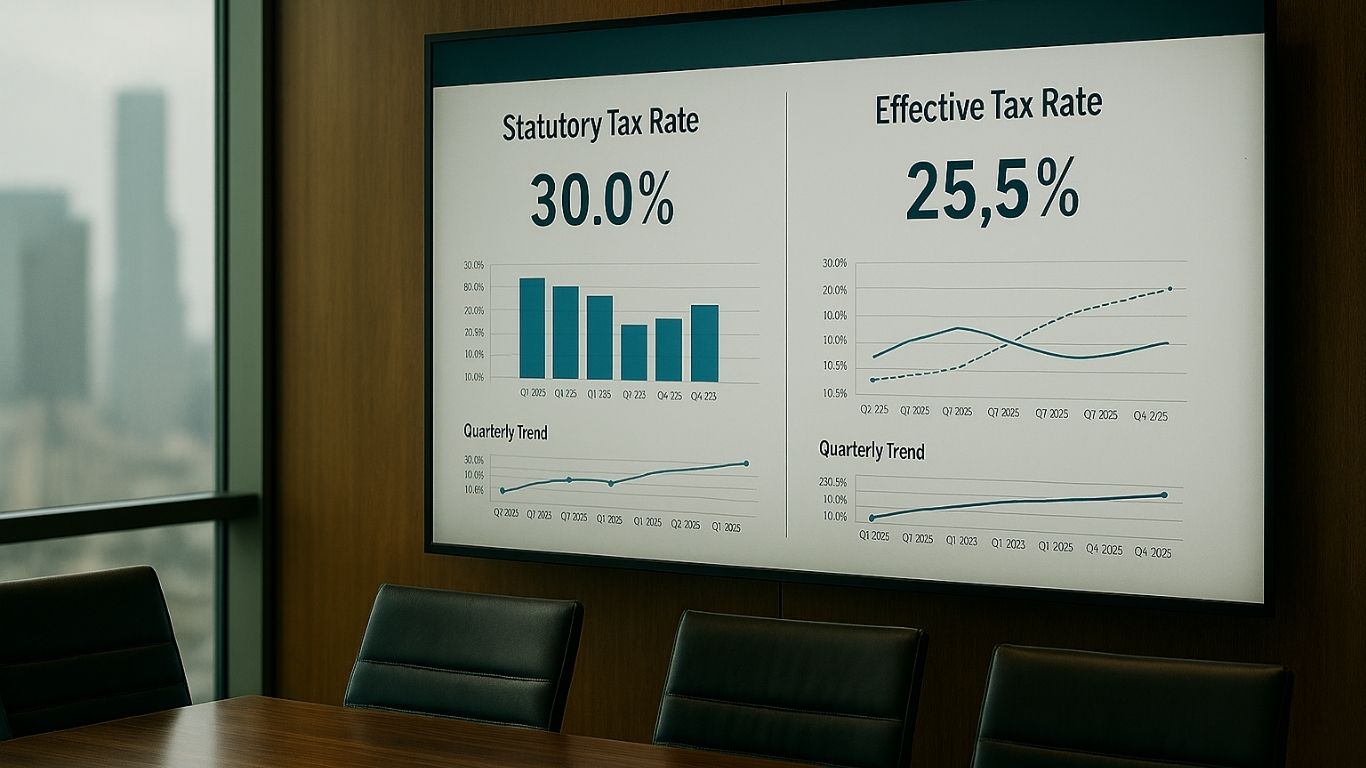
The effective tax rate reconciliation compares:
Statutory federal rate (21%)
vs.
Actual effective tax rate reported
When the rate materially deviates from 21%, the explanation matters.
A significantly lower rate may reflect:
- Tax credits
- Favorable state apportionment
- Permanent differences
A significantly higher rate may signal:
- Valuation allowance increases
- Nondeductible expenses
- State tax exposure
- Intercompany add-back adjustments
The ETR reconciliation is not just a footnote.
It is a strategic diagnostic report.
CFOs who understand this schedule at a granular level are better equipped to:
- Evaluate planning opportunities
- Explain performance to lenders
- Prepare for transaction scrutiny
Your effective tax rate tells a strategic story so make sure it’s accurate.
Interim Tax Provisions: Where Errors Multiply
For companies preparing quarterly financial statements, ASC 740 requires use of the Estimated Annual Effective Tax Rate (EAETR) method.
Ordinary income is taxed using an annualized projected rate applied to year-to-date results.
However, discrete items such as:
- Stock compensation adjustments
- One-time transactions
- Certain credits
are excluded from the EAETR and recognized in the period incurred.
Years with significant transactions, acquisitions, restructurings, debt refinancings often expose weaknesses in interim provision processes.
An inaccurate interim provision:
- Distorts quarterly earnings
- Creates volatility
- Raises questions with lenders or investors
Provision discipline must be continuous, not year-end reactive.
Interim provision discipline prevents year-end surprises.
Why the Provision Matters in Transactions
When preparing for:
- Private equity investment
- Sale process
- Refinancing
- Bank covenant negotiations
The tax provision becomes part of diligence.
Buyers and lenders evaluate:
- Deferred tax accuracy
- Valuation allowance reasoning
- FIN 48 exposure
- State tax modeling
- Sustainability of effective tax rates
A weak or inconsistent provision invites further scrutiny, and a well-documented, stable provision communicates financial maturity.
Provision quality influences valuation quality.
The Bigger Reality
The tax provision is not a compliance task.
It is a financial reporting discipline that directly influences:
- Reported earnings
- Debt covenants
- Investor confidence
- Transaction outcomes
Companies operating at $30M, $50M, or $100M in revenue cannot afford to treat ASC 740 as an afterthought.
If your organization has experienced growth, restructuring, multi-state expansion, or volatility in earnings and your tax provision process has not evolved alongside it, that gap deserves attention.
If you would like to review how your ASC 740 process aligns with your growth trajectory, we’re happy to have that conversation.